A raised bed looks simple until you stand in the soil aisle trying to guess how many bags will fill it. Guess low and you make a second trip with an unfinished bed sitting at home. Guess high and you pay for soil you have nowhere to put. The good news is that this is one of the few garden questions with an exact answer. A raised bed is a box, a box has a volume, and once you can measure three sides you can know, before you spend anything, how much soil it holds in cubic feet, in cubic yards, and in bags.
This guide gives you the formula, walks through real bed sizes with the arithmetic shown, and then covers the parts a bare number leaves out: how deep to fill for what you want to grow, what the soil should be made of, whether bags or a bulk delivery makes sense for your total, and what to do when the soil settles after the first few waterings, because it will.
Before you do any math on paper, run your own bed through the SoilCalculator below. Type in the inside length and width of your frame and the depth you plan to fill, and it returns your volume in cubic feet and cubic yards plus a bag count, so you can check the worked examples in this article against your own numbers as you read.
Interactive tool
Raised Bed Soil Calculator
Enter your bed size and fill depth. The calculator returns the soil volume in cubic feet and cubic yards, the bag count at the two common bag sizes, and a 60/40 topsoil and compost split for filling a new bed.
32.0 cubic feet of soil
That is 1.19 cubic yards in bulk, or about 22 bags at 1.5 cubic feet or 16 bags at 2 cubic feet.
Filling a new bed with a 60/40 mix: 19.2 cubic feet of topsoil and 12.8 cubic feet of compost.
Loose soil settles after the first few waterings. Most gardeners add roughly a tenth more than the raw volume and top the bed up in the second season.
The math is plain geometry: length times width times depth. One cubic yard is 27 cubic feet. Bag counts are rounded up, because a half filled bed helps no one.
The Formula: Length Times Width Times Depth
Soil volume for a rectangular bed is one multiplication:
Volume in cubic feet = length in feet x width in feet x depth in feet.
Length and width are easy. Depth is where beginners slip, because beds are described in inches and the formula wants feet. Convert depth by dividing inches by 12. A fill depth of 12 inches is 1 foot. A fill depth of 8 inches is 8 divided by 12, which is 0.67 feet. Once every number is in feet, multiply all three and you have cubic feet.
Two conversions turn cubic feet into the units soil is actually sold in:
Cubic yards: divide cubic feet by 27. There are 27 cubic feet in one cubic yard. Bulk soil, the kind delivered by a small dump truck or tipped from a landscape yard trailer, is priced by the cubic yard.
Bags: divide cubic feet by the bag size printed on the bag. Common bag sizes are 1.5 cubic feet and 2 cubic feet. Always round a bag count up to the next whole bag, because a bed filled to seven eighths of its depth is a bed you have to top up anyway.
Measure the inside of the frame, not the outside. Boards have thickness, and on a small bed the inside footprint can be several inches shorter in each direction than the outside measurement. The inside measurement is the space the soil actually occupies, and it is the honest number to calculate from.
Worked Example: An 8 by 4 Foot Bed Filled 12 Inches Deep
The 8 by 4 foot bed is the most common first bed, so let us work it completely, step by step, the same way the calculator does.
Length: 8 feet. Width: 4 feet. Depth: 12 inches, which is 12 divided by 12, or 1 foot.
Volume: 8 x 4 x 1 = 32 cubic feet.
Cubic yards: 32 divided by 27 = 1.19 cubic yards.
Bags at 1.5 cubic feet: 32 divided by 1.5 = 21.3, which rounds up to 22 bags.
Bags at 2 cubic feet, for comparison: 32 divided by 2 = 16 bags exactly.
So an 8 by 4 foot bed filled 12 inches deep needs 32 cubic feet of soil mix, which is 1.19 cubic yards or 22 bags at 1.5 cubic feet. Hold on to those three numbers. Every other size in this article is the same three steps with different inputs, and if you can follow this example you can size any rectangular bed you will ever build.
Notice what the example also tells you about shopping. At 22 bags, you are at the size where it is worth pricing a bulk delivery of about 1.25 cubic yards before you load a cart. We come back to that decision below.
Common Bed Sizes at 8 and 12 Inches Deep
Most beginners choose between two fill depths. Eight inches suits leafy greens, herbs, beans, and other shallow rooted crops, and it is the practical minimum for a bed that sits on decent ground. Twelve inches suits tomatoes, peppers, squash, and root vegetables, and it is the safer choice when the bed sits on hard, compacted, or poor ground, because the roots may never leave the bed. The table below uses the same formula for three common footprints at both depths. Bag counts use 1.5 cubic foot bags and are rounded up.
Bed size
Depth
Cubic feet
Cubic yards
Bags at 1.5 cubic feet
4 by 4 ft
8 in
10.7
0.40
8
4 by 4 ft
12 in
16.0
0.59
11
8 by 4 ft
8 in
21.3
0.79
15
8 by 4 ft
12 in
32.0
1.19
22
10 by 3 ft
8 in
20.0
0.74
14
10 by 3 ft
12 in
30.0
1.11
20
Check one line by hand so the table earns your trust. The 10 by 3 foot bed at 8 inches: 10 x 3 x 0.67 = 20 cubic feet. Divided by 27, that is 0.74 cubic yards. Divided by 1.5, that is 13.3, rounded up to 14 bags. The arithmetic is all there is to it.
Two patterns in the table are worth remembering. First, depth matters as much as footprint: filling the 8 by 4 bed to 12 inches instead of 8 takes half as much soil again. Second, a modest bed is a modest amount of soil. A 4 by 4 bed at 8 inches is under 11 cubic feet, which is a car trunk load of bags, not a delivery.
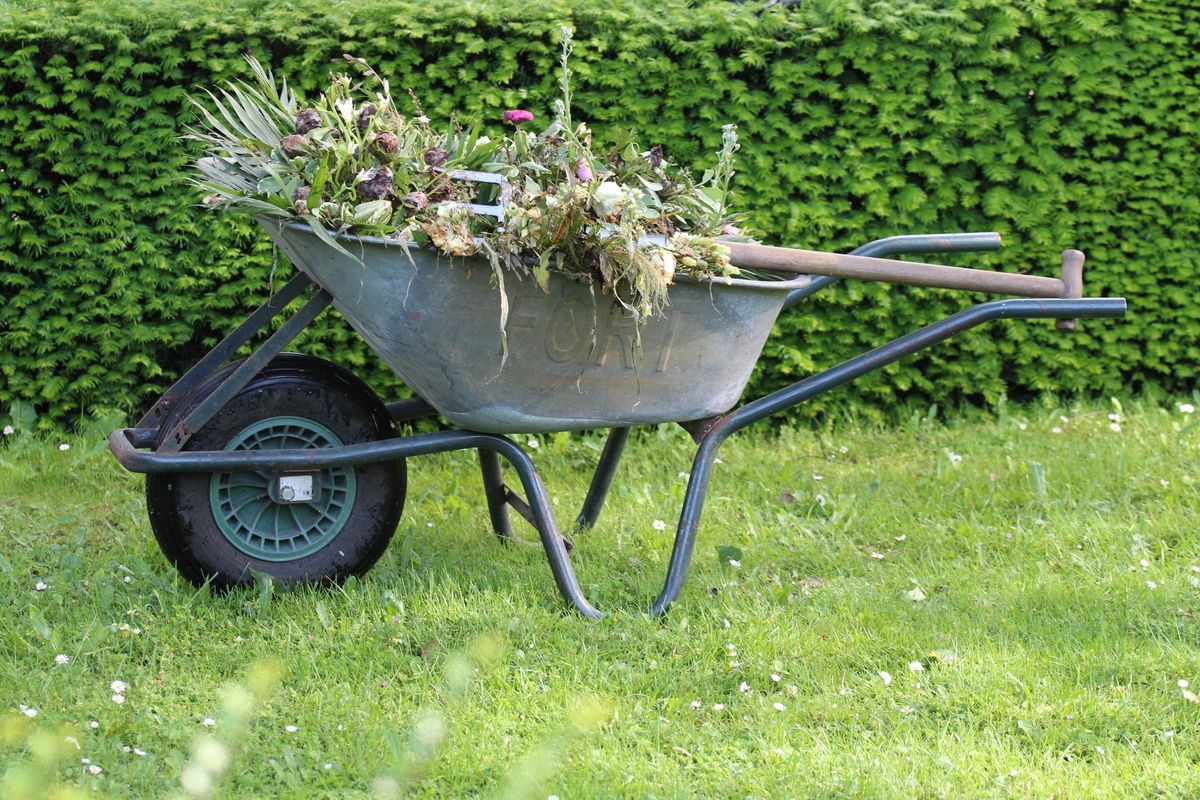
Wheelbarrow standing in a green garden ready to move soil to a raised bed
How Deep Should You Actually Fill?
The frame height and the fill depth are not the same decision. A frame built 12 inches tall does not have to be filled to the brim on day one, and there are good reasons to leave the soil line 1 to 2 inches below the rim. That headspace keeps soil and mulch from washing over the edge when you water, and it gives you room to add compost on top each season without mounding.
Choose fill depth by crop and by what is under the bed:
Greens, herbs, radishes, and beans do well in 8 inches of mix, especially when the bed sits on loosened ground that roots can continue into.
Tomatoes, peppers, cucumbers, and squash are happier with 10 to 12 inches, because they root deeper and drink more.
Carrots and other long root crops want the full 12 inches, and more if your frame allows it, because a root that hits hard ground forks or stops.
If the bed sits on concrete, compacted clay, or ground you do not trust, treat the bed as the whole root zone and fill to 12 inches. There is no useful soil below for roots to find.
One honest exception: very deep frames, 18 inches and taller, do not need to be solid soil all the way down for most crops. Gardeners sometimes place clean branches, logs, or leaves in the bottom portion and put the full soil depth on top. That approach saves soil on a tall bed, but for a standard 8 to 12 inch bed, fill it with mix. The whole depth is root zone.
What the Soil Should Be: The 60/40 Mix
Do not fill a raised bed with dirt dug from the yard, and do not fill it with plain topsoil alone. Yard soil compacts inside a frame, drains poorly, and brings weed seed with it. A raised bed behaves more like a very large container than like open ground, and it needs a mix that stays loose, holds moisture, and feeds plants at the same time.
The working mix for this site, and the one to use with the calculator totals, is simple:
60 percent topsoil, screened if you can get it, which gives the mix body and mineral soil.
40 percent compost, which gives it organic matter, slow nutrition, and moisture holding capacity.
For the 8 by 4 foot bed at 12 inches, that split applied to 32 cubic feet looks like this in the cart:
Topsoil: 32 x 0.60 = 19.2 cubic feet. In 1.5 cubic foot bags that is 12.8, so 13 bags.
Compost: 32 x 0.40 = 12.8 cubic feet. In 1.5 cubic foot bags that is 8.5, so 9 bags.
Total: 13 plus 9 = 22 bags, matching the bag count from the worked example.
If you buy in bulk, order about 0.71 cubic yards of topsoil and about 0.48 cubic yards of compost for that same bed, and expect the yard to round your order to the nearest half yard. Bagged raised bed mixes that blend soil and compost for you are a fine shortcut for one small bed. Read the bag as a volume, count it toward your total cubic feet, and you do not need to split it further.
Mix the two ingredients as you fill rather than dumping all of one and then all of the other. Add a few inches of topsoil, then a layer of compost, and fork them together in the bed, or tip alternating bags into a wheelbarrow and turn the pile once before barrowing it in. Layered but unmixed soil creates bands that water and roots move through unevenly.
Bags or Bulk: Deciding at Your Total
Neither option is always cheaper or easier. Decide from your cubic yard number:
Under about 0.5 cubic yards (a 4 by 4 bed, or one shallow bed): bags are simpler. No delivery fee, no pile on the driveway, and you can buy exactly your count plus one spare.
Around 1 cubic yard and up (one deep 8 by 4 bed, or two beds of any size): price a bulk delivery. You will move the soil by wheelbarrow either way, and bulk mix or separate bulk topsoil and compost usually costs less per cubic foot at this scale. Ask whether the yard sells a ready raised bed blend, and if not, order the 60/40 split as two products.
Several beds at once: bulk is almost always the right call, and one delivery beats many car trips. Add the cubic feet of every bed together first, then convert the total to yards.
Whichever route you choose, buy for the calculated total, not for a guess. The formula is exact for a rectangular box. The only planned extra you need is for settling, which is the next topic.
Settling: Why the Bed Drops, and What to Do About It
Fresh soil mix is full of air. After the first thorough waterings and the first rains, the particles settle, the compost begins to break down, and the soil line drops. On a 12 inch fill, expect the surface to sit noticeably lower within the first few weeks. This is normal, it happens in every bed, and it is not a sign that you calculated wrong.
Handle settling in three simple moves:
Fill to your planned depth, water the whole bed deeply and evenly, and let it sit for a day or two before planting if you can. Much of the first drop happens in that first soak.
Top up to your intended soil line with more of the same mix before you plant, keeping the finished surface 1 to 2 inches below the rim.
Each following season, expect to add a shallow top up of compost, about 1 to 2 inches across the bed, as the organic matter continues to break down. For an 8 by 4 foot bed, 1 inch across the whole surface is 8 x 4 x (1 divided by 12), which is 2.67 cubic feet, or about 2 bags at 1.5 cubic feet. That small annual number is the real maintenance cost of a raised bed, and it is worth knowing before you build three of them.
If you prefer to buy the settling allowance up front, add about 10 percent to your calculated total and keep the extra on hand for the top up. For the 32 cubic foot example, 10 percent is 3.2 cubic feet, or about 2 more bags. Buying the base total and topping up later works just as well. What does not work is filling a bed to half its depth to save money and expecting deep rooted crops to thrive. Depth is the one input you cannot fix later without disturbing the plants.
A Short Measuring Checklist Before You Buy
Run through these five checks and your number will be right the first time:
Measure the inside length and inside width of the frame, in feet. Convert inches to feet by dividing by 12 (30 inches is 2.5 feet).
Decide fill depth in inches from the crop list above, and convert it to feet.
Multiply length x width x depth for cubic feet.
Divide by 27 for cubic yards, and divide by your bag size for bags, rounding bags up.
Split the total 60/40 into topsoil and compost, and add a small allowance or a top up plan for settling.
That is the whole skill. A tape measure, three multiplications, and two divisions stand between you and an exact soil order for any raised bed.
Frequently Asked Questions
How much soil do I need for an 8 by 4 foot raised bed?
At 12 inches deep, an 8 by 4 foot bed needs 32 cubic feet of soil mix, which is 1.19 cubic yards or 22 bags at 1.5 cubic feet. At 8 inches deep it needs 21.3 cubic feet, which is 0.79 cubic yards or 15 bags at 1.5 cubic feet. Use the inside measurements of your frame for the most accurate count.
How do I convert cubic feet to bags of soil?
Divide your cubic feet by the volume printed on the bag, then round up to the next whole bag. A total of 32 cubic feet divided by a 1.5 cubic foot bag gives 21.3, so you buy 22 bags. The same total in 2 cubic foot bags is exactly 16 bags. Always use the volume on the bag, not its weight, because soil weight changes with moisture.
Can I fill a raised bed with topsoil alone?
It is not a good idea. Topsoil alone compacts in a frame, drains unevenly, and runs out of nutrition quickly. Blend it with compost at about 60 percent topsoil to 40 percent compost by volume. The compost keeps the mix loose, holds moisture, and feeds plants through the season. Straight yard soil is worse than either, because it compacts the most and carries weed seed.
How much soil settles in a new raised bed?
Expect a visible drop after the first deep waterings as air leaves the mix and compost starts to break down. Fill to your planned depth, water deeply, let the bed sit for a day or two, then top up to 1 to 2 inches below the rim before planting. After the first season, plan on adding about 1 to 2 inches of compost across the bed each year, which is 2.67 cubic feet per inch on an 8 by 4 foot bed.
Should I buy bagged soil or bulk soil?
Decide by your cubic yard total. Under about half a cubic yard, bags are simpler and avoid a delivery fee. At about 1 cubic yard and above, which is one deep 8 by 4 foot bed or any two beds, get a bulk price and compare it with your bag count. Bulk soil is moved by wheelbarrow either way, and at larger totals it usually costs less per cubic foot.
Photo credits: Alfo Medeiros (Pexels); hans middendorp (Pexels). Photos are served from this site; follow the credit to the library page for the original.