How to Plant Grass Seed in Fall: The Frost Countdown and the Two Tracks
By the Windchime Walker editorial team
Photo: Rubenstein Rebello / Pexels
Fall is the best seeding window of the year for cool season grass, and the reasons are physical: the soil still holds summer's warmth, so seed germinates fast, while the air has cooled, so seedlings grow without heat stress and the summer weeds have stopped competing. Soil temperature in the 50 to 65 degree band is where fescues, ryegrass, and bluegrass germinate best, and fall delivers it for weeks. But fall seeding is two different jobs wearing one name, and the guides that blend them serve neither. Sowing bare ground is a soil project with a seeding at the end. Repairing thin ground is a surface project, seed delivered through an existing canopy to the soil. This page runs both tracks separately, on the frost countdown that governs them both.
Our how to overseed a lawn in fall guide owns thickening an existing lawn, and our when to plant grass seed guide owns the timing decision across the whole year. This page owns fall sowing on bare and thin ground.
Interactive tool
Fall Grass Seed Checklist
Check off each step as you finish it. Your progress stays on this page.
0 of 8 complete
0% done
The Frost Countdown: The Only Date That Matters
Cool season seedlings need roughly six weeks of growing weather to root deeply enough to survive winter, so the sowing deadline is set by frost, not by the calendar month. The method: find your area's average first hard frost date, a hard frost being about 28 degrees, the temperature that stops tender growth; count back 45 to 60 days; that window is your sowing window, with the earlier end safer. In practice that is late August to mid September across the northern states, sliding into October in the transition zone. Family Handyman's version of the same rule, at least 45 days before the expected first frost, agrees with the seed producers' six to eight weeks. Soil temperature is the confirmation check: sow while the soil at an inch or two down sits in the 50 to 65 degree band, warm enough for fast germination, which a cheap soil thermometer reads in a minute. Sowing after the window does not fail dramatically; it fails quietly, in spring, as thin patches where the seedlings winter killed. And one boundary is absolute: fall is a cool season window. Warm season grasses, bermuda, zoysia, centipede, are not fall sown at all; their window is late spring, and seed put down in cooling fall ground is wasted.
Track One: Bare Ground
On bare ground the seeding is the last step of a soil job. Clear weeds and debris, loosen the top few inches where the ground is compacted, work in any amendments the soil test calls for, and rake a level seedbed with a fine tilth. Starter fertilizer, high in phosphorus, goes down at sowing, worked lightly into the surface. Sow at the new lawn rate for your species, which runs higher than any overseeding rate: tall fescue at about 6 to 8 pounds per 1,000 square feet, Kentucky bluegrass at 2 to 3, perennial ryegrass at 7 to 9, using the bag's new lawn figure where it differs. Spread in two crosswise passes, half the seed each way, for even cover. Rake the seed in no deeper than 1/4 inch, roll it for firm seed to soil contact, and mulch bare ground with a light layer of straw, which holds moisture, stops the seed washing in a storm, and disappears into the lawn as it grows. Slopes get the mulch without negotiation; bare sloped seed in a fall thunderstorm relocates to the bottom of the hill.
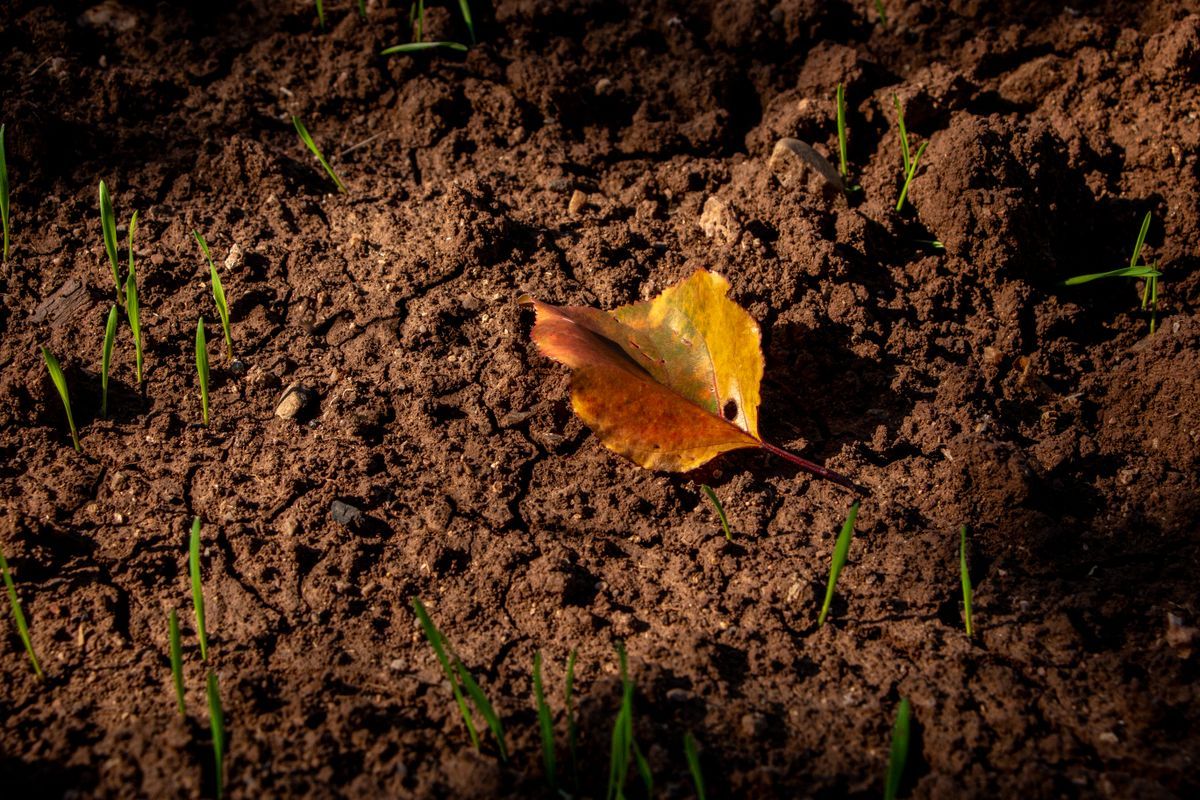
An autumn leaf on soil surrounded by new grass sprouts
Track Two: Thin Ground, Which Is Not Overseeding
Thin ground, bare patches in a lawn that is mostly there, gets its own prep, in the order the fall guides converge on. Kill or pull the weeds in the patches about a week ahead. Mow the surrounding lawn a notch lower than usual and bag the clippings, so seed can reach the soil instead of landing on a canopy. Rake the bare patches firmly to scratch the top layer open, and where the ground is compacted, the screwdriver test tells you: if a screwdriver will not push into the soil easily, core aerate the area, because seed on concrete hard ground is bird food with extra steps. Dethatch only where the thatch layer runs over an inch. Then sow at the new lawn rate on the bare patches themselves, not the overseeding rate for the lawn as a whole, rake the seed into the scratched soil, and firm it. The distinction from overseeding is the point: overseeding spreads a moderate rate across a whole living lawn to thicken it, while thin ground repair treats each patch as a small new lawn, with soil contact as the non negotiable step.
Watering: The Taper Into Winter
Fall watering is kinder than spring watering because the weather helps, but the discipline is the same shape. Keep the top inch of soil consistently moist until germination: light watering once or twice a day when there is no rain, more on unmulched ground in a dry windy spell. Germination runs 5 to 21 days by species, ryegrass in the first week, fescue in the second, bluegrass bringing up the third. As the seedlings stand, taper to deeper and less frequent watering, pulling the roots down after the moisture. The first mow waits until the new grass reaches about 3 inches, then cut high, removing only the top third, with a sharp blade that cuts instead of tearing seedlings loose. Keep leaves off the young lawn through the fall; a mat of wet leaves smothers new grass more completely than any frost, and the fall cleanup is part of the seeding job, not a separate chore. Fertilizer beyond the starter waits until the grass is established and growing, and in cold climates the last feeding is timed to feed roots before dormancy rather than push top growth into the freeze.
Why Fall Beats Spring, and What Spring Is For
The comparison is worth stating once, because it explains the whole calendar. Spring sowing runs into three headwinds fall avoids: the soil is cold when the air first warms, so germination crawls; the summer annual weeds, crabgrass above all, germinate exactly when the seedlings do and grow faster; and the young lawn meets its first summer, its hardest season, at a few months old. Fall sowing meets winter instead, which a rooted cool season seedling is built for, and arrives at its first summer nearly a year old with deep roots. Spring is for the repairs winter reveals and for warm season lawns, whose calendar is reversed. If you sow one lawn in your life, sow it in fall, on the countdown, with the soil contact done properly, and let the season do the heavy lifting it is offering.
Dormant Seeding: The Option After the Window Closes
If the countdown has already run out, there is one legitimate late play: dormant seeding. Seed sown after the soil has cooled below germination, in late fall, lies in the ground over winter and germinates at the first spring warmth, gaining a two to three week head start on spring sown seed. It is a real technique with real costs: some seed is lost to birds, wash, and rot over the winter, so the rate goes up by a fifth to a quarter, and the seedbed must be prepared in fall while the ground is still workable, which is the actual work of the method. Dormant seeding suits bare ground repairs you discovered too late and slopes you stabilize before winter erosion. It does not suit thin lawn repair, where the seed cannot reach soil through a dormant canopy, and it never outperforms a proper in window fall sowing; it outperforms the alternative, which is a spring sowing into cold soil against the crabgrass. Treat it as the salvage option it is, priced honestly, and next year run the countdown from August instead of reading about it in November.
Frequently Asked Questions
When is the best time to plant grass seed in fall?
About six weeks, and at least 45 days, before your area's average first hard frost, while soil temperature sits in the 50 to 65 degree band. That is late August to mid September in the northern states, sliding into October in the transition zone. Find the frost date and count back; the countdown, not the month, is the rule.
Is fall seeding the same as overseeding?
No. Overseeding spreads a moderate rate across a whole living lawn to thicken it. Fall seeding on bare or thin ground treats the area as a new lawn: soil prep or firm raking, the higher new lawn seeding rate, seed raked in no deeper than 1/4 inch, and mulch on bare ground. This page covers the seeding tracks; our overseeding guide covers the thickening job.
How much seed do I need for a new fall lawn?
Use the new lawn rate: roughly 6 to 8 pounds per 1,000 square feet for tall fescue, 2 to 3 for Kentucky bluegrass, and 7 to 9 for perennial ryegrass, following the bag where it differs. Sow in two crosswise passes, half each way, for even coverage.
Can I plant warm season grass seed in fall?
No. Fall is the cool season window only. Bermudagrass, zoysia, and centipede need warm late spring soil and fail in cooling fall ground. The Southern practice of overseeding a warm season lawn with ryegrass for winter color is a different job with its own rules.
How do I water fall sown grass seed?
Keep the top inch of soil moist until germination with light watering once or twice daily in dry weather, then taper to deeper, less frequent watering as seedlings establish. Germination takes 5 to 21 days by species. Keep fallen leaves off the young lawn, since a wet leaf mat smothers it.
Photo credits: Rubenstein Rebello (Pexels); Osman İçli (Pexels). Photos are served from this site; follow the credit to the library page for the original.