Container Gardening Ideas: Gallery Looks, Converted Into Layouts You Can Build
By the Windchime Walker editorial team
Photo: thel0stkidd . / Pexels
Container idea galleries are beautiful and almost useless. They show you the finished arrangement in perfect light and tell you nothing about the pot sizes underneath it, how many plants it took, where it can actually sit, or what it costs you in watering visits every week for the rest of the summer. This page keeps the ideas and adds the missing half: each arrangement specified as a layout you can shop for and build in an afternoon, with its maintenance price stated honestly, because an idea you cannot keep watered is not an idea, it is a chore with flowers on it.
Our container gardening for beginners guide owns the mechanics, pots, mix, and feeding that make any of this survive. This page owns arrangement: which pots, which plants, in which pattern, and why it reads as designed.
Interactive tool
Small Space Container Ideas Checklist
Check off each step as you finish it. Your progress stays on this page.
0 of 8 complete
0% done
The Formula That Runs Half the Gallery: Thriller, Filler, Spiller
The classic container recipe works because it assigns every plant a job. The thriller is the vertical event in the center or back: an ornamental grass, a tall salvia, a dwarf canna, something with height and nerve. The filler is the middle mound that makes the pot look full: petunias, calibrachoa, geraniums, coleus, planted in a ring of three to five. The spiller is the edge plant that breaks the pot's rim and connects it to the ground: trailing lobelia, sweet potato vine, creeping jenny, bacopa. In a 14 to 16 inch pot, the working counts are one thriller, three to five fillers, and three spillers set between them at the rim. The formula fails in two predictable ways: a thriller too small for the pot, which reads as an accident rather than a centerpiece, and colors chosen plant by plant instead of as one palette of two or three colors repeated. Pick the palette first, from the site of the pot, the house color, the furniture, the one pot you already love, and let every plant audition against it.
Groupings: Odd Numbers, Varied Heights, One Material Family
A row of identical pots in a line reads as a nursery. A grouping reads as a garden. The rules that convert one into the other are simple and strict. Group in odd numbers, three or five pots, because the eye reads odd groups as composed and even groups as paired off. Vary the heights deliberately, a tall pot, a medium, a low wide one, and raise the short ones on stands, steps, or upturned pots rather than buying all tall containers. Keep the pots in one material family, all terracotta, all dark resin, all weathered zinc, while the plants vary; mixed pots with mixed plants is visual noise, while one of the two variables held constant is style. Leave breathing room: a grouping where the pots touch reads as clutter, while a hand's width of space between them reads as intention. On steps, the arrangement builds itself, one pot per step alternating sides. In a corner, the triangle is the layout: tallest at the back corner, medium front left, low front right, and the eye completes it.
Vertical Ideas: Walls, Railings, and the Hanging Layer
Small spaces run out of floor before they run out of wall, and the vertical layer is where container gardens double. Railing planters and saddle boxes put flowers at eye level and cost no floor at all; where building rules allow them, they are the highest value idea in this article, and where they do not, a shelf or stand inside the railing achieves the same height legally. Wall pockets and mounted planters suit herbs and trailing plants and must be watered more often than any floor pot, because they are small, exposed, and above the reach of your watering routine's memory; put the drought tolerant plants up high and the thirsty ones at hand level. Hanging baskets are the ceiling layer, one at a doorway or over a seating corner, and they obey the basket law from our fern pages: they dry fastest of anything you own, so hang them where you will see them daily, because a basket you see is a basket you water. A ladder shelf or stepped plant stand against a wall is the renter's vertical garden: five to seven small pots of herbs and flowers in the footprint of one large pot, with the sun loving plants promoted to the top step.
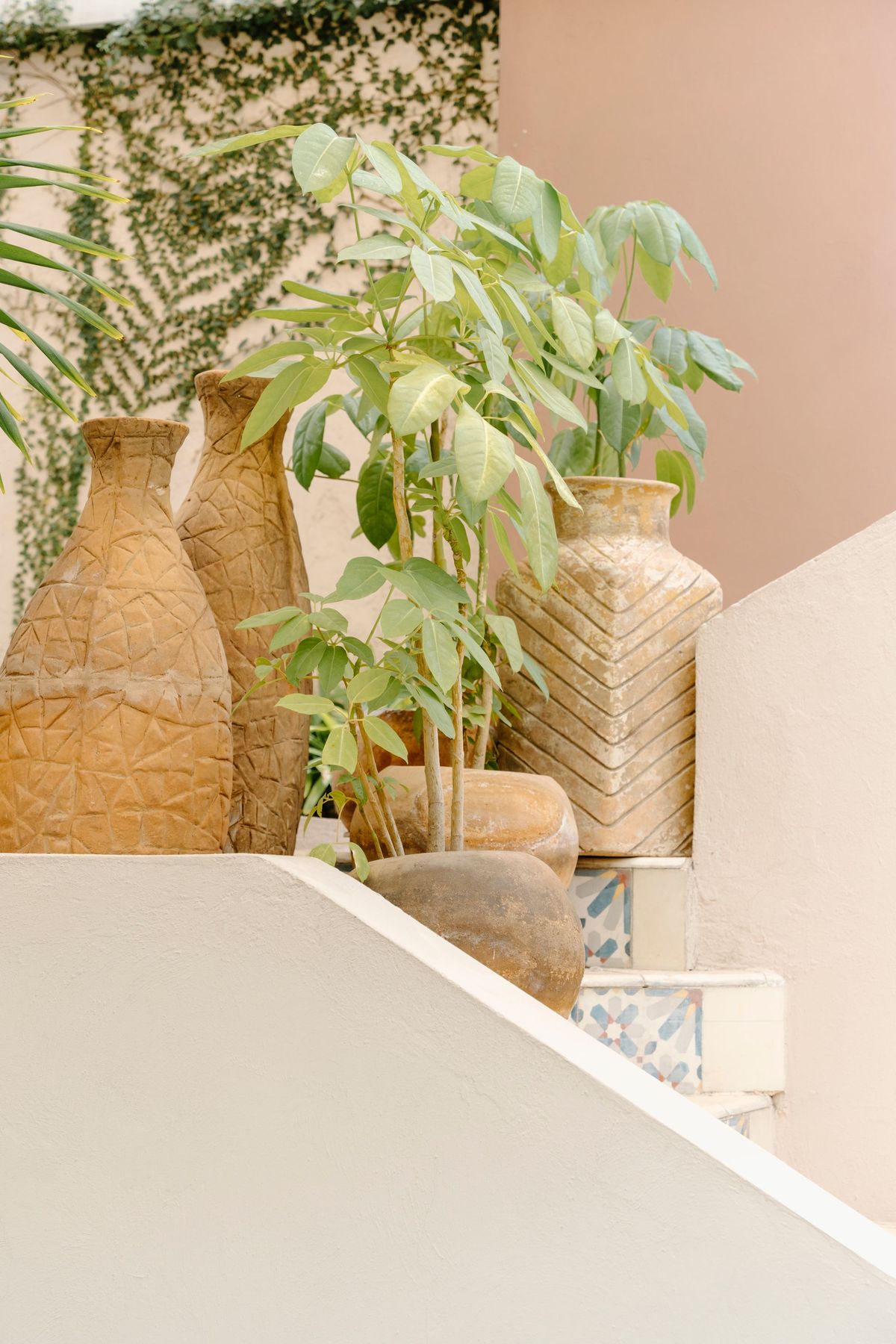
Terracotta pots and plants arranged up a set of garden steps
The One Big Pot: the Statement Planter Strategy
The most reliable small space idea is the counterintuitive one: a single oversized planter, 20 inches across or more, planted generously, instead of a scatter of small pots. It reads as design where six small pots read as accumulation. It holds a water reservoir that forgives a weekend away. And it anchors a space, giving a patio or doorway a center that furniture arranges around. Plant it by the thriller filler spiller formula at double scale, or as a single specimen, an olive standard, a dwarf conifer, a clump of ornamental grass, with a low underplanting of one trailing plant. The weight warning belongs here: a 20 inch pot of wet mix is a two person lift and a real load on a balcony, so place it once, on a wheeled caddy if your winters require moving it, and consult the weight discipline in our balcony garden guide if it lives above ground level.
Every Idea Has a Watering Price: the Honest Table in Words
Before adopting any arrangement, price it in visits. A large floor pot in part shade: water twice a week in summer. A 12 inch pot in full sun: every other day. A hanging basket or wall pocket: daily in heat, no exceptions, and twice a day in a heat wave is not unheard of. A self watering planter at any size: roughly half the visits of its conventional twin, which is why the statement planter and the railing box are the two best places to spend self watering money. Group your containers by thirst as well as by looks where you can, so the daily round is one corner of the patio, not a pilgrimage. The checklist below turns the system into a build: choose the site, fix the palette, pick one idea per zone, count the plants, price the watering, and only then go to the garden center, list in hand, immune to the beautiful unpriced idea on the end cap.
Seasonal Rotation: One Set of Pots, Three Looks
A container garden's quiet advantage over a planted bed is that it can be re-cast. The pots stay; the planting changes with the season, and a small space gets three gardens a year from one set of containers. Spring runs on the cool tolerant cast: pansies and violas as fillers, snapdragons as small thrillers, sweet alyssum spilling, with bulbs tucked into the big pots the previous fall for a first act before the annuals even arrive. Summer is the full formula at full throttle, the heat lovers in the palette you chose, at the watering price stated above. Fall is the edit rather than the replacement: pull the spent summer fillers, keep any thriller still standing, and replant the gaps with ornamental kale and cabbage, fall pansies, and mums bought in bud, while the spillers that survive, creeping jenny and ivy among them, carry over. Winter, in cold climates, is the evergreen act: the statement planter holds a dwarf conifer or a holly, the groupings thin to their most architectural members, and cut evergreen boughs fill the gaps where the summer fillers were. The rotation is also the budget system: the pots, the mix refreshed with compost, and the stands are bought once, and each season's plant bill is a fraction of the first year's. Plan the year's three casts when you buy the spring one, and the garden never has the threadbare month that makes owners drift away from it.
Frequently Asked Questions
What is the thriller filler spiller method?
A container recipe that assigns each plant a job: one tall thriller for height in the center or back, three to five fillers mounding in the middle, and spillers trailing over the rim. In a 14 to 16 inch pot that is one thriller, a ring of fillers, and three spillers. Choose a palette of two or three colors first and let every plant audition against it.
How do I arrange pots so they look designed instead of scattered?
Group in odd numbers, three or five; vary the heights and raise short pots on stands or steps; hold the pot material constant in one family while the plants vary; and leave a hand's width of space between pots. Identical pots in a straight line read as a nursery; a varied height triangle in one material reads as a garden.
What is the best container idea for a very small space?
One oversized statement planter, 20 inches or more, planted generously. It anchors the space, holds a forgiving water reservoir, and reads as design where many small pots read as clutter. Add one vertical element, a railing box or a hanging basket, and a small space is fully gardened at two watering stops.
How much watering do container arrangements need?
By size and exposure: a large floor pot in part shade about twice a week in summer, a 12 inch pot in full sun every other day, and hanging baskets and wall pockets daily in heat. Self watering planters roughly halve the visits. Price every idea in watering visits before you build it.
Can I copy an arrangement from a photo exactly?
You can get closer than the photo suggests if you reverse engineer it: identify the thriller, filler, and spiller, estimate the pot diameter from the plants' scale, count the plants, and note the palette. Then adapt the plant list to your light, because the photo's sun is the one ingredient that never transfers.
Photo credits: thel0stkidd . (Pexels); Brunxs (Pexels). Photos are served from this site; follow the credit to the library page for the original.