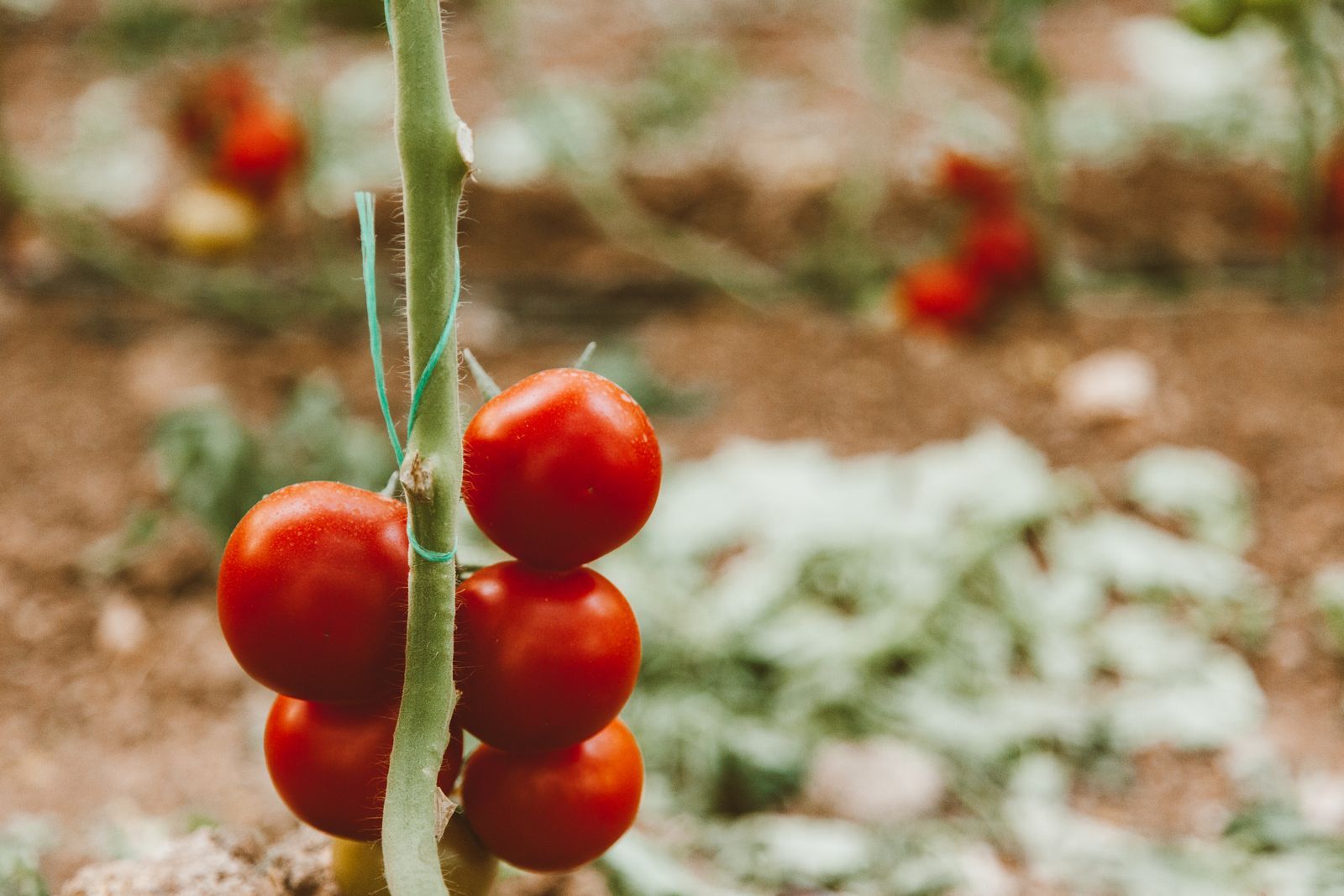
Here is the short answer, from a source you can check. University of Georgia Cooperative Extension Circular 963, the Vegetable Planting Chart, lists tomatoes at 24 inches between plants and 48 inches between rows. If you plant at that spacing, support the plants, and water at the base, you have followed the published guidance and you can stop second guessing. Most other advice you will find online is a range built around that center: staked and pruned plants a little closer, caged plants a little wider, unsupported plants wider still. This guide explains the default, when to adjust it, and how to turn it into a plant count for your own bed before you buy transplants.
The trap this question sets for beginners is size. A tomato transplant is a small plant in a small pot, a few inches tall, and 24 inches of empty soil around it looks absurd on planting day. By midsummer the same plant is a tall, wide vine carrying heavy fruit, and the gardener who planted at transplant size is pushing through a wet wall of leaves to pick tomatoes hidden inside it. Spacing is decided for the plant in August, not the plant in May.
Use the SpacingPlanner on this page, set to tomatoes, before you dig. Enter your bed length and width and it lays out your plants at the planner grid spacing for tomatoes, 24 inches, and tells you how many fit: an 8 by 4 foot bed fits 8 plants. Buy that many transplants, not the flat that happens to be on sale.
Interactive tool
Plant Spacing Planner: The Tomato Bed
Tomatoes are preset in the crop list below. Enter your bed size and see how many plants fit at the 24 inch extension spacing, row by row, before you buy a single transplant.
8 tomato plants fit this bed
4 plants per row across 2 rows, on a 24 inch grid. Extension spacing for this crop: 24 in between plants, 48 in between rows.
The grid uses the in-row spacing in both directions, the standard square foot layout for raised beds. In open ground, keep the wider row spacing in the note above so you can walk and weed between rows.
Spacing figures: University of Georgia Cooperative Extension, Circular 963, Vegetable Planting Chart, source.
The Default Spacing and Where It Comes From
Circular 963 gives one tomato figure: 24 inches between plants in the row, 48 inches between rows. That is the figure this site uses as the default, and it is worth understanding what each half of it buys you. The 24 inches in the row gives each plant room for its root system and its canopy once it is tied to a support, so neighboring plants meet as leaves at full growth rather than growing through each other. The 48 inches between rows is mostly air and access: a corridor that lets air move down the row to dry leaves, and lets you walk, tie, prune, and pick without brushing wet foliage against every plant you pass, which is one way leaf diseases travel around a bed.
Other extension services publish ranges that contain this figure. The University of Maryland Extension general range reported in spacing guides is 18 to 36 inches between plants and 48 to 60 inches between rows, with staked, pruned plants at the closer end because they are kept to a few main stems. The Georgia figure sits sensibly inside that range: not the tightest defensible spacing, not the widest. For a beginner who wants one number and a reason to trust it, 24 and 48 is the right default.
In a raised bed, the row figure changes jobs. You do not walk between rows inside a bed, so instead of one row of plants plus a 48 inch path, the bed is laid out on a grid at the in-row distance. At a 24 inch grid, an 8 by 4 foot bed, which is 96 by 48 inches, holds 96 divided by 24, or 4 plants along its length, and 48 divided by 24, or 2 rows across, for a total of 8 plants. The planner does this math for any bed you enter. In open ground, keep the full 48 inches between rows and be glad of it the first time you carry a full harvest basket down the row.
Why Spacing Matters More for Tomatoes Than for Most Crops
Tomatoes are large, long season, leafy plants, and three problems scale directly with crowding. The first is disease. The common tomato leaf diseases spread in wet conditions and move from leaf to leaf and plant to plant. Spaced plants dry faster after rain, dew, and watering because air reaches the leaves. Crowded plants hold a still, humid pocket of air in the middle of the bed, leaves stay wet for hours longer, and an infection that starts on one low leaf has a short, damp bridge to every neighbor.
The second is light and ripening. A tomato plant shades itself when it is crowded, and fruit inside a dense canopy colors slowly and unevenly while the plant spends energy on leaves competing for light. Spaced plants let sun reach more of the canopy, which is where the fruit is. The third is simple access. Tomatoes need repeated work all season: tying to the support, removing suckers on staked plants, checking the undersides of leaves, and picking ripe fruit every few days at peak. If you cannot reach a plant without forcing your way in, that work does not get done, and small problems become large ones unseen.
There is also a root story. Tomato roots spread widely, roughly matching the ambition of the vine above. Crowded plants draw water and nutrients from the same soil volume, so each plant gets less and the bed dries unevenly. The result of planting 12 tomatoes in the space for 8 is rarely 12 plants worth of tomatoes. It is closer to 8 plants worth, divided among 12 stressed plants, with more disease mixed in.
Adjusting for Support: Stakes, Cages, and Sprawling Plants
Support is the biggest legitimate reason to move away from the default, because support decides whether the plant grows up or out. The ranges below are the ones reported across the top spacing guides for this question, which cite extension sources including University of Maryland and University of Minnesota Extension.
Support method
Between plants
Between rows
Staked or trellised, pruned to 1 to 3 stems
18 to 24 inches
3 to 4 feet
Caged
24 to 36 inches
4 to 5 feet
Sprawling on the ground, no support
36 to 48 inches
4 to 6 feet
Read the table against the default. A staked plant pruned to one to three stems is a narrow, vertical plant, so 18 to 24 inches in the row works, and the Georgia figure of 24 inches is the comfortable end of that band. A caged plant keeps most of its stems and becomes a wide bush inside the cage, so it earns 24 to 36 inches. A sprawling plant with no support occupies the ground itself and needs 36 to 48 inches, plus the widest rows, and it also sits its fruit on the soil, which is why most gardeners support tomatoes in the first place.
Whichever support you choose, install it at planting time. Driving a stake or setting a cage after roots have spread tears those roots, and the plant pays for it. Decide the support before you mark the spacing, because the support sets the spacing, not the other way around.
Gloved hands planting a young tomato transplant in garden soil with a trowel at the marked spot
Adjusting for Type: Determinate, Indeterminate, and Cherry Tomatoes
The second adjustment is the kind of tomato you bought, which is printed on the plant tag as determinate or indeterminate. Determinate, or bush, tomatoes grow to a set size, stop, and ripen most of their fruit in a concentrated window. They are the smaller plants and sit at the closer end of the ranges: about 18 to 24 inches between plants is the commonly reported figure for supported determinate types. Indeterminate, or vining, tomatoes keep growing and fruiting until frost, become the tallest plants in the garden, and need the full default or more: 24 inches staked and pruned, and toward 36 inches in a large cage.
Cherry tomatoes surprise beginners, because the fruit is small and the plant is not. Most cherry varieties are vigorous indeterminate vines and need the same spacing as full size indeterminate tomatoes, 24 to 36 inches depending on support. Planting cherry tomatoes at salad green spacing because the tomatoes are bite sized is a classic route to an unmanageable thicket. Compact and dwarf varieties are the exception, at about 12 to 18 inches, and the tag will say the plant is dwarf, patio, or container bred. If the tag gives a spacing, follow the tag for that variety. A variety specific instruction beats a general chart, including this one.
Tomatoes in Raised Beds and Containers
In a raised bed, use the grid math from the planner. An 8 by 4 foot bed fits 8 tomato plants at the 24 inch grid, arranged as 2 rows of 4. A 4 by 4 foot bed fits 4 plants on the same grid. Plant tall indeterminate varieties along the north edge of the bed in the Northern Hemisphere, so their height does not shade smaller crops to their south, and keep the bed to tomatoes and low companions rather than filling every gap. Wide spacing leaves room for low plants such as basil between tomatoes; basil itself sits at 12 inches between plants per University of Maryland Extension, and a basil plant at the sunny edge of a tomato bed uses light the tomato canopy does not reach early in the season.
In containers, the rule is one tomato plant per pot. Two plants in one container compete for the same limited water and nutrients and both produce less. Give an indeterminate or cherry tomato a large container, a compact bush type a medium one, and set the pots themselves 18 to 24 inches apart so air can move and you can reach around each plant. Container tomatoes also dry out far faster than bed tomatoes, so spacing them where you will actually water them daily in hot weather matters as much as the inches between pots.
How to Mark Out and Plant at the Right Spacing
Measure, do not pace. Work in this order. First, decide your support and read your spacing off the sections above: for most beginners with stakes or a trellis, that is 24 inches between plants and, in open ground, 48 inches between rows. Second, stretch a string line along the row and mark each planting spot with a marked stick: a spare piece of wood with a clear line every 24 inches makes the spacing repeatable without re-reading a tape at every hole. Third, set your stakes or cages on the marks before you dig, so the support and the plant share the same spot from day one.
Plant tomatoes deeper than they grew in the pot. Tomatoes root along a buried stem, so remove the lowest leaves and set the plant with much of its stem below ground, leaving the top sets of true leaves above the surface. A leggy transplant can be laid in a shallow trench with the stem sideways and the tip bent gently upward; the tip will straighten in a few days and the buried stem will root along its length. Water each plant deeply at planting to settle soil against roots and stem. Add mulch around the plants once the soil has warmed, keeping it off the stem itself, to slow soil splash onto low leaves and to even out soil moisture. Water at the base of the plant, with a soaker hose, drip line, or a gentle watering can, rather than overhead, so the leaves you worked to keep airy also stay dry.
If you already planted too close, you are not stuck. Prune staked plants to one or two main stems, remove the lowest leaves up to about 12 inches from the ground to lift foliage away from soil splash, keep up with tying so air channels stay open, and water strictly at the base. If plants are truly growing through each other by midsummer, removing the weakest plant entirely often saves the harvest of its neighbors. One healthy plant outyields two diseased ones sharing its space.
Frequently Asked Questions
What is the standard spacing for tomato plants?
University of Georgia Cooperative Extension Circular 963 lists tomatoes at 24 inches between plants and 48 inches between rows. That is the default used on this page. Other extension ranges run from 18 to 36 inches between plants depending on support and pruning, with staked plants at the close end and caged or sprawling plants at the wide end.
How many tomato plants fit in an 8 by 4 foot raised bed?
Eight plants, at the 24 inch grid the planner uses: 4 plants along the 8 foot length and 2 rows across the 4 foot width. That count assumes the whole bed is planted on a grid, as raised beds are, rather than in open garden rows with a walking path between them. Enter any other bed size in the planner for its count.
Can I plant tomatoes 12 inches apart?
Only dwarf and micro varieties bred for containers, or plants pruned strictly to a single stem in rich soil with careful tying, can sit at about 12 inches. For standard determinate and indeterminate tomatoes, 12 inches is too close: roots compete, leaves stay wet, and disease spreads quickly. Use 18 to 24 inches for staked plants as the closest standard spacing.
How far apart should cherry tomatoes be planted?
Most cherry tomatoes are vigorous indeterminate vines, so give them the same spacing as full size indeterminate tomatoes: 24 to 36 inches depending on support, or 18 to 24 inches if staked and pruned to a few stems. The small fruit is misleading. The plant is one of the largest in the garden. Only compact determinate cherry varieties sit at 18 to 24 inches, and dwarf types at 12 to 18 inches.
What happens if tomatoes are planted too close together?
Leaves stay wet longer after rain and watering, so fungal leaf diseases start earlier and spread faster. Plants shade each other, fruit ripens slowly, roots compete for water and nutrients, and you cannot reach inside the planting to tie, prune, check leaves, or pick. Total harvest usually falls rather than rises. If crowding is already happening, prune to one or two stems, clear the lowest leaves, water only at the base, and remove the weakest plant if the bed has become a thicket.
Photo credits: ROMAN ODINTSOV (Pexels); Tamara Elnova (Pexels). Photos are served from this site; follow the credit to the library page for the original.