How Often to Water a Money Tree: Deep Soak, Then a Real Dry Spell
By the Windchime Walker editorial team
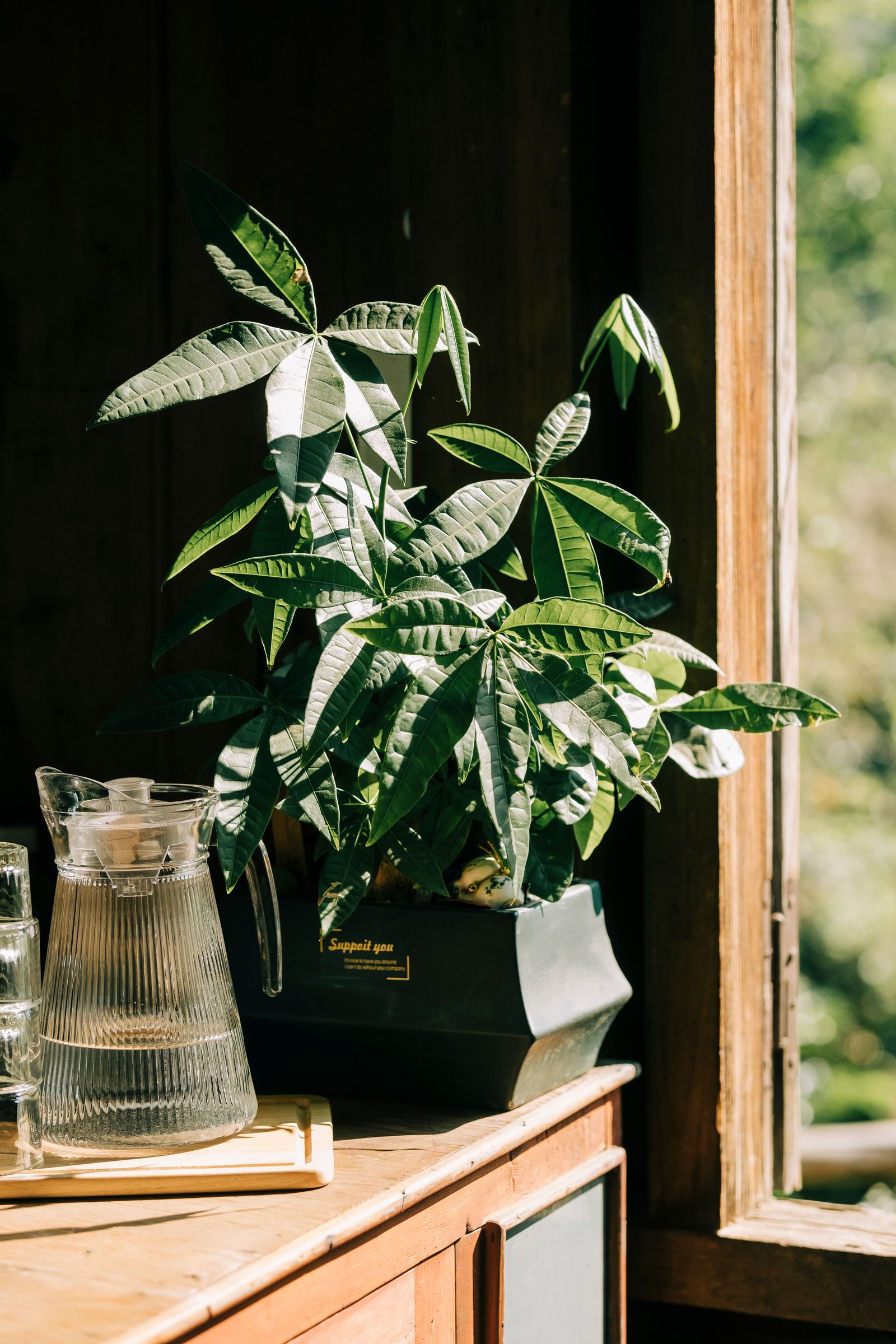
Photo: Kha Ruxury / Pexels
Ask five sources how often to water a money tree and you will get one answer about frequency, roughly every one to two weeks in summer, and two different answers about the thing that actually matters: how dry the mix should be before you water. Half the guides say the top inch. The other half say the top 2 to 3 inches. This page does not average them into a useless top 2 inches. It explains why both exist, which one fits your pot, and the rest of the money tree's watering system, including the trap built into almost every gift money tree ever sold.
Our houseplant watering chart owns intervals across plants. This page owns the money tree: its conflict, its soak, and its diagnosis.
Interactive tool
Watering Calculator: The Money Tree Pot Audit
The deep soak half of this plant's rhythm is a volume that grows with the pot. Enter your pot diameter as both length and width below and a depth of about 1 inch to see what one thorough watering is for your tree, small pot or large.
19.9 gallons
For 32 square feet at 1 inch deep. That is about 76 liters, or 10 trips with a standard 2 gallon watering can.
A rain gauge or a straight sided can set in the bed tells you when a sprinkler or soaker hose has actually delivered this depth. Time alone is a guess, because hose pressure varies from house to house.
The conversion is arithmetic, not opinion: one inch over one square foot is 144 cubic inches of water, and a US gallon holds 231 cubic inches, so each square foot at one inch takes 0.62 gallons.
The Short Answer, Then the Conflict
Water deeply until it drains from the holes, empty the saucer, then let the mix dry before you water again: the top 1 inch in a small pot, the top 2 to 3 inches in a large one. In an average room that rhythm lands at every 1 to 2 weeks in the growing season and stretches toward every 3 weeks in winter. NC State Extension's guidance for Pachira aquatica underlies the drainage half of that rule: this is a plant from Central and South American wetlands that nevertheless does not tolerate standing water in a pot, because a swamp has moving, oxygenated water and a saucer has a stagnant puddle. The wild origin explains the deep soak. It does not excuse the puddle.
Why the Sources Disagree, and How to Decide
The two dryness depths are not really a disagreement about the plant. They are a disagreement about pot size, written by people picturing different plants. The top inch rule comes from guides picturing the common gift money tree: a braided trunk in a 4 to 6 inch pot, where the whole root ball is small and the top inch is a meaningful fraction of it. The top 2 to 3 inches rule comes from guides picturing a mature tree in a 10 or 12 inch pot, where the top inch dries in a day from surface evaporation while the root zone below stays wet for a week. Use this decider: pots up to about 6 inches across, water when the top inch is dry; larger pots, check deeper, with a finger or a skewer, and water when the top 2 to 3 inches are dry while the mix below is still faintly moist. The principle under both rules is the same: the root zone should cycle from moist to nearly dry, never from soaked to soaked and never to bone dry dust.
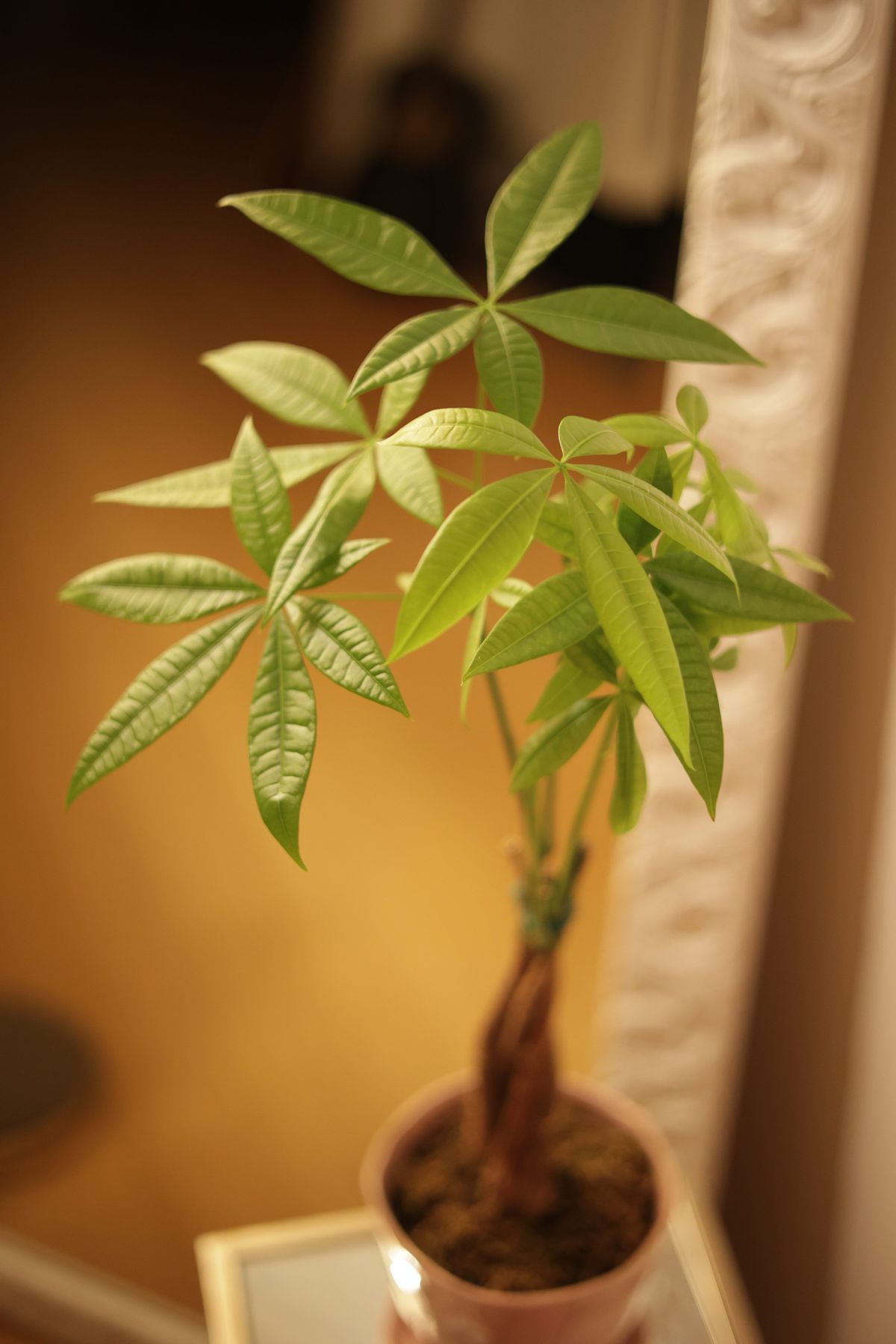
Money tree leaves in bright indoor light
The Cachepot Trap in Every Gift Money Tree
Money trees are sold as gifts, and gifts are sold dressed: the nursery pot sits inside a decorative cachepot with no hole, often with the trunk's braid tied and a layer of glued or loose decorative stone on top. Each element of the costume fights watering. The cachepot hides standing water, so the plant can sit in its own runoff for weeks invisibly, rotting at the base of the braid where you cannot see it. The stone layer hides the mix surface, so the fingertip check cannot happen. The fix takes five minutes and saves more money trees than any schedule: lift the nursery pot out and look after every watering until you know the plant's rhythm; pour off anything in the cachepot, every time; and loosen or remove the stone layer over the root zone so you can reach the mix. If the plant came planted directly into a hole free decorative pot, repot it into a pot with drainage at the first convenient spring day and keep the pretty pot as the cachepot it should have been.
The Soak, and What Thorough Means for a Tree
When the check says water, water like weather. Take the plant to a sink or tub if it is movable, and pour slowly over the whole surface until water runs from the holes, then wait and repeat once, because a big root ball wets unevenly on the first pass. Let it drain until the dripping stops before it goes back into its cachepot or saucer, and empty whatever collects within the hour. For a tree too large to move, water in place in two passes with a tray check between them, and use a turkey baster or a small pump to clear the saucer; large plants die of the saucer more often than of the can. Rotate the plant a quarter turn at each watering as well: money trees grow toward the light, and the rotation keeps the canopy even and stops the lean that eventually tips a top heavy tree.
Leaf Drop: the Money Tree's One Complaint, Decoded
A money tree that drops leaves is almost always reporting on water, but the report needs decoding because both too much and too little produce it. Work the evidence in this order. First, the mix: if it is wet deep down and leaves are yellowing and dropping from the bottom up, the plant is overwatered; check for the cachepot puddle before anything else, then let the plant dry properly and inspect the trunk base for softness, which means rot has started. Second, if the mix is dry most of the way down and the dropping leaves are crisp at the edges, the plant is underwatered, often because a small pot in bright light dries faster than the owner's weekly habit assumes; soak it fully and shorten the check interval. Third, the confounders: a plant moved to a new room, a cold draft from a winter window or an air conditioning vent, and the low light of winter all drop leaves on a plant whose watering is correct. A money tree that drops a few leaves after any change and then stabilizes is adjusting, not dying; new growth at the stem tips is the all clear.
Humidity, Feeding, and the Braided Trunk
Average household humidity is acceptable to this plant, but it prefers more, and dry heated winter air shows up as crispy leaf edges that owners misread as thirst. Grouping plants, a pebble tray, or a humidifier near the tree answers it better than extra watering, which only wets the roots while the leaves stay dry. Feed lightly: a balanced houseplant fertilizer at half strength once a month in spring and summer is ample, and none in winter. Salts from heavier feeding burn leaf edges in the same misleading way, so if edges brown on a well watered plant, flush the pot at a sink before adjusting anything else. The braid itself needs one watering related check: the trunk bases, bound together, hold moisture and hide rot, so at each watering in winter, press the trunks gently at the base. Firm is healthy. Soft means one stem is rotting, and the rescue is to unpot, cut away the dead stem entirely, and repot what remains; a braid with a rotting member loses all its stems if the dead one stays.
First, Confirm You Have This Plant
One confusion poisons more money tree watering advice than any other: the name is shared. Pachira aquatica, this page's plant, is the braided trunk tree with large palmate leaves, and it wants the soak and dry rhythm above. Crassula ovata, the jade plant, is also sold as a money tree or money plant in many shops, and it is a succulent that wants the opposite treatment: much longer droughts, watered like the aloe on this site. If your money tree has small, thick, coin shaped leaves on a branching woody stem, you have the jade, and you should water it by the succulent rules. Check the plant before the schedule; the schedule depends on which money tree is actually in the pot.
Keeping the Tree Its Size: Pruning and the Bigger Pot Decision
A money tree under good watering grows, and indoor trees that grow eventually meet their ceiling, literally. Manage size with pruning rather than with thirst, because a tree kept small by drought is a stressed tree dropping leaves, while a pruned tree is a shaped one. Prune in spring: cut a stem back to just above a leaf node, and the tree branches below the cut; take the longest and the most wayward stems first, and step back often, because the canopy you are shaping is three dimensional and the view from the ladder lies. The bigger pot decision follows the same discipline as the dryness rule: repot when roots circle the drainage holes or the tree dries implausibly fast for its size, go up one size only, and remember that the day you move from a 6 inch pot to a 10 changes which dryness depth rule applies to you, from the top inch to the top 2 to 3 inches, because the pot, not the plant, was what the rule was describing all along.
Frequently Asked Questions
How often should I water a money tree?
Deeply, until it drains, then not again until the mix dries: the top 1 inch in pots up to about 6 inches, the top 2 to 3 inches in larger pots. In most rooms that is every 1 to 2 weeks in summer and closer to every 3 weeks in winter. The dryness check decides; the calendar just reports what the check usually says.
Why do sources disagree about money tree watering depth?
Because they are picturing different pots. The top inch rule suits the small gift sized tree, where an inch is a large share of the root ball. The top 2 to 3 inches rule suits a mature tree in a big pot, where the surface dries long before the root zone. Match the depth to your pot size and the two rules stop contradicting each other.
Why is my money tree dropping leaves?
Read the mix first. Wet mix plus yellowing leaves dropping from the bottom means overwatering; check the cachepot for hidden standing water. Dry mix plus crisp edged leaves means underwatering. If the mix is right, suspect a recent move, a cold or air conditioning draft, or winter low light; a plant that stabilizes and pushes new tip growth is adjusting, not dying.
Can a money tree sit in water in its decorative pot?
No. NC State Extension is explicit that standing water is not tolerated, whatever the plant's swamp origins. The decorative cachepot is the number one hidden cause: lift the nursery pot, pour off collected water after every watering, and never let the plant stand in its own runoff.
Is a money tree the same as a jade plant?
No, and the confusion matters. Pachira aquatica is the braided trunk tree of this page and wants a deep soak followed by a real dry spell. Crassula ovata, the jade plant, is also sold as a money tree but is a succulent wanting long droughts. Identify by the leaves: large and palmate means Pachira; small, thick, and coin shaped means jade.
How do I know if the trunk is rotting?
Press the trunks gently at the base at watering time. Healthy trunks are firm. A soft trunk is rotting, usually from standing water hidden by the cachepot. Unpot the plant, cut the dead stem away completely, and repot the firm stems in fresh mix; leaving a rotting stem in the braid spreads the loss to the rest.
Photo credits: Kha Ruxury (Pexels); Loft of SAX (Pexels). Photos are served from this site; follow the credit to the library page for the original.