How Often to Water African Violets: Room Temperature, From the Bottom
By the Windchime Walker editorial team
Photo: Anna Bondarenko / Pexels
Every houseplant has a watering rule, but the African violet is the one where the rule is mostly about how, not how often. Water this plant the way you water everything else, from the top, with cold tap water, on a Saturday, and it will punish you in three specific ways: spotted leaves, a rotting crown, and a slow decline nobody connects to the watering can. Water it its way and it is one of the most reliable flowering houseplants ever sold. This page is the violet's way, complete.
Our houseplant watering chart owns intervals across plants. This page owns the violet: its check, its bottom watering method, its water temperature law, and its rescues.
Interactive tool
Watering Calculator: The African Violet Pot Audit
Your violet drinks from the bottom, and the amount is a volume. Enter your pot diameter as both length and width below and a depth of about 1 inch to see what a full 20 to 30 minute bottom watering delivers to a pot that size.
19.9 gallons
For 32 square feet at 1 inch deep. That is about 76 liters, or 10 trips with a standard 2 gallon watering can.
A rain gauge or a straight sided can set in the bed tells you when a sprinkler or soaker hose has actually delivered this depth. Time alone is a guess, because hose pressure varies from house to house.
The conversion is arithmetic, not opinion: one inch over one square foot is 144 cubic inches of water, and a US gallon holds 231 cubic inches, so each square foot at one inch takes 0.62 gallons.
The Short Answer, Then the Method
Water when the top inch (about 2 to 3 centimeters) of mix feels dry to a fingertip, which in most homes works out to every 7 to 10 days. Water from the bottom: set the pot in a saucer or bowl of room temperature water and let the mix drink upward for 20 to 30 minutes, then pour off whatever remains. The plant should never sit in water beyond that half hour. Everything else on this page is the reasoning and the refinements, but if you do only this paragraph, your violet will already be ahead of most.
Why Room Temperature Is a Law, Not a Preference
Iowa State University Extension states it plainly: cold water on African violet leaves causes rings and spots. The mechanism is cell damage: the violet's leaf tissue, adapted to warm forest floors, is shocked by cold water in a way most houseplants tolerate. The spots are permanent on the leaf they mark, which is why one careless top watering with cold water can disfigure a plant for the year it takes to grow that leaf out. Room temperature water, drawn a few hours early or mixed to lukewarm, costs nothing and removes the entire category of damage. This is also why the watering can for violets lives at room temperature permanently in serious collections: fill it after each watering and it is always ready and always the right temperature.
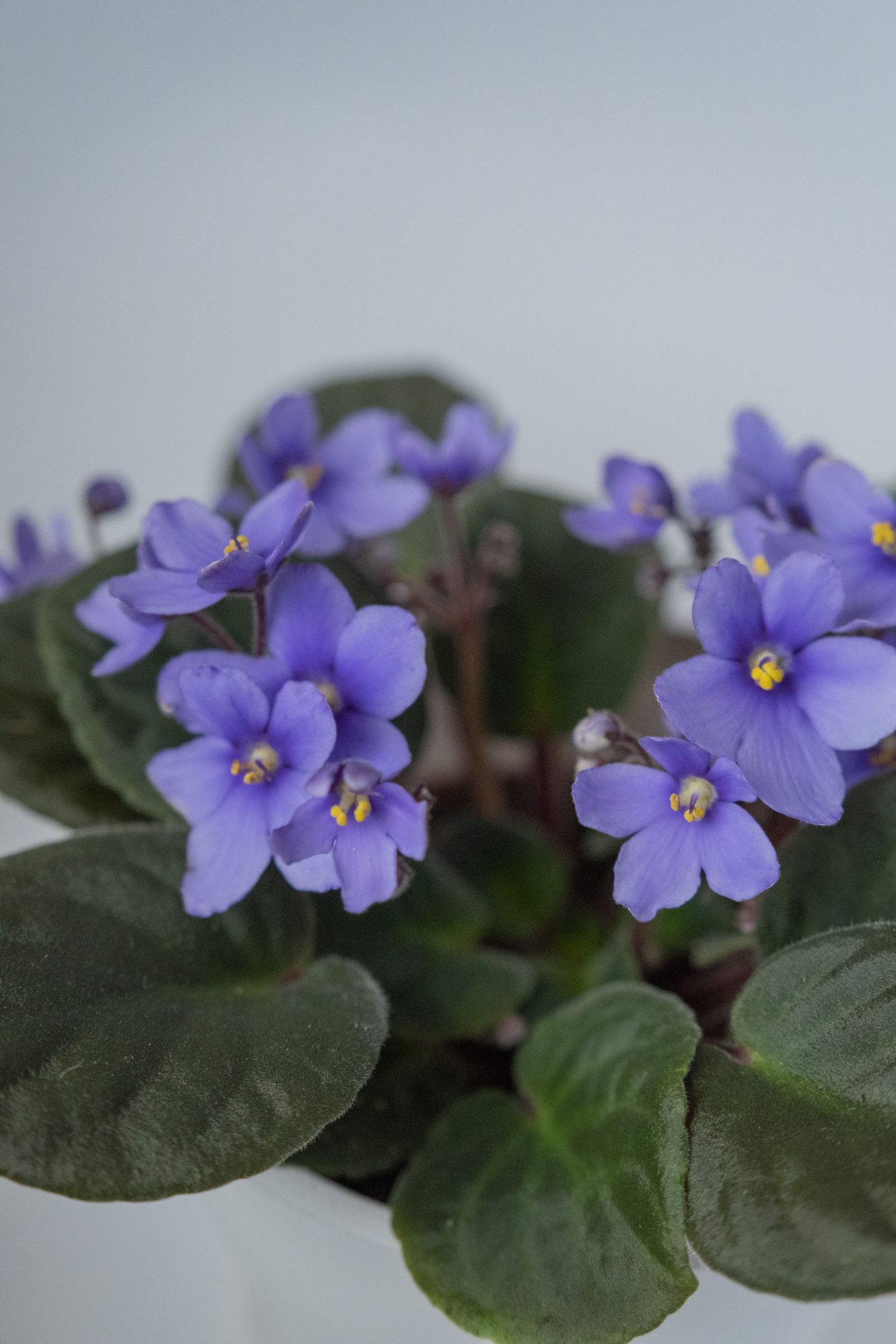
An African violet plant with fuzzy green leaves
Why the Bottom, and Why the Crown Matters
The violet grows as a flat rosette from a central crown, and that crown is the plant's single point of failure. Water sitting in the crown, especially in cool rooms or low light, rots it, and crown rot kills the whole rosette from the center outward. Top watering also splashes the fuzzy leaves, and the leaves hold droplets against themselves and spot. Bottom watering routes around both problems: water rises through the mix by capillary action, the surface and crown stay dry, and the leaves are never touched. Set the pot in water deep enough to reach about a third of the pot's height, wait 20 to 30 minutes, and test the surface with a fingertip: it should feel just moist when the watering is done. If the surface is still dry after 30 minutes, your mix has dried too far to wick well; water gently from the top that once, at the mix edge, keeping water off the leaves, and do not let the mix reach that state again.
The Monthly Flush: the Bill Bottom Watering Runs Up
Bottom watering has one cost, and honest guides name it: salts rise. Fertilizer salts and minerals from tap water are carried upward by the same capillary action that waters the plant, and because water never flows down and out, the salts accumulate in the top layer of mix, eventually showing as a white crust and as leaf edge burn. The fix is a monthly exception to the method: once a month, water from the top, slowly, with a generous volume, at a sink, letting water run through and away and carrying the salts with it. Use room temperature water, pour at the edge of the pot under the leaves rather than over them, and let the pot drain completely before it goes back to its saucer. Mark it on the calendar if you must mark anything about this plant; the flush is the one appointment a violet actually keeps.
Wick Watering and Self Watering Pots, Judged
Two systems promise to automate the violet, and both deserve a fair hearing. Wick watering runs a cord from a reservoir below into the pot; the mix stays at a constant light moisture, which violets genuinely enjoy, and a reservoir can carry a plant through a two week vacation untouched. Its risks are the same salt climb as bottom watering, answered by the same monthly flush, and algae in a clear reservoir, answered by an opaque one. Self watering pots, the classic two piece violet pot where an unglazed inner pot sits in a glazed outer reservoir, are the traditional tool for this exact plant and work well, with one discipline: the reservoir must be emptied, rinsed, and refilled rather than topped up forever, or the water in it goes stale and the salts concentrate. Either system beats irregular hand watering for this plant. Neither excuses you from the flush.
Light, Feeding, and the Flowering Connection
Owners usually arrive at a watering page because the plant is not flowering, and watering is often innocent. Violets bloom on light: bright indirect light, or 12 to 14 hours under a simple grow light, is the flowering trigger, and a violet in a dim corner will be a handsome green rosette forever regardless of watering perfection. Watering still plays its part. A plant kept evenly moist at the roots, never soggy and never droughted, holds its buds; a plant cycling between dry and drenched drops them. Feeding is the third leg: a fertilizer made for African violets, or any balanced houseplant food at quarter to half strength, given with the bottom watering every watering or two during active growth, is the standard collection practice. Weak and constant beats strong and occasional for a plant that is always drinking from below.
Diagnosing a Violet in Trouble
Center leaves small, tight, and pale. Usually light or crown trouble; check for crown rot (below) and move the plant brighter gradually. Leaf spots and rings. Cold water or water standing on leaves; the marks are permanent on those leaves, and the fix is method, not medicine. Outer leaves limp and soft despite moist mix. Root or crown rot from chronic overwatering or water in the crown; act fast, below. White crust on the mix surface. Salt accumulation; flush, and consider whether your water is hard enough to justify rainwater or distilled for this one plant. No flowers, healthy leaves. Light, almost always. Move it brighter or give it a light before you change anything about water.
The Crown Rot Rescue
If the center of the rosette is soft, dark, or collapsing, speed matters more than gentleness. Slide the plant from its pot and inspect: healthy roots are white and the crown firm; rot is brown and mushy. Cut away every soft part with a clean blade, down to firm tissue, even if that leaves a small crown with a few leaves. Dust the cut with a pinch of ground cinnamon or let it callus for a few hours, then set the crown on fresh, barely moist violet mix in a small clean pot, cover loosely with a clear bag or dome to hold humidity, and keep it in bright indirect light. Many rescued crowns root again within a few weeks. The lesson the rescue teaches is the page's whole argument: this plant's deaths are almost never thirst. They are water in the wrong place, at the wrong temperature, for too long.
Repotting: the Violet's Other Watering Event
African violets need repotting on a rhythm other houseplants do not, because the plant grows by shedding its outer leaves and extending a bare neck of stem above the mix, and a violet on a tall neck waters poorly and blooms worse. Repot once or twice a year for a growing plant: either into a pot one size larger with the neck buried deeper in fresh mix, or, for a long necked plant, the deeper surgery of scraping the neck lightly, and resetting the rosette lower so the buried neck roots into the fresh mix. The mix matters to the watering: violet mix is lighter and more porous than standard potting mix, often cut with extra perlite, because a plant watered from below needs a mix that wicks evenly without staying sodden at the base. Pot size is the other watering variable owners get wrong: violets bloom best slightly snug, in a pot about a third the diameter of the leaf span, and an over potted violet sits in a large volume of wet mix its roots cannot use, which is the one reliable way to rot a bottom watered plant. Keep the pot small, the mix fresh, and the neck buried, and the method on this page runs exactly as designed.
Frequently Asked Questions
How often do African violets need watering?
When the top inch of mix feels dry, typically every 7 to 10 days in an average room. Check with a fingertip rather than a calendar, and water from the bottom with room temperature water for 20 to 30 minutes, then discard what remains.
Why can't I water an African violet from the top?
Two reasons: water in the central crown can rot it and kill the rosette, and water on the fuzzy leaves, especially cold water, causes permanent rings and spots, a warning Iowa State Extension gives explicitly. Bottom watering keeps the crown and leaves dry while the roots drink.
What happens if I use cold water on an African violet?
Cold water shocks the leaf cells and leaves yellow or white rings and spots that do not heal; the leaf carries the mark until it is replaced by new growth. Always use room temperature water, which is easy if you refill the can right after watering and let it stand.
How do I fertilize an African violet without burning it?
Feed weakly and steadily: violet fertilizer or a balanced houseplant food at quarter to half the label strength, mixed into the bottom watering water every watering or two in the growing season. Then flush the pot from the top once a month so the salts that bottom watering carries upward do not accumulate.
Is a self watering pot good for African violets?
Yes, it is the traditional pot for this plant: an unglazed inner pot in a glazed reservoir keeps moisture even, which violets love. Empty and rinse the reservoir at each refill rather than topping it up forever, and keep up the monthly top flush for salts.
Why is my African violet not blooming even though I water it right?
Almost always light. Violets need bright indirect light or 12 to 14 hours under a grow light to set buds. A healthy, green, non flowering violet in a dim spot is asking for light, not for a different watering schedule.
Photo credits: Anna Bondarenko (Pexels); Michael Telitsyn (Pexels). Photos are served from this site; follow the credit to the library page for the original.