How Often to Water a Jade Plant: Read the Leaves, Not the Calendar
By the Windchime Walker editorial team
Photo: Kevin Malik / Pexels
The jade plant runs on the same storage logic as a camel. Its thick, glossy leaves are water tanks, and a well grown plant can sit in bone dry mix for weeks, drawing down its reserves leaf by leaf, looking none the worse. That anatomy sets the rule: water only when the mix is fully dry through the whole pot, then soak it deeply. In calendar terms, for most rooms, that lands at about every 2 to 3 weeks in the growing season and stretches to every 4 to 6 weeks in winter. University of Wisconsin Madison Extension gives the same shape in different words: allow the mix to dry between thorough waterings and restrict water in winter. NC State Extension's profile matches it, moderate watering once the mix is dry, reduced from fall through late winter. The weak guides that say every 1 to 2 weeks are describing small plants in small pots in bright sun, and even then the check matters more than the number.
Our houseplant watering chart owns intervals across many plants. This page owns the jade plant alone.
Interactive tool
Watering Volume Calculator: The Jade Plant Pot Audit
A jade plant stores water in its leaves, so the pot dries fully before the next deep soak. Enter your pot diameter as both length and width with a depth of 1 inch to size that soak.
19.9 gallons
For 32 square feet at 1 inch deep. That is about 76 liters, or 10 trips with a standard 2 gallon watering can.
A rain gauge or a straight sided can set in the bed tells you when a sprinkler or soaker hose has actually delivered this depth. Time alone is a guess, because hose pressure varies from house to house.
The conversion is arithmetic, not opinion: one inch over one square foot is 144 cubic inches of water, and a US gallon holds 231 cubic inches, so each square foot at one inch takes 0.62 gallons.
The Gauge the Plant Carries: Its Own Leaves
Every watering guide for this plant teaches a soil check, and the soil check works, but the jade carries a better instrument on its own stems. A jade leaf that is fully charged is firm, plump, and slightly springy when you press it gently between finger and thumb. As the plant spends its reserves, the leaves lose that spring: they feel softer, then faintly flexible, and only much later do they wrinkle. Water when the plumpness first softens across most of the plant, not when the leaves wrinkle. Wrinkling is the plant deep in its reserves, and a jade that is repeatedly run to wrinkling grows slowly and drops leaves it did not need to drop. The leaf gauge has one more advantage over any calendar: it integrates everything, pot size, light, temperature, season, into a single reading taken off the plant itself. Learn it on your plant over two or three cycles, checking the leaves the day you water and again a week later, and you will never need an interval table again.
The Soil Check, Done at Full Depth
Back the leaf gauge with a soil check that reads the whole pot, not the surface. The top inch of a jade pot dries within days of a soak while the bottom half stays moist for a week or more, and watering on the surface reading is how jades rot. Use the dowel method: push a wooden skewer or chopstick to the bottom of the pot, leave it a minute, and read the wood when you pull it out. Damp mix darkens the wood and clings to it along whatever depth is still wet. For a jade, the skewer should come out dry and clean nearly to the bottom before you water. The weight check is the second instrument, and for tabletop plants it is the fastest one in the house: a dry jade pot is startlingly light next to a freshly soaked one. For the big tree form plants, too heavy to lift, the dowel is the check, full stop, which is why the next section treats them as their own case.
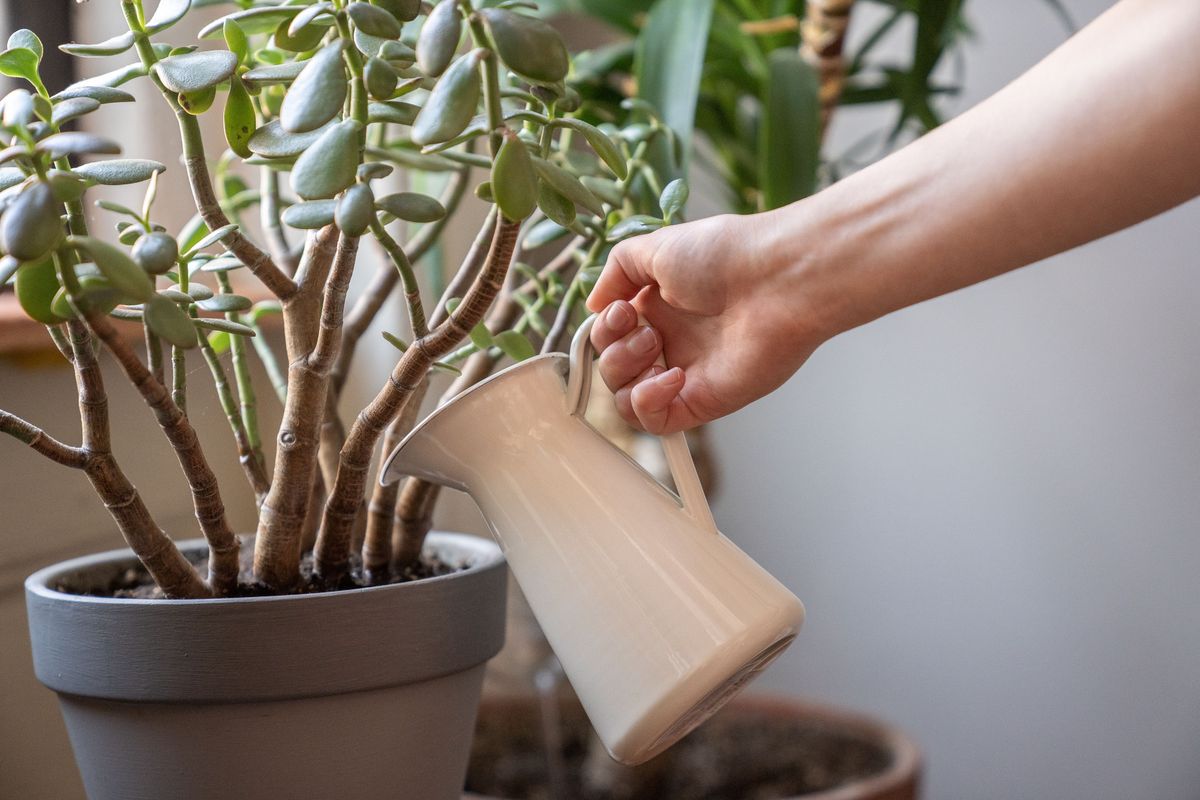
A hand pouring water from a jug into a jade plant pot
The Drink: Deep, Slow, and Drained
When both gauges say dry, water like you mean it. Pour slowly over the whole surface until water runs freely from the drainage holes, let the pot drain completely, and empty the saucer. The calculator above sizes the drink: enter the pot diameter as both length and width with a depth of 1 inch for a working estimate, and expect a large specimen to take a quart or more, because you are refilling the entire root zone and the leaves behind it. Two rules guard the method. Never water a jade in sips: a splash that wets the top inch teaches roots to live at the surface and leaves the deep mix in a permanent damp twilight that rots stems. And never let the pot stand in runoff: jade roots in a saucer of water are roots in the one condition this drought plant cannot handle. If your plant lives in a decorative pot without drainage, water it in its nursery pot at the sink and set it back only when the dripping stops.
The Tree Form Problem: Old Plants in Heavy Pots
The jade plants that die of kindness are usually the old ones, the tree form specimens in 12 and 14 inch pots that took a decade to grow. They cannot be lifted for a weight check, their size makes owners nervous, and nervous owners water. Run a tree form jade on the dowel check alone, read at full depth in two places in the pot, and water only when both readings come out dry. Its interval will be the longest in your house, often 4 weeks in summer and 6 or more in winter, because the volume of mix and the volume of stored leaf water are both large. Feed it rarely, once or twice in the growing season with a dilute balanced fertilizer, and only on a day it is watered, never into dry mix. Prune for shape in spring, and let the pruned branches callus for a few days if you want to root them: jade propagates from a single leaf or stem piece laid on dry mix, which is the plant's storage economy working in your favor one more time.
Leaf Drop: The Diagnosis Order
A jade that drops leaves is filing a report, and the cause is water more often than any guide admits, in both directions. Work the order. First, overwatering: leaves drop plump and healthy looking, sometimes with a soft stem base, and the mix is damp. The fix is the rescue below, not a schedule adjustment. Second, underwatering: leaves drop wrinkled and thin, the mix is dry to the bottom, and the plant perks up within days of a soak. Third, light: a jade moved suddenly into much dimmer conditions sheds leaves it can no longer afford, and the cure is a brighter spot, introduced gradually so the leaves do not scorch. Fourth, age and season: old leaves on the interior of a big plant yellow and drop in fall as the plant consolidates, which is normal and needs nothing. The diagnosis matters because the treatments oppose each other: watering a rotting plant harder is the classic jade fatality, and withholding water from a thirsty one on rot suspicion is the runner up.
The Soft Stem Rescue
If a stem base goes soft and dark, that section is rotting and it will not recover. Cut above the rot with a clean knife, into firm green tissue, and keep cutting until the cross section shows no brown ring. Let the cut end air dry for several days until it calluses, then set the cutting on dry mix and wait a week before the first light watering; jade cuttings root readily and the rescued piece becomes a new plant. Tip the remaining plant out, shake off the wet mix, cut away any black mushy roots, and repot the sound root ball into fresh dry mix in a pot with drainage. Then do the hardest thing in jade care: nothing. No water for at least a week. The leaves carry enough reserve to fund the recovery, and a dry week is what stops the rot. Run the leaf gauge, the full depth check, and the rare deep soak, and a jade plant will outlive the pot you bought it in several times over.
Frequently Asked Questions
How often should I water a jade plant in winter?
Stretch the interval to about every 4 to 6 weeks for most rooms, and let the checks overrule the calendar: water only when the mix is dry to the bottom of the pot and the leaves have just begun to lose their plump spring. Growth nearly stops in winter, the plant spends its leaf reserves slowly, and more jades are lost to winter watering than to any other single cause. A plant on a cold windowsill needs the least water of all, because cold plus wet mix is the rot combination.
Should I mist my jade plant?
No. Jade leaves store water internally and gain nothing from misting, and water sitting on the leaves and in the leaf joints invites rot and fungal spots, especially indoors where air moves slowly. If the air in your home is dry, the jade is the one plant that does not care. Spend the effort on the soak and drain routine instead, and wipe dust off the leaves with a dry or barely damp cloth so they can take in light.
Why are my jade plant's leaves wrinkling?
Wrinkled leaves mean the plant has spent deep into its stored water, which happens when a dry spell runs long or when the roots can no longer take up water. Check the mix first: if it is dry to the bottom, soak the plant thoroughly and the leaves should plump back over several days. If the mix is wet and the leaves still wrinkle, suspect root rot, because dead roots cannot drink; tip the plant out and follow the soft stem rescue. A plant that wrinkles a week after every soak is usually rootbound or in a mix that no longer holds moisture evenly, and it is asking for a repot in spring.
Can I water a jade plant from the bottom?
Yes, and for small pots it works well: set the pot in a basin with a few inches of water for 20 to 30 minutes, let it drain fully, and return it to its saucer. Bottom watering wets the whole root zone evenly and keeps the stem base dry. It fails on large tree form plants, which are too heavy to move and too deep for water to wick reliably to the top of the root ball; top water those slowly instead, in two passes, so the mix absorbs rather than sheds the drink.
Is tap water safe for a jade plant?
For most homes, yes. Jade plants are not among the salt sensitive houseplants, and ordinary tap water used in a soak and drain routine leaves little residue behind, because each thorough watering flushes the last one's salts out the drainage holes. If you see a white crust building on the mix surface or the pot rim over many months, flush the pot with a long slow pour of plain water at the sink, or repot with fresh mix in spring. What jades cannot tolerate is not the water itself but water that never leaves: frequency and standing runoff do the damage.
Photo credits: Kevin Malik (Pexels); Kevin Malik (Pexels). Photos are served from this site; follow the credit to the library page for the original.