How Often to Water Roses: Three Schedules for New, Established, and Potted Roses
By the Windchime Walker editorial team
Photo: Declan Sun / Pexels
How often to water roses has no single answer because roses live in three situations, and each has its own schedule. A rose planted this spring is still growing the root system that will feed it and needs water every 1 to 3 days at first. An established bush in the ground runs on a deep soak of about an inch of water a week. A rose in a pot in July can need water every day. Pages that blend the three into one rhythm under water the new plant, over water the established one, and confuse the pot owner entirely. This page keeps them separate, with the numbers for each and the checks that tell you which schedule your rose is on.
Our how to plant roses guide owns planting day itself. This page owns the water from that day forward.
Interactive tool
Watering Volume Calculator: The Rose Bed
Established roses take a deep soak of about 1 inch a week, more in hot weather. Enter your bed size below with a depth of 1 inch to see what that soak is in gallons, and water at the base in the morning.
19.9 gallons
For 32 square feet at 1 inch deep. That is about 76 liters, or 10 trips with a standard 2 gallon watering can.
A rain gauge or a straight sided can set in the bed tells you when a sprinkler or soaker hose has actually delivered this depth. Time alone is a guess, because hose pressure varies from house to house.
The conversion is arithmetic, not opinion: one inch over one square foot is 144 cubic inches of water, and a US gallon holds 231 cubic inches, so each square foot at one inch takes 0.62 gallons.
Schedule One: New Roses, the Establishment Rhythm
For the first 4 to 6 weeks after planting, and through the whole first season in dry weather, a new rose is watered every 1 to 3 days depending on heat and soil, keeping the root zone evenly moist while the roots grow out of the planting hole into the surrounding soil. The volume is a real soak, a couple of gallons worked into the root zone slowly, not a sprinkle that wets the mulch and stops. The reasoning is root geometry: until the roots colonize the bed, the plant drinks only from the small volume you planted it in, and that volume dries like a pot. The signal to graduate to the established schedule is sustained new growth and a plant that stands through a hot afternoon without flagging; the taper is gradual, stretching the interval while deepening the drink, so the roots follow the water down. Bare root roses planted in spring are the thirstiest version of this schedule and the least forgiving of a dry first fortnight.
Schedule Two: Established Roses, and an Honest Conflict
An established rose in the ground wants depth over frequency: one deep soak a week in most weather, aimed at wetting the root zone 12 inches down, with the surface allowed to dry between drinks. On the amount, the extension sources conflict and this page flags it rather than splitting the difference. University of Illinois Extension puts established roses at about 1 inch of water per week. Mississippi State Extension's guidance runs to 2 inches per week in hot weather. The Royal Horticultural Society lands in the same territory from the other direction: 5 to 10 liters per established plant per watering, at most once a week in a dry summer. Read together, the working standard is this: 1 inch a week as the baseline in ordinary summer weather, rising toward 2 inches in genuine heat, in sandy soil, or under a plant in full bloom load, which is when roses spend water fastest. The calculator above turns inches into gallons for your actual bed: enter the bed size with a depth of 1 or 2 inches and the argument becomes arithmetic.
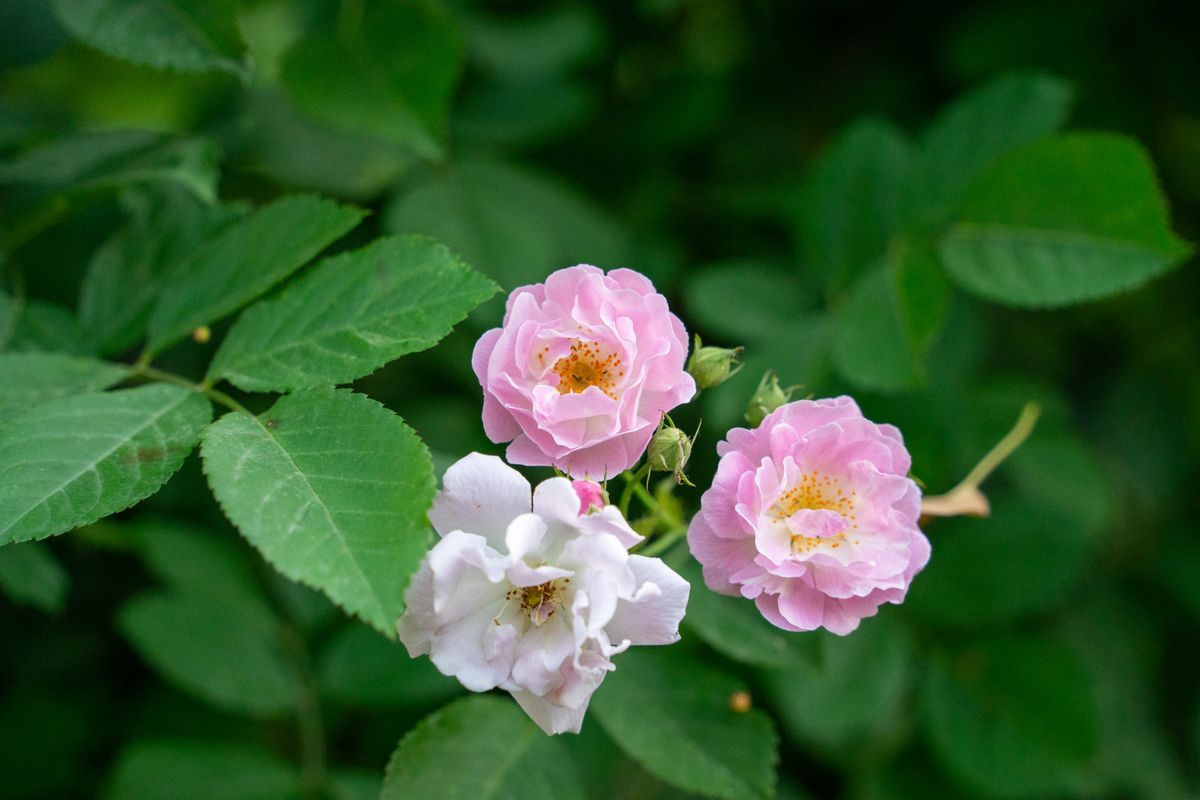
Three delicate pink roses amid green foliage
Schedule Three: Potted Roses Drink Like Pots
A rose in a container is on the container clock, not the rose clock. In summer heat a potted rose, especially in a dark pot in full sun, can need water daily, and in a heat wave a small pot may need it morning and evening. The check is the fingertip at an inch or two down, run daily in hot weather, and the drink is a full soak until water exits the drainage holes. Potted roses also expose the size trap: a large floribunda in a 3 gallon pot is a plant whose roots fill the whole reservoir, and no schedule fixes an undersized pot; 5 gallons is a working minimum for a bush rose and more is kinder. Feed potted roses more often than bed roses too, because every daily drink carries a little fertility out the drainage holes with it. Winter care flips the problem: a potted rose's roots are exposed to cold on all sides, so the pot gets shelter, and watering drops to just enough to keep the mix from going dust dry.
Water at the Base, in the Morning: the Black Spot Rule
Roses carry a fungal enemy, black spot, that spreads in water sitting on leaves, and watering technique is half its control program. Water at the base of the plant, with a soaker hose, drip line, or a can spout under the foliage, so the leaves stay dry. Water in the morning, so any splashed foliage dries within the hour as the day warms. Keep the center of the bush open by pruning for air flow, and clear fallen leaves from under the plant, because the fungus overwinters in them and splashes back up with the first wet week. None of this requires a spray bottle of anything, and it is the difference between a bush that defoliates by August and one that carries its leaves, and therefore its blooms, through the season. Overhead watering of roses in the evening is the single habit that does the most damage per minute of effort in the whole rose garden.
Mulch, Soil, and the Deep Root Payoff
Mulch is the interval stretcher: 2 to 3 inches of shredded bark or compost over the bed, kept a few inches clear of the canes, cuts evaporation enough to turn a twice a week bed into a once a week bed in the same weather. Soil writes the other half of the schedule. Roses in sand drink on the short end of every range on this page and want the higher weekly figure; roses in clay hold water longer, want the longer interval, and punish frequent watering with the root problems that follow poor drainage. The payoff for the deep and infrequent rhythm is the plant itself: roots that chase water downward are roots that find it during a dry fortnight, which is why an established rose grown on this system sails through a vacation or a hosepipe ban that stresses the daily sprinkled garden. Train the roots deep in the first two seasons and the established schedule becomes easy to keep, because the plant has built the reservoir you are no longer carrying in a can.
Form Changes the Volume: Climbers, Shrubs, and Miniatures
The three schedules sort roses by situation, and form adjusts the volumes inside them. Climbing roses, once established, are the deepest rooted and the most drought capable of the family, but their first two seasons are establishment, and a climber asked to cover a wall on an established rose's water will stall at half height; water a young climber like a new rose until it has clearly taken off. Shrub and bush roses are the standard case the schedules were written for. Miniature roses are the trap: sold in small pots, they are usually grown in containers whatever the label says, and their schedule is the potted one, daily checks in heat, with the added warning that their small pots freeze hard in winter and want shelter or sinking into a bed for the cold months. Ground cover roses in a bed drink on the established schedule but spread their roots wide and shallow, so their soak should wet a wider area to a moderate depth rather than a narrow column to full depth. None of this changes the base rules, base watering in the morning, the deep soak, the dry surface between drinks. Form just tells you where the water has to reach, which is the question every watering schedule is secretly answering.
Frequently Asked Questions
How often should I water roses?
By situation. New roses: every 1 to 3 days for the first 4 to 6 weeks, keeping the root zone evenly moist. Established roses in the ground: one deep soak a week, about 1 inch of water, rising toward 2 inches in heat. Potted roses: as often as daily in summer heat, checked with a fingertip.
How much water do roses need per week?
About 1 inch per week for established bushes in ordinary weather, per University of Illinois Extension, and up to 2 inches per week in hot weather on Mississippi State Extension guidance. The RHS equivalent is 5 to 10 liters per plant per weekly watering. Heat, sand, and full bloom push you to the higher figure.
Should I water roses every day?
Only potted roses in summer heat, and only when the fingertip check at an inch or two down says the mix is dry. Established roses in the ground should not be watered daily; daily shallow drinks grow shallow roots and wet foliage, which invites black spot.
Why do my roses get black spot, and does watering matter?
Black spot is a fungus that spreads in water on leaves, so watering matters a great deal. Water at the base in the morning, never overhead in the evening, prune for air flow, and clear fallen leaves from under the bush. Dry foliage is the cheapest fungicide in the rose garden.
When should I stop watering roses in fall?
Taper as growth slows and the weather cools; established roses need little once autumn rain arrives. Keep new roses watered until the ground freezes, because they enter winter with small root systems. A deep soak before a hard freeze, on a day above freezing, helps any rose overwinter.
Photo credits: Declan Sun (Pexels); 坤林 刘 (Pexels). Photos are served from this site; follow the credit to the library page for the original.