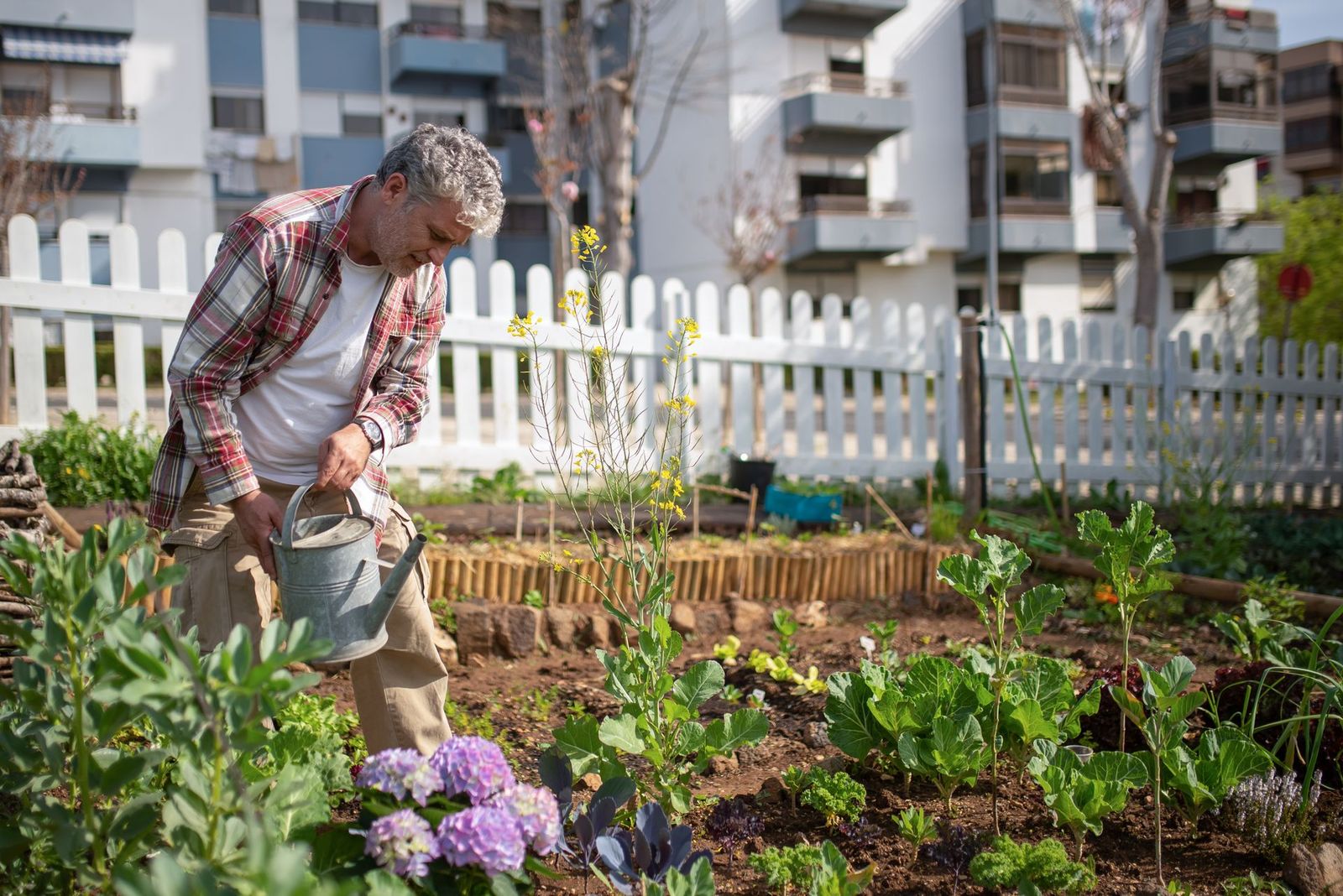
If you are new to vegetable gardening, watering is the job that feels simplest and causes the most quiet damage. A light sprinkle every day feels caring. It is usually the worst pattern of all, because it wets only the top of the soil, trains roots to stay shallow, and leaves plants helpless the first hot afternoon you miss a day. The opposite mistake, drowning the bed on a fixed schedule whether it needs water or not, rots roots and yellows leaves just as surely. The way out of both mistakes is to stop thinking in days and start thinking in depth. Your garden does not need water on Tuesdays. It needs a measurable amount of water, reaching a measurable depth, whenever the soil at root level has dried enough to ask for it.
Here is the working figure. Mississippi State University Extension Service states that vegetable gardens need about 1 inch of water each week, and that a garden in sandy soil may need up to 2 inches. That inch counts rain and watering together. It is a starting budget for an established garden in ordinary weather, not a law, and the rest of this guide shows you how to measure it, convert it into gallons for your own bed, and adjust it for your soil, your weather, and the stage your plants have reached. By the end you will have a routine you can run in about ten minutes once a week, plus a five minute check midweek.
Before you pick up the hose, run your own bed through the WateringCalculator below. Enter your bed size and the weekly amount you are aiming for, and it converts inches into gallons and into watering time, so the numbers in this guide become your numbers instead of a stranger's.
Interactive tool
Garden Watering Calculator
Advice like "give the bed an inch of water" only helps if you know what an inch costs. Enter the bed size and the depth you want to apply, and read the answer in gallons, liters, and watering cans.
19.9 gallons
For 32 square feet at 1 inch deep. That is about 76 liters, or 10 trips with a standard 2 gallon watering can.
A rain gauge or a straight sided can set in the bed tells you when a sprinkler or soaker hose has actually delivered this depth. Time alone is a guess, because hose pressure varies from house to house.
The conversion is arithmetic, not opinion: one inch over one square foot is 144 cubic inches of water, and a US gallon holds 231 cubic inches, so each square foot at one inch takes 0.62 gallons.
What One Inch of Water Actually Means
An inch of water means a layer of water 1 inch deep spread over the whole surface of your bed. It is a depth, not a bucket count, which is why the same inch means very different gallons on different beds. The conversion is plain arithmetic: 1 inch of water over 1 square foot of soil is about 0.62 gallons. Multiply your bed area in square feet by 0.62 and you have the gallons in one inch for your garden.
Work it once for the most common beginner bed, a raised bed that is 4 feet by 8 feet. The area is 32 square feet. Multiply 32 by 0.62 and you get about 20 gallons. So one inch of water on that bed is about 20 gallons, every week, from rain and the hose combined. A 10 foot by 10 foot garden is 100 square feet, so one inch there is about 62 gallons. A small 4 foot by 4 foot bed is 16 square feet, so one inch is about 10 gallons. Write your bed's one inch number on a note by the spigot. That single number ends most watering confusion, because every decision after this is just a fraction or a multiple of it.
Depth matters as much as volume. The point of the weekly inch is where it ends up: down in the root zone, several inches below the surface, not glittering on the leaves at noon. Water applied slowly at soil level soaks down. Water sprayed fast over the top on a hot, windy afternoon partly evaporates, partly runs off, and partly sits on foliage where it invites disease. Same gallons, very different result. That is why this guide keeps returning to two habits: water deeply, and water at the base of the plants.
How Often: Deep and Infrequent Beats Light and Daily
For an established in ground garden in average soil, give the weekly amount in one or two deep waterings. One deep soaking that wets the soil well down into the root zone, then several dry days on top, teaches roots to grow downward where moisture lasts. Daily light watering does the reverse. Roots crowd near the surface, the surface dries within hours, and the plant wilts fast in heat even though you watered that morning.
Soil type moves the frequency, not the weekly total. Sandy soil drains fast and holds little, so split the weekly inch into two waterings of about half an inch each, which matches the guidance Mississippi State University Extension Service gives for sandy ground needing the higher total. Loam, the dark crumbly middle soil most gardeners hope for, usually takes the whole inch in one or two sessions. Clay holds water a long time but absorbs it slowly, so water once a week and apply it slowly, in pulses if you must, so it soaks in instead of pooling and running off. Raised beds drain and warm faster than the ground, so in summer they often need the weekly amount split into two or three waterings. Containers are the extreme case: a small pot in summer sun can need water every day, and the rule there is different, water until it runs from the drainage hole, then check again tomorrow.
Seedlings and fresh transplants are the honest exception to deep and infrequent. Seeds and tiny roots live in the top inch of soil, and that top inch dries fast. Until plants are established, keep the surface consistently moist with light, frequent watering, even twice a day for seeds in warm weather. Once roots have grown down and plants are putting on real size, shift gradually to the deep weekly pattern. The plant's stage, covered below, tells you when to make that shift.
How to Measure What You Actually Applied
Most beginners have no idea how much water they put down, and guessing is how beds end up at half an inch one week and three inches the next. Three simple methods fix that, and none of them needs anything you do not already own.
First, the rain gauge. Put an inexpensive rain gauge, or any straight sided jar marked in inches, in the open in the garden. Whatever it catches is what your bed received, and you subtract it from your weekly inch. Half an inch of rain means you owe the bed about half an inch, roughly 10 gallons on a 4 by 8 foot bed. Light showers that barely wet the surface count for very little, because they never reach the roots; a gauge tells you the truth instead of letting a damp looking surface fool you.
Second, the can test, the classic method The Old Farmer's Almanac teaches for measuring an inch. Set a few straight sided cans, tuna cans are the traditional choice, at different spots in the bed. Mark 1 inch up from the bottom inside each can. Run your sprinkler, soaker hose, or watering routine and time how long it takes for the cans to collect a given depth. If a can holds half an inch after 30 minutes, you know an hour gives you about an inch in that spot. Compare cans: if the can near the hose holds twice the water of the far can, your coverage is uneven and the far end of the bed is living on half rations.
Third, the bucket test for hose users. Time how long your hose, at the flow you actually use, takes to fill a 5 gallon bucket. If it fills in 2 minutes, your hose delivers about 2.5 gallons a minute. Your 4 by 8 foot bed needs about 20 gallons for an inch, so a full inch from that hose takes about 8 minutes of watering aimed at the soil, not the paths. Write that time down too. Between the gauge, the cans, and the bucket, you can now state, in gallons and minutes, exactly what your watering does. The calculator at the top of this page does the same math for any bed and any target depth.
After watering, verify depth with the screwdriver test the Almanac recommends: push a long screwdriver or a trowel into the soil. If it slides in easily to about 6 inches, water reached the root zone. If it stops hard at 2 inches, you sprinkled, no matter how long the hose ran. Digging a small check hole with a trowel in one corner of the bed tells you the same thing with your eyes: moist and dark at root depth means you are done, dry and pale means water again slowly.
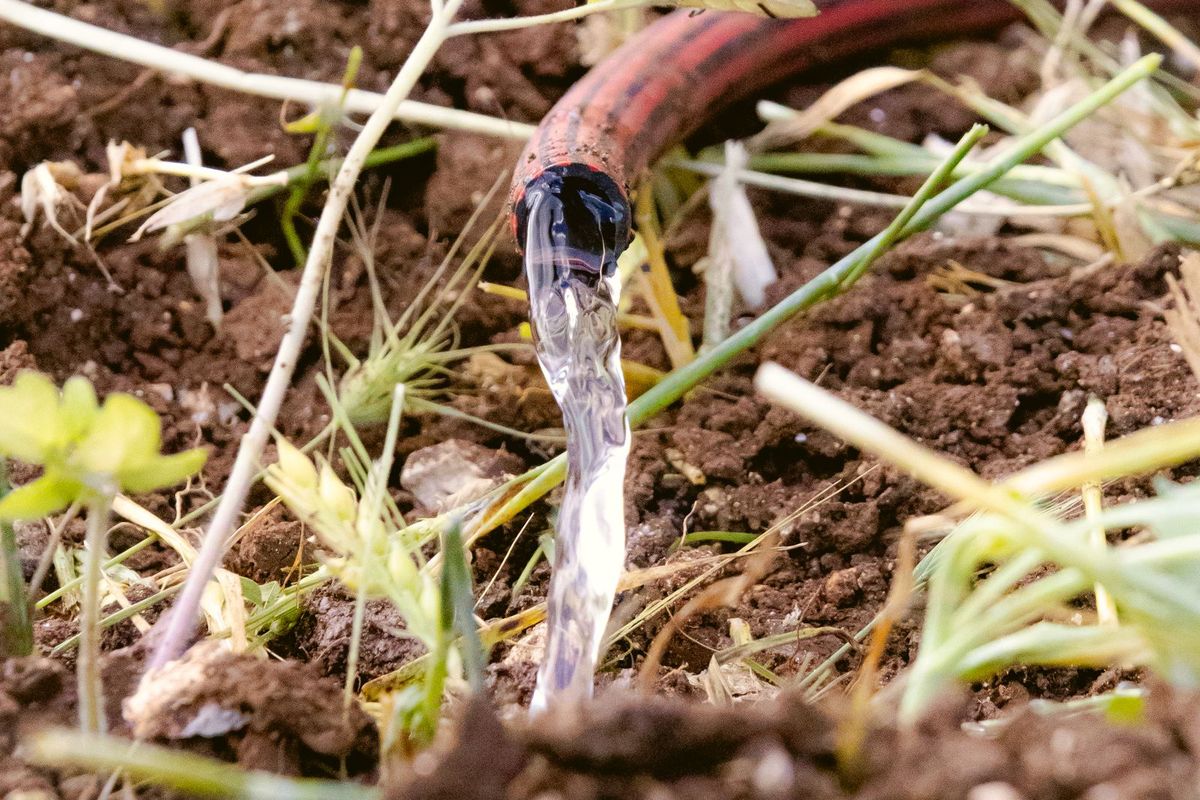
A garden hose watering the soil at the base of plants in a vegetable bed
When to Water, and Where to Aim It
Early morning is the best time to water a vegetable garden. The air is cool, the wind is usually calm, less water evaporates before it soaks in, and plants start the hot part of the day with full roots. Any water that lands on leaves dries quickly in the morning sun, which lowers the chance of leaf diseases that thrive on foliage that stays wet. Evening is the workable second choice if morning is impossible, and it is fine when you water at the base of the plants and keep leaves dry. Midday watering is not forbidden, and a badly wilting plant should never wait for a better hour, but more of a midday application evaporates, so morning remains the habit to build.
Aim at the soil, not the plant. Water belongs at the base, where roots can take it up. A watering can or a hose with a gentle wand, held low, does this well in a small bed. A soaker hose laid along the row does it hands free and loses very little to wind. Drip lines do it most precisely of all, delivering slow water plant by plant. Overhead sprinklers are the least accurate tool for vegetables: they wet every leaf, water the paths, and drift in any breeze. If a sprinkler is what you have, run it early in the morning and use the can test to learn its real output, then accept its limits with open eyes.
One more timing trap catches beginners every summer: afternoon wilt. Many plants droop in strong heat even with moist soil, a temporary slump that protects the leaves, and they recover by evening on their own. Do not water on the evidence of a 3 p.m. slump alone. Check the soil. If it is moist at root depth and the plant perks up by evening, it was never thirsty. Wilting that is still there in the cool of the early morning is the real warning, and that plant needs a deep drink right away.
Adjusting by Growth Stage
A bed's thirst changes across the season, and a schedule that never changes will be wrong at both ends of it.
At the seed and seedling stage, the job is surface moisture. Roots are short, the top inch is their whole world, and it dries in hours. Water lightly and often, keep the seedbed evenly damp, and never let a crust form over emerging seedlings. Gentle application matters here too, since a hard stream can wash seeds out of their rows.
At the transplant stage, water each plant in well at planting, soaking the hole so roots make contact with the surrounding soil. For the first week or two, check new transplants daily. Their roots have not yet grown out into the bed, so they live on the moisture in their small root ball, which dries faster than the bed around it.
At the fast growth stage, when plants are sizing up and leafing out, settle into the main pattern: about 1 inch a week in one or two deep waterings, checked with a finger pushed 2 to 3 inches into the soil near the plants. Dry at that depth means water. Still moist means wait a day and check again. This finger test, simple as it sounds, is the single most reliable scheduling tool you own, and it overrules any calendar, including the one in this guide.
At the flowering and fruiting stage, steadiness matters more than volume. Tomatoes and peppers forming fruit, cucumbers and squash filling out, beans setting pods, all suffer when moisture swings from dry to flooded and back. Uneven watering at this stage is the pattern behind cracked tomato skins, bitter cucumbers, and dropped blossoms. Keep the root zone evenly moist, water deeply on your regular rhythm, and do not let the bed go bone dry between drinks. Toward the very end of the season, a few crops ease off: bulb onions, for example, want less water as their tops begin to fall over, since drier conditions near harvest help the bulbs store well.
In a heat wave, raise the amount before you raise the frequency. Hot, dry, windy weather can push a garden toward 1.5 inches a week or more, and Mississippi State University Extension Service puts sandy gardens at up to 2 inches. Give the extra water as a deeper morning soaking, check soil daily in raised beds and containers, and lean on mulch, which is the next section, to hold what you applied.
Mulch: The Habit That Changes the Schedule
Mulch is a layer of material spread on the soil surface around your plants, and it is the single biggest water saver a beginner can add. A layer of organic mulch 2 to 4 inches deep, materials like straw, shredded leaves, or compost, shades the soil, slows evaporation, keeps roots cooler, and softens the impact of heavy watering so the surface does not crust. Garden Voila and the Almanac both treat mulch as the first water conservation step, ahead of any hardware, and they are right: a mulched bed simply dries out more slowly than a bare one.
In schedule terms, mulch stretches the gap between waterings. A bare sandy bed might ask for water twice a week; the same bed mulched might hold moisture an extra day or two, which is often the difference between a plant that copes and a plant that wilts while you are at work. Mulch does not change the weekly target much. It changes how forgiving the schedule is when life gets in the way. Apply mulch after plants are up and growing, keep it a small distance from the stems themselves so they do not stay damp at the base, and top it up whenever bare soil starts to show through. Inorganic covers exist, but for a beginner vegetable bed, organic mulch earns a second dividend: it breaks down slowly into the soil and improves it season after season.
Signs You Are Watering Too Much, and Too Little
Underwatering announces itself clearly once you know the script. Leaves wilt and stay wilted into the morning. Leaf edges turn dry, pale, and eventually crispy. Growth slows, lettuce and greens turn bitter and bolt early, fruit stays small, and the soil pulls away from the edges of a raised bed or pot. The finger test finds dust dry soil at 2 to 3 inches. The fix is a slow, deep watering that reaches the root zone, then a return to the weekly rhythm with mulch added if the bed dries too fast. One drowning after a drought is not the fix; swings are the problem, so water deeply, then let the top dry before the next drink.
Overwatering is quieter and more dangerous, because it looks like care. Soil stays wet and sometimes sour smelling for days. Lower leaves yellow and feel soft rather than crispy. Plants wilt even though the soil is wet, a confusing sign that makes sense once you know that roots need air as well as water: roots sitting in saturated soil cannot breathe, begin to rot, and stop feeding the plant, so the top wilts in a puddle. Fungus gnats hovering over the soil and green algae on the surface are supporting clues. The fix is to stop watering, let the soil dry to the finger test depth, improve drainage if water stands after watering, and resist the urge to help with more water or more fertilizer. Most overwatered beds recover if the pattern changes promptly. Most drowned roots do not recover if it does not.
Hold the two pictures side by side and the finger test separates them every time. Yellow, soft leaves over wet soil: too much water. Yellow, crispy leaves over dry soil: too little. When in doubt, dig before you pour.
A Simple Weekly Routine You Can Copy
Here is the whole guide compressed into one routine, written for a 4 by 8 foot raised bed and easy to scale with the calculator.
On your main watering morning, check the rain gauge first and note the week's rain. Do the finger test in two or three spots, 2 to 3 inches down. If the soil is still moist everywhere and rain covered most of the inch, skip watering and check again midweek. If it is dry, water deeply at the base of the plants in the early morning, aiming for the week's inch minus the rain: about 20 gallons for the full inch on this bed, about 10 gallons if half an inch of rain already fell. Time it with your bucket test number, or set cans out the first few times until your timing is proven. After watering, push a screwdriver in: easy to about 6 inches means the job is done.
Midweek, spend five minutes. Finger test again, glance at containers and any new transplants, and top up only what is genuinely dry. Glance at the mulch and add a handful anywhere soil shows. That is the whole system: measure, convert, apply slowly at the roots, verify depth, and let the soil, not the calendar, call the next round. Run it for a month and watering stops being a worry and becomes what it should be, a small, confident habit at the start of the garden day.
Frequently Asked Questions
Should I water my vegetable garden every day?
Usually no. Daily light watering keeps roots shallow and plants dependent on you. Established vegetables do better with the weekly amount, about 1 inch including rain, given in one or two deep soakings. The exceptions are seeds and seedlings, brand new transplants, and containers in hot weather, which can need daily checks and often daily water.
How many gallons is 1 inch of water on my bed?
About 0.62 gallons per square foot. Multiply your bed's length by its width to get square feet, then multiply by 0.62. A 4 by 8 foot bed is 32 square feet, so 1 inch is about 20 gallons. A 10 by 10 foot garden needs about 62 gallons. Subtract whatever the rain gauge says already fell.
What is the best time of day to water vegetables?
Early morning. Less water evaporates, wind is calm, plants face the heat with full roots, and wet leaves dry fast, which lowers disease risk. Evening works if you water at the base and keep foliage dry. Water at midday only when a plant is badly wilted and cannot wait.
How do I know if my garden needs water today?
Push a finger or a trowel 2 to 3 inches into the soil near the plants. Dry at that depth means water. Moist means wait. Wet and sticky means the soil may already be too wet. Ignore the surface, which dries within hours, and ignore a midday wilt that recovers by evening. Morning wilt plus dry soil is the true signal.
Can I overwater a vegetable garden?
Yes, and it is as common as underwatering. Soil that stays soggy starves roots of air, leading to soft yellow leaves, root rot, and disease, and the plant can wilt while sitting in wet soil. The cure is restraint: stop, let the soil dry to the finger test depth, water deeply but less often, and mulch so each watering lasts longer.
Photo credits: Kampus Production (Pexels); Yeşim Çolak (Pexels). Photos are served from this site; follow the credit to the library page for the original.