Basil is the herb that makes a beginner feel like a gardener. It grows fast, smells like summer itself, and turns a tomato salad or a plain pasta into an event. It is also the herb beginners kill most confidently, usually by planting it too early into cold nights, or by harvesting it like a lawn, shearing the top and leaving a bare stick that never recovers. Basil does not want to be mowed. It wants to be pinched, in the right place, at the right time, and that one skill is most of this article.
The rest is warmth and room. Basil is a genuinely tropical plant that sulks below 50 degrees Fahrenheit, and it wants the University of Maryland Extension spacing of 12 inches between plants so air can move through its soft, disease prone leaves. Give it warmth, room, and the pinch, and a few plants will supply a kitchen all summer.
The Plant Spacing Planner on this page carries basil at that Maryland spacing of 12 inches. Enter your bed, row, or the number of pots you plan, and count your plants before you sow or shop: basil is generous, and most beginners discover they need fewer plants than they feared and more pinching than they expected.
Interactive tool
Plant Spacing Planner: The Basil Patch
Basil is in the crop list below at the University of Maryland Extension spacing of 12 inches between plants. Enter your bed or row size and count your plants before you sow or buy starts.
8 tomato plants fit this bed
4 plants per row across 2 rows, on a 24 inch grid. Extension spacing for this crop: 24 in between plants, 48 in between rows.
The grid uses the in-row spacing in both directions, the standard square foot layout for raised beds. In open ground, keep the wider row spacing in the note above so you can walk and weed between rows.
Spacing figures: University of Georgia Cooperative Extension, Circular 963, Vegetable Planting Chart, source.
Step 1: Respect the Warmth Rule
Every basil failure story begins with temperature. Basil comes from warm climates and has no tolerance for cold at all. Nights consistently above 50 degrees Fahrenheit are its minimum comfort, and a single cold snap well above freezing can blacken its leaves and stop it cold. Planting basil on the first warm weekend of spring, while nights still dip into the forties, is the classic way to lose it.
So basil goes out late, with the tomatoes and peppers: North Dakota State University Extension H1139 places basil transplants about 2 weeks after the last spring frost, started from seed indoors only about 3 weeks before that frost date, because basil germinates and grows quickly once it is warm. If you buy plants early, keep them indoors on a sunny sill and take them out only for warm afternoons until the nights settle. A basil plant that waits a week indoors loses nothing. A basil plant that meets a 45 degree night loses weeks, or its life.
Cold damage has a signature look: leaves blackening at the edges or going limp and dark after a chilly night, on a plant that was fine at dinner. If you see it, the plant may recover from the stem if the growing points survived, but the honest lesson is the calendar's, not the plant's. Basil planted late outgrows basil planted early, every spring, because warmth is not a preference for this herb. It is the whole requirement.
Step 2: Site and Spacing at 12 Inches
Give basil your warmest, sunniest ground: at least 6 hours of direct sun, and more where summers are not extreme. In very hot climates a little afternoon shade keeps leaves tender, but in most gardens basil wants the sun the tomatoes get, and it grows happily at their feet or in its own row.
Space plants 12 inches apart, the University of Maryland Extension figure, whether in a bed, a row, or a cluster of pots. That gap looks wide for a small herb and fills in fast: a pinched basil plant becomes a small bush, and bushes whose leaves touch hold the damp, still air that invites downy mildew, basil's most serious disease. Air is prophylaxis. Space for it.
Soil should be the garden's ordinary good soil, loosened, with compost worked in, and drainage that does not leave the roots sitting in water. Basil wants steady moisture but wet feet rot it, a balance containers make easy and heavy clay makes worth an extra fork of loosening.
Step 3: Start From Seed or From Starts
Both work, and the choice is about timing. Seed sown indoors about 3 weeks before your last frost, per NDSU H1139, gives you plants ready to set out 2 weeks after it, and a packet holds enough seed for years of basil at a fraction of the cost of plants. Basil seed is small but not fussy: it germinates quickly in warmth, and seedlings grow fast on a sunny sill or under a light.
Bought starts are the zero planning option and perfectly respectable: buy them when the nights are warm enough to plant them the same week, choose stocky plants with several sets of leaves and no flowers yet, and pinch them the day they go in, which is the next step and the heart of the whole method. One warning: supermarket basil, sold as a dense pot of many seedlings meant for immediate eating, is not a garden plant bargain. It is a bouquet with roots. Garden center starts, spaced as individual plants, are the ones bred to become bushes.
Step 4: The Pinch, Above a Leaf Pair, Step by Step
Here is the skill. A basil stem grows upward from a central tip, and along the stem sit pairs of leaves. In the angle where each leaf meets the stem, a tiny side shoot waits. While the central tip grows, those side shoots stay asleep. Remove the tip, and the plant wakes the two shoots at the highest remaining leaf pair, turning one stem into two. That branching, repeated, is how a basil plant becomes a bush instead of a spire, and a bush is what produces leaves for months.
Do it like this. Find a stem that has grown at least three sets of leaves. Look at the second set of leaves up from the base, or on a young plant the first full pair above the lowest leaves. Just above that leaf pair, where you can see the tiny side shoots waiting in the joints, snip or pinch the stem cleanly with your fingernails or small scissors. That is the whole cut. You have removed the tip and a set or two of young leaves, which go in the kitchen, and instructed the plant to branch.
Repeat on every stem as it grows, every week or two through the season, always cutting back to just above a leaf pair, never into bare stem below the lowest leaves. A stem cut below its last leaf pair has no side shoots left to wake and will die back; a stem cut above a pair branches within days. Pinching feels like theft the first time and like magic by the third. The plant gets wider, denser, and more productive with every cut, and the harvest in your hand is the proof.
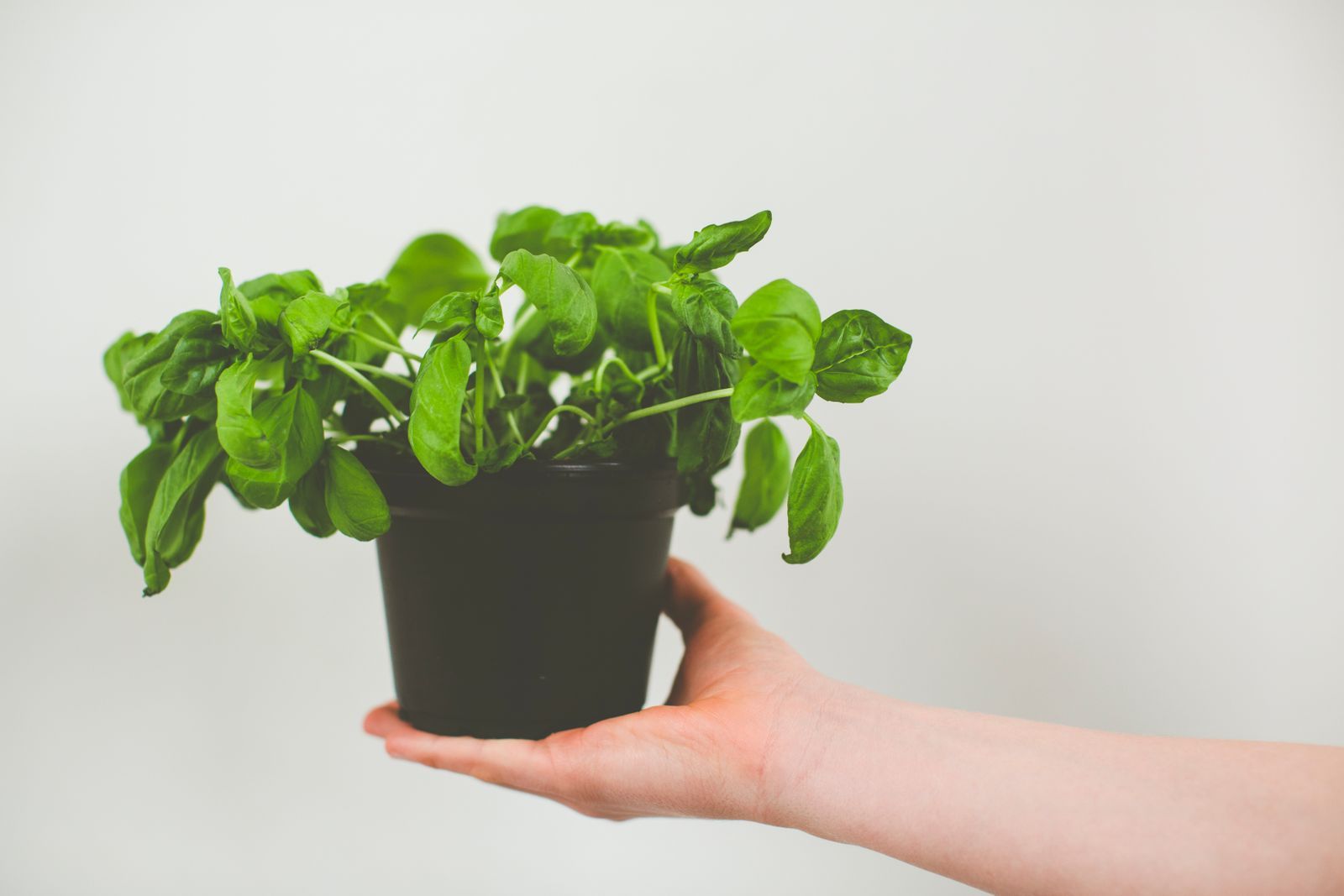
A hand holding a basil plant in a black pot, a young plant at exactly the size for its first pinch
Step 5: Harvest by the Third Rule
Harvesting basil is pinching with a bigger basket. The standing rule: never take more than a third of the plant at one picking. A plant stripped harder cannot feed its roots, stalls, and sometimes dies, while a plant picked by thirds regrows the harvest within a couple of warm weeks. For a big pesto day, pick a third from each of several plants rather than scalping one plant to the bone.
Pick in the morning when the leaves are full of water and at their most aromatic, and pick whole stem tips back to a leaf pair, not individual leaves torn from stems. Leaf tearing leaves the stem's tip intact and growing upward toward flowers; tip picking is pinching, and it keeps the plant branching. Wash basil gently and late, just before using, and never refrigerate fresh leaves if you can avoid it: cold blackens basil almost as reliably in the refrigerator as in the garden, so store stems in a glass of water on the counter like flowers.
Step 6: Water, Feed, and Watch the Flowers
Water basil at the base, keeping the leaves as dry as you reasonably can, and keep the soil evenly moist: the garden's rule of about 1 inch of water per week is the baseline, with pots wanting their usual more frequent attention. Basil wilts dramatically when dry and recovers dramatically when watered, but repeated hard wilting toughens leaves and hurries the plant toward flowering, so treat the first wilt as information and adjust.
Feed lightly. Basil grown in compost enriched soil needs little more; its leaves are the harvest, so a modest nitrogen supply supports them, but overfed basil grows lush and less aromatic, and soft growth invites disease. The pinch and the sun do more for flavor than any bottle.
Now the flowers. Basil is an annual racing to set seed, and once it flowers seriously, leaf production slows and flavor turns coarser. Every flower spike you see forming at a stem tip is the plant changing jobs. Pinch flower spikes off the moment you spot them, cutting back to the leaf pair below, and the plant returns to leaves. Late in the season, when you have pesto in the freezer and the plant is tired, you may let one plant flower for the bees, who adore it, and for seed. Until then, the rule is absolute: flowers off, leaves on.
Basil in Pots
Basil is one of the happiest container herbs, and a pot on a sunny step is many gardeners' whole basil patch. Use a pot with drainage, filled with potting mix, one plant per pot at the 12 inch logic applied to soil volume: a crowded pot of basil behaves like a crowded bed, all stems and mildew. Pots dry quickly in the heat basil loves, so check moisture daily in summer. The pinch matters even more in pots, because a pinched plant stays compact and productive in its small world instead of going tall, woody, and done by July. Bring pots in or take final harvests before the first cold nights of fall; basil will not survive to be asked twice.
Problems: Black Leaves and Fuzzy Undersides
Blackened leaves after a cold night are temperature, covered above. The other signature problem is downy mildew, which shows as yellowing leaves with a fuzzy gray purple growth on their undersides, spreading fast in warm, damp, crowded plantings. Prevention is the spacing, the base watering, and the air this guide keeps prescribing; there is no good cure once it takes hold, so remove badly infected plants to protect their neighbors and harvest hard from any plant that shows early signs. Pale, slow basil in high summer is usually hungry, thirsty, or root bound in a small pot. Diagnose in that order before reaching for products.
Varieties: Genovese and Its Cousins
The classic basil of pesto and tomato salads is Genovese type: large, glossy leaves, the flavor everyone means by basil. It is the right default for a first plant. Around it sits a family worth exploring once the pinch is second nature. Thai basil carries a distinct anise note and purple stems, thrives in heat, and is the basil of Southeast Asian cooking. Lemon basil is smaller leaved and citrus scented, wonderful with fish and in drinks. Holy basil, or tulsi, is grown as much for tea and tradition as for cooking, with a clove like warmth. Greek and other dwarf basils form neat small mounds that suit pots and edges and ask less pinching to stay tidy.
All of them obey this article's rules: warmth without exception, 12 inches of air, the pinch above a leaf pair, harvest by thirds. Choose by your kitchen, the way you chose your first garden's crops, and let one new variety a year teach you the family's range. Basil seed keeps well, so a small collection costs little and lasts seasons.
Basil Indoors on a Windowsill
Basil is the herb everyone tries on the kitchen windowsill, and the windowsill is harder than the garden in two specific ways: light and company. Most sills give fewer hours of strong light than basil wants, so indoor plants grow leggy, stretching thin stems toward the glass. Combat it by turning the pot a quarter turn every few days so all sides take a turn at the light, pinching even more faithfully than outdoors, and accepting a slower, smaller plant as the honest indoor yield. A small grow light transforms the situation entirely and is the one upgrade indoor herb growers never regret.
Company is the supermarket pot problem in reverse: a windowsill pot holds one plant happily, and the dense multi seedling pots sold for cooking should be eaten, not kept. If you want a lasting indoor plant, start one plant from seed or buy a single garden center start and pot it alone. Water from the base where you can, keep the leaves dry, and harvest by the same third rule. Indoor basil rarely matches the garden's abundance, but a modest plant by the stove in January justifies itself every time you cook.
Frequently Asked Questions
When should I plant basil outside?
About 2 weeks after your last spring frost, per North Dakota State University Extension H1139, and only when nights are staying consistently above 50 degrees Fahrenheit. Basil has no cold tolerance at all, and leaves can blacken on a night well above freezing. A plant held indoors an extra week loses nothing; a plant chilled loses weeks or dies.
How do I pinch basil correctly?
Find a stem with at least three sets of leaves, and snip the stem just above a leaf pair, the point where two leaves meet the stem and tiny side shoots wait in the joints. Removing the tip wakes those two shoots, so one stem becomes two. Repeat on each stem every week or two, always cutting above a leaf pair, never into bare stem below the lowest leaves.
How far apart should basil plants be?
Space basil 12 inches apart, the University of Maryland Extension spacing, in beds, rows, and effectively in pots, one plant per pot. A pinched basil plant becomes a small bush, and bushes need the gap for air movement, which is your main defense against downy mildew. Use the Plant Spacing Planner on this page to count plants for your space before you buy.
Why is my basil turning black?
Cold is the first suspect: basil leaves blacken after nights in the forties, and even a refrigerator can blacken picked leaves. In the garden, blackening after a chilly night means the plant went out too early or a cold snap caught it. In warm weather, black spots with yellowing and fuzzy growth underneath the leaves point instead to downy mildew, which calls for removing infected plants and improving air flow.
Can I harvest a whole basil plant at once?
Take no more than about a third of the plant at one picking. A harder stripping starves the roots of the leaves that feed them, and the plant stalls or dies instead of regrowing. For a large harvest like a pesto batch, pick a third from each of several plants. Picked by the third rule and pinched regularly, basil regrows its harvest in a couple of warm weeks.
Why does my basil keep flowering and tasting bitter?
Flowering is basil's endgame: once it sets seed, leaf production slows and flavor coarsens. Pinch off every flower spike the moment it forms, cutting back to the leaf pair below, and the plant returns to making leaves. Heat, drought stress, and age all hurry flowering, so steady watering and relentless pinching are what keep basil sweet into late summer.
Photo credits: Markus Spiske (Pexels); Matteo Badini (Pexels). Photos are served from this site; follow the credit to the library page for the original.