How to Grow Carrots in Containers: Depth Is the Whole Decision
By the Windchime Walker editorial team
Photo: Julia Filirovska / Pexels
Every carrot failure in a container is the same failure: a long variety in a short pot, hitting the bottom and forking, stunting, or curling into the shapes that fill comedy photographs. The crop itself is easy in pots, arguably easier than in heavy garden soil, because you control the mix completely. The one decision that decides it is depth, and depth is a variety decision: match the carrot class to the pot and the crop nearly grows itself. Short and round types need 8 to 10 inches of mix. Most standard varieties need 12 inches. Long types, the exhibition and deep soil carrots, need up to about 20 inches, which in practice means a deep grow bag or a tall planter rather than a standard pot. This page is built around that matrix, because it is the article the question actually needs.
Our how to grow carrots guide owns the in ground crop. This page owns the depth driven container version.
Interactive tool
Container Carrot Checklist
Check off each step as you finish it. Your progress stays on this page.
0 of 8 complete
0% done
The Variety Class by Depth Matrix
Read the packet before you fill the pot, because the packet's mature length is the pot specification. Round and short rooted types, the Parisian and Thumbelina class and the short Nantes types, mature at 3 to 5 inches of root and thrive in 8 to 10 inches of mix, which makes them the window box and shallow planter carrots. Standard Danvers and Nantes varieties mature at 6 to 8 inches and want the full 12 inch pot, with a couple of inches of mix below the root tip so the tip never feels the floor. Long Imperator types mature at 9 to 11 inches or more and need 16 to 20 inches of depth, a specification most pots cannot meet, which is why long carrots are the ones that fork in containers while the same seed grows straight in a deep bed. The rule underneath the matrix: pot depth equals mature root length plus 3 to 4 inches of working room. Buy the variety for the pot you own, not the pot for the variety you covet, unless you are prepared to buy the deep bag the long types demand.
The Mix: Loose, Sieved, and Stone Free to the Bottom
Forked carrots are usually blamed on the variety and usually caused by the mix. A carrot root tip that meets a stone, a clod, or a chunk of bark turns aside and splits, and in the ground you cannot help the stones. In a container you can, which is the container's whole advantage. Fill with a light potting mix and run your hands through it to the full depth, removing every stone, clump, and woody piece bigger than a pea. A handful of sand worked through a heavy mix loosens it further, but avoid fresh manure and rich unfinished compost, which fork roots chemically rather than physically and burn seedlings besides. Fill the pot to within an inch of the rim and settle it by watering before you sow, because mix that settles after sowing buries the seed deeper than you planted it. Depth discipline at sowing is the other half of straight roots: seed at 1/4 inch deep, no deeper, because carrot seed is small and a deep sowing in a container simply fails quietly.
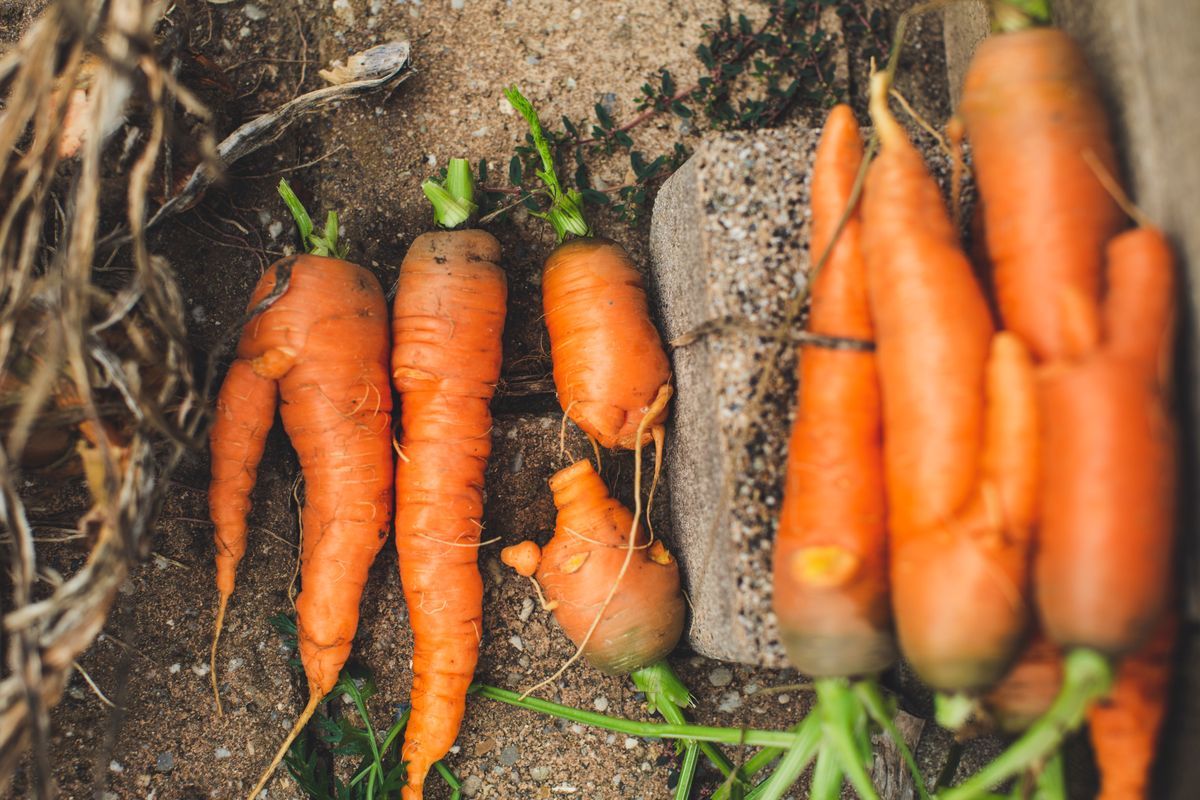
Freshly harvested carrots pulled from garden soil
Germination: Three Weeks of Never Dry
Carrot seed germinates slowly, 14 to 21 days, and it germinates at the surface of the mix, the exact layer a container dries first. More container carrots are lost in those three weeks than in the rest of the season combined. The system is moisture discipline: sow, water in gently, and then keep the top half inch of mix continuously moist until the green threads appear. The board trick, borrowed from market gardeners, is the reliable method: lay a board, a piece of burlap, or a sheet of cardboard directly over the sown surface, which holds the moisture and the warmth, and lift it every couple of days to check; the day the first seedlings show, the cover comes off for good. In hot or windy weather, water the covered pot around the edges so the surface under the board stays damp. Once the seedlings are up, the discipline relaxes to ordinary container care, deep watering when the top inch dries, but the memory of those three weeks is why experienced growers sow carrots in containers with more confidence than in the open bed, where the surface cannot be covered as completely.
Sowing Pattern and Thinning in a Pot
Rows are a field habit and a pot has no fields. Sow across the whole surface in a rough grid, scattering seed thinly and evenly, or pinch small clusters at grid points about 2 inches apart. The grid uses the container's whole area, which rows in a round pot waste at the edges. Thinning still applies, and it is still the step beginners skip: thin first to about 1 inch apart when the seedlings are a couple of inches tall, then to the final 2 to 3 inches as the roots begin to size, eating the second thinnings as the baby carrots they are. Our in ground guide runs the same 2 to 3 inch final spacing from the University of Georgia chart, and the container obeys the same geometry; a carrot needs its 2 inches of shoulder room whatever it grows in. Crowded carrots in a pot do not fight dramatically; they simply all stay thin, which reads at harvest as a pot of pencils. Feed lightly once the roots are sizing, a balanced liquid feed every couple of weeks, because a container's fertility washes through and a hungry carrot grows all top and no root.
Harvest and the Shoulder Test
Container carrots announce themselves: the orange shoulder of the root pushes up at the surface as it sizes, and its width is the harvest gauge. Most varieties are sweetest pulled at 1 to 1.5 inches across the shoulder, before the core turns woody in warm weather. Loosen the mix with a fork or a strong jet of water at the pot's edge before pulling, because a carrot that snaps at the shoulder leaves its best half in the pot. The container gives you one more harvest advantage: you can pick selectively, thinning the grid by eating, taking the largest shoulders and leaving the rest to size, so a single pot delivers over weeks instead of in one glut. When the pot is done, the mix goes to the ornamental beds or gets refreshed before it grows anything hungry again, and next season's carrots start in clean mix, because the straight root you are growing is a report on the mix, and you want the report to stay good.
Succession, Feeding, and the Winter Pot
A container of carrots is a 70 to 90 day tenancy, and the patio grower who wants a continuous supply runs the pot in succession: sow a fresh pot every 3 to 4 weeks from spring through midsummer, and the harvests follow each other instead of arriving as one glut of roots that must all be eaten in a fortnight. The later sowings carry into fall, and carrots sweeten as the nights cool, because the plant moves sugar into the root against the cold; the last pot of the year is routinely the best eating. In mild climates a fall sown pot, sheltered against a wall, holds its roots in the mix through winter as living storage, pulled as needed, which no bag of store carrots matches for flavor. Feeding across these successions stays light and steady: a half strength liquid feed every two weeks once the tops are a few inches tall, stopping a month before harvest so the roots finish on their own sugars. And the shoulders deserve one last mention as the pot's report card: green shoulders mean the roots are pushing up into the light and want a covering of mix or mulch, a five second fix that keeps the top of the root sweet instead of bitter.
Frequently Asked Questions
How deep does a container for carrots need to be?
By variety class: 8 to 10 inches of mix for short and round types, 12 inches for most standard varieties, and up to about 20 inches for long types. The working rule is mature root length plus 3 to 4 inches of room below the tip. A long variety in a short pot is the classic container carrot failure.
How deep do I sow carrot seed in a container?
One quarter inch deep, and settle the mix by watering before you sow so it does not sink the seed deeper afterward. Carrot seed is small and slow, 14 to 21 days to germinate, and deep sowing in a pot fails quietly.
How do I keep carrot seed moist until it germinates?
Cover the sown surface with a board, burlap, or cardboard, which holds moisture against the drying surface layer, and check every couple of days. Remove the cover the day seedlings appear. Keep the top half inch of mix continuously moist through the whole 14 to 21 day window.
How far apart should carrots be in a container?
Sow in a grid across the whole surface rather than rows, thin first to 1 inch, then to a final 2 to 3 inches as roots size. The final spacing matches the in ground standard; crowded container carrots all stay thin instead of sizing up.
Why are my container carrots forked?
Usually the mix, not the variety: the root tip met a stone, clod, or bark chunk and turned. Sieve the mix by hand to the full depth before filling, removing anything bigger than a pea. Fresh manure and unfinished compost also fork roots, so keep the mix clean and finished.
Photo credits: Julia Filirovska (Pexels); Markus Spiske (Pexels). Photos are served from this site; follow the credit to the library page for the original.