A healthy cucumber plant is the sprinter of the vegetable garden. Given warm soil, water, and something to climb, it will go from seed to first harvest faster than almost anything else you plant, and then produce with an enthusiasm that catches beginners off guard. The gardeners who struggle with cucumbers almost always lost the crop before it started: seed sown into cold soil, vines left to sprawl into a mildewed tangle, or fruit left hanging until the plant decided its job was done.
This guide settles those three things in order. Trellis first, warmth second, spacing third, then the simple care rhythm of a crop that mostly asks to be watered steadily and picked relentlessly. Follow it and your problem with cucumbers will be the pleasant one: more cucumbers than any household can eat, arriving daily.
The Plant Spacing Planner on this page carries cucumbers at the University of Georgia Cooperative Extension spacing of 12 inches between plants in rows 60 inches apart. If you trellis, as this guide urges, enter your trellis length as the bed length and count your plants before you sow: a short trellis of cucumbers outproduces a long sprawl of them.
Interactive tool
Plant Spacing Planner: The Cucumber Trellis
Cucumbers are in the crop list below at the University of Georgia Cooperative Extension spacing of 12 inches between plants. Enter your trellis length as the bed length to count your plants before you sow.
8 tomato plants fit this bed
4 plants per row across 2 rows, on a 24 inch grid. Extension spacing for this crop: 24 in between plants, 48 in between rows.
The grid uses the in-row spacing in both directions, the standard square foot layout for raised beds. In open ground, keep the wider row spacing in the note above so you can walk and weed between rows.
Spacing figures: University of Georgia Cooperative Extension, Circular 963, Vegetable Planting Chart, source.
Step 1: Decide to Trellis Before You Sow a Single Seed
Cucumbers are vines, and a vine given a trellis grows up instead of out. That one decision buys you four things at once. The fruit hangs clean instead of resting on wet soil where it rots and yellows. Air moves through the foliage, drying leaves faster and slowing the mildew diseases that are the cucumber's main enemy. The fruit is visible, straight, and easy to pick at the right size instead of hidden under leaves until it becomes a yellow bludgeon. And the same harvest comes from a fraction of the ground, because a trellised row uses vertical space that a sprawling patch wastes.
Build or place the trellis before sowing, not after the vines start running, because installing support among growing vines damages roots and stems. Almost anything sturdy and climbable works: a panel of wire fencing, a lattice section, netting strung between posts, or an A frame of lumber and mesh. Cucumbers climb by tendrils that grip thin supports best, so give them mesh, string, or narrow slats rather than smooth wide boards. Set the trellis on the north side of the bed if you can, so the vines do not shade their neighbors as they climb.
Ground growing is not forbidden; gardeners with space have sprawled cucumbers for centuries. But a beginner's first cucumber season goes better on a trellis, and nearly every problem in the troubleshooting section below shrinks when the vines are up in the air.
Step 2: Wait for Warm Soil
Cucumbers are tropical in temperament. Their seed rots in cold soil and their transplants sulk in cold nights, and no amount of early sowing bravery changes their biology. Wait until the soil has warmed to at least 65 to 70 degrees Fahrenheit before planting out, which in most gardens means a week or two after the last spring frost, when the weather has genuinely turned. A hand pushed into the bed should feel the season: soil that still bites with cold is not cucumber soil yet.
This patience costs nothing, because cucumbers grow so fast once conditions suit them. A sowing into warm soil germinates in days and races; a sowing into cold soil struggles for weeks and often loses to rot before it starts. Sow seed directly in the bed where the plants will grow, because cucumbers dislike root disturbance and transplant poorly compared to most vegetables. If your season is short and you start indoors, use individual pots, keep the indoor stretch brief, and transplant with the root ball undisturbed.
Choose your variety with the harvest in mind. Slicing cucumbers are the salad standard. Pickling types produce smaller, firmer fruit in quantity and are just as good eaten fresh. Burpless and seedless greenhouse types exist for tender stomachs and trellis growing. For a first season, one vigorous slicing variety on a trellis will teach you everything and feed you generously.
Step 3: Sow and Space at 12 Inches
Sow seeds in small groups along the trellis line, or plant transplants singly, at the University of Georgia spacing of 12 inches between plants, with rows 60 inches apart for ground plantings; trellised rows can stand closer to neighboring crops because the vines occupy air, not ground, but keep the 12 inches between plants along the trellis itself. Thin seedling groups to the strongest one or two plants once they are growing, and do it by snipping rather than pulling where roots are tangled.
Cucumber roots run shallow and wide, which is why the row spacing is generous and why the soil preparation that matters most is at the surface: work compost into the top layer before sowing, and mulch the bed once plants are established, keeping mulch a small distance from the stems. The shallow roots also explain the crop's thirst, which is the next step.
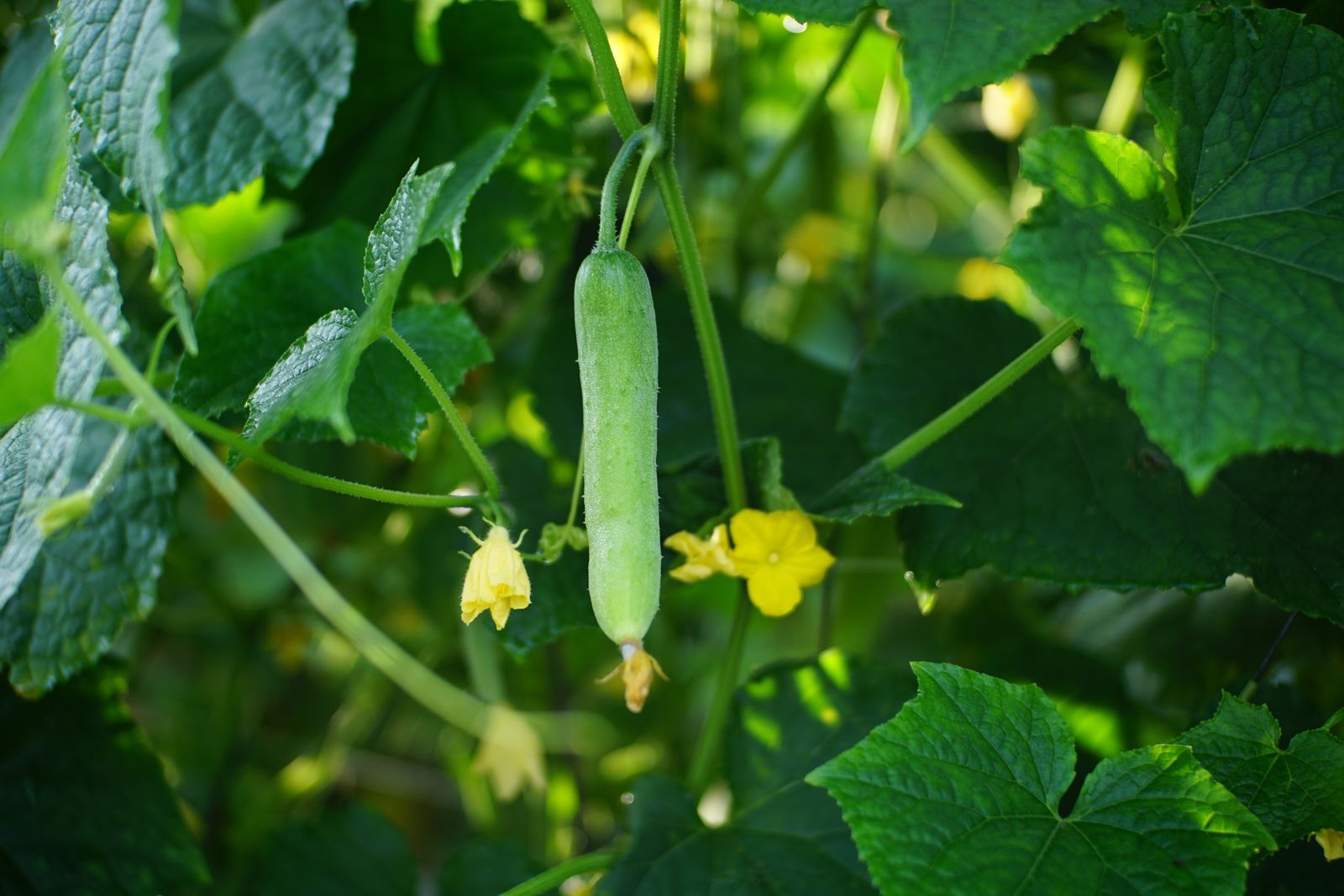
A green cucumber hanging from its vine among leaves and yellow flowers, growing clean in the air on a support
Step 4: Water Steadily, About an Inch a Week
Cucumbers are mostly water wearing a green jacket, and the plant cannot build them from dry soil. Follow the garden's standing rule of about 1 inch of water per week from rain and watering combined, and lean generous in hot weather, in sandy soil, and once fruit is sizing, when the plant's demand peaks. Water at the base, soaking the root zone, and keep the foliage as dry as you can: wet leaves in a dense vine are mildew's favorite address.
Evenness matters. Soil that swings between dry and soaked produces bitter, misshapen fruit and stresses the plant into dropping its young cucumbers. Mulch is the tool that evens the swings, and a finger pushed into the soil near the plant is the gauge: dry a couple of inches down means water today, deeply. In a heat wave, a trellised plant in full fruit may want water more often than the weekly rule suggests, and wilting in the afternoon that recovers by morning is the plant asking. Answer it.
Step 5: Feed the Vine, Train the Vine
Cucumbers are hungry as well as thirsty, which is the natural consequence of growing that fast. The compost worked in before sowing carries the early weeks. Once vines start running and flowering, a balanced feed by label directions, or side dressings of compost along the row, keeps production coming. Do not overdo nitrogen: a cucumber fed like a lawn becomes a magnificent vine with leaves the size of dinner plates and very little fruit.
Guide the vines onto the trellis as they grow, tucking and tying loosely where tendrils have not yet gripped. Five minutes of guidance a week keeps the vine in its airspace and off its neighbors. Once the tendrils take hold, the plant climbs on its own and your job shrinks to watching for fruit.
Step 6: Understand Flowers and Pollination
A cucumber plant makes two kinds of flowers: male flowers, which appear first and in greater number, on thin stems, and female flowers, which carry a tiny cucumber behind the petals and become fruit after pollination by bees and other insects. Beginners panic twice here, once when the first flush of flowers makes no fruit, because those are males announcing the plant is mature, and once when small fruit yellows and drops, which usually means it was never pollinated.
Support pollination by keeping insecticides off the vines entirely, especially during bloom, and by letting the plant flower in peace. Most modern varieties are bred to set fruit heavily and many are largely self fertile in effect, but bees remain the workforce. A garden with flowers nearby for the bees is a garden whose cucumbers set.
Step 7: Pick Small, Pick Often
This is the harvest rule that decides your season: pick cucumbers smaller than you think and more often than you planned. A slicing cucumber is at its best young, firm, and fully green, before the seeds inside swell. Check the vines every day or two in season, because a cucumber at perfect size on Tuesday is oversized by Friday.
The reason is the plant's accounting. A cucumber vine's purpose is to ripen seed, and a fruit left to mature on the vine tells the plant its purpose is accomplished, at which point production slows and stops. Picking fruit young and relentlessly keeps the plant in producing mode. The yellow, swollen cucumber found hiding under a leaf is not a bonus; it is a signal flare that the plant is winding down, so remove it the moment you find it, edible or not, to restart the vine's ambition. In peak season, picking is a daily pleasure, and the harvest will still outrun your kitchen. That is the cucumber succeeding, not failing.
Problems: Mildew, Bitterness, and Beetles
Powdery mildew, a white dusting on leaves late in the season, and its wetter cousin downy mildew are the cucumber's chronic diseases. Trellising, spacing, watering at the base, and morning watering all slow them; few home gardeners escape some mildew by season's end, and a plant that has produced for weeks before mildew arrives has done its job. Remove badly infected leaves and keep picking.
Bitter cucumbers come from stress, most often uneven watering and heat, concentrated in the skin and stem end. Steady moisture prevents most of it; peeling and cutting away the stem end rescues a mildly bitter fruit. Cucumber beetles, small striped or spotted beetles that chew leaves and spread disease, are best handled by vigilance: handpick them, keep the bed clean of debris, and protect young seedlings, which they can kill outright, with a light cover until flowering, removing it so bees can work.
Cucumbers in Containers
A trellised cucumber is one of the best container crops there is, because the vine climbs out of its own footprint and a patio can hold a surprising harvest. Choose a large pot, the largest you can water faithfully, fill it with potting mix and never garden soil, and give the vine a trellis, a railing, or a tomato cage to climb from the day it sprouts. Bush varieties bred for containers exist and produce well in pots without a trellis, at some cost in total yield.
Container cucumbers live or die by water discipline. A pot's small soil volume dries fast in the heat that cucumbers love, so expect to water daily in summer, sometimes twice in a heat wave, checking with a finger rather than a schedule. Feed container plants more regularly than bed plants too, since every watering washes a little nutrition out of the pot. Get those two habits right and a single potted vine will keep a household in salad cucumbers.
A Cucumber Season, Start to Finish
Watch how the pieces fit across one season. A week or two after your last frost, with the soil warmed to the 65 to 70 degree range, you sow seed along a trellis that is already standing, in a bed whose top layer holds compost. Germination takes days in that warmth. The vines reach, grip, and climb through their first month while you guide tendrils and keep the soil evenly moist.
Flowering begins with male blossoms, then females, then the first pickable fruit, often within about two months of sowing for many varieties, your packet's days to maturity being the honest estimate for yours. From then on the season is a rhythm of watering and picking every day or two. Late in the season, mildew usually arrives on older leaves; you prune the worst, keep picking, and let the plant finish its work. When the vines decline, pull them, compost the healthy remains, and note the variety and the dates in your journal. A second, late sowing in midsummer is possible in long season gardens and extends fresh cucumbers toward fall, timed so the plants mature before cold nights return.
When the Harvest Outruns the Kitchen
It will. Cucumber gluts are a rite of passage, and they are a storage problem with happy solutions. Fresh cucumbers keep only a short while in the refrigerator, so the glut wants processing or sharing. Pickling types were bred for the jar, and even slicing cucumbers make fine quick refrigerator pickles. Cucumber water, salads with the fruit sliced into vinegar and onion, and the simple gift bag left with a neighbor all move the harvest honorably.
Next year, let the glut calibrate you. One or two trellised plants supply most households; the planner on this page will show you how few plants your trellis actually needs at 12 inch spacing. Plant for your kitchen, not for your ambitions, and succession sow a second small batch later rather than one overwhelming first one. The goal is cucumbers at the table every day, not a wheelbarrow of them one weekend in August.
Frequently Asked Questions
Should I grow cucumbers on a trellis or on the ground?
On a trellis, especially as a beginner. Trellised fruit hangs clean instead of rotting on wet soil, air moving through the vines slows mildew, the fruit is easy to see and pick at the right size, and the harvest comes from far less ground. Install the trellis before sowing, and give the vines mesh, netting, or string to grip, because cucumber tendrils hold thin supports best.
When should I plant cucumbers?
After the last spring frost, when the soil has warmed to at least 65 to 70 degrees Fahrenheit. Cucumber seed rots in cold soil and transplants stall in cold nights, while seed sown into warm soil germinates in days and grows fast enough to make up for the wait. Sow directly in the bed where the plants will grow, since cucumbers resent root disturbance.
How far apart do cucumbers go?
Space plants 12 inches apart along the row or trellis, the University of Georgia Cooperative Extension figure, with about 60 inches between rows for ground plantings. The wide row spacing is for the vines' shallow, spreading roots and for air. Use the Plant Spacing Planner on this page, entering your trellis length, to count plants before you sow.
Why are my cucumbers bitter?
Bitterness concentrates in the skin and stem end and is driven by stress, most often uneven watering and hot weather. Keep soil moisture steady with deep watering at the base and mulch, about 1 inch of water per week and more in heat. For a bitter fruit already picked, peel it and cut away the stem end generously; the rest is usually fine.
Why do my cucumber flowers fall off or the tiny fruit turn yellow?
The first flowers on a cucumber plant are male and never make fruit; female flowers, recognizable by the tiny cucumber behind the petals, come after. A young fruit that yellows and drops was usually not pollinated. Keep insecticides off the vines during bloom so bees can work, and be patient: once female flowers and pollinators align, fruit set takes off quickly.
Can I grow cucumbers in a small garden?
Yes, and trellising is what makes it possible. A single short trellis, even the side of a fence or a railing, holds two or three plants at 12 inch spacing and produces a full household supply from a strip of ground a sprawling patch would need a whole bed to match. In the smallest spaces, grow one plant in a large pot with a cage or trellis and water it faithfully. Cucumbers reward vertical thinking more than any other common vegetable.
Why are my cucumber leaves wilting in the afternoon?
Check the soil before worrying. Cucumbers commonly wilt in hot afternoon sun even in adequate moisture, a temporary response that recovers by evening as the plant's water transport catches up. If the wilt is gone by morning, the plant is coping. If the soil a couple of inches down is dry, or the plant is still wilted at dawn, water deeply at the base that morning and add mulch; persistent dawn wilting in wet soil is a different problem, usually root or stem damage, and a plant declining that way rarely recovers.
How often should I pick cucumbers?
Every day or two in season, and pick them smaller than you think. A fruit left to swell and yellow on the vine signals the plant to stop producing, while relentless picking of young, firm, fully green fruit keeps the vine in production mode for weeks. Check under leaves carefully; the hidden oversized cucumber is the classic beginner find, and it should come off the moment you spot it.
Photo credits: Agung Sutrisno (Pexels); Czapp Árpád (Pexels). Photos are served from this site; follow the credit to the library page for the original.