Onions have a reputation as an easy crop, and they are, once you make the one decision that determines whether you harvest bulbs or a season of elegant green scallions. That decision is day length. An onion plant grows leaves in cool weather and starts forming a bulb only when the days reach a certain length, and varieties are bred to trigger at different lengths. Plant a variety bred for the wrong latitude and the trigger fires too early, making a marble, or never properly fires at all. Everything else in onion growing is ordinary garden care. This one choice is the crop.
Here is the rule, stated before any planting step, because it decides what you buy. Short day onions begin bulbing at 10 to 12 hours of daylight and suit the southern states, roughly the lower third of the country, where they are planted in fall or late winter. Long day onions need 14 to 16 hours and suit the northern states, planted in spring, where summer days are long enough to trigger them. Intermediate day types trigger between the two and cover the middle band of the country. Match the type to your latitude using the seed supplier's map, and the crop becomes as easy as its reputation.
The Plant Spacing Planner on this page is set to the University of Georgia standard in our data, onions about 3 to 4 inches apart. Utah State Extension's figures agree closely, planting seed, sets, and transplants 3 to 4 inches apart in rows 8 to 16 inches apart, so this is one crop where the sources shake hands.
Interactive tool
Plant Spacing Planner: The Onion Bed
Onions are in the crop list below at the University of Georgia Cooperative Extension spacing of 3 to 4 inches between plants. Enter your bed size to see how many sets or transplants a bed actually takes.
8 tomato plants fit this bed
4 plants per row across 2 rows, on a 24 inch grid. Extension spacing for this crop: 24 in between plants, 48 in between rows.
The grid uses the in-row spacing in both directions, the standard square foot layout for raised beds. In open ground, keep the wider row spacing in the note above so you can walk and weed between rows.
Spacing figures: University of Georgia Cooperative Extension, Circular 963, Vegetable Planting Chart, source.
Step 1: Choose Your Start: Seed, Sets, or Transplants
Onions offer three ways in, and each has an honest case. Seed is the cheapest and offers every variety, including the exact day length type your latitude demands, but it starts earliest: sow indoors 8 to 12 weeks before your last frost. Our data from North Dakota State University Extension publication H1139 uses 10 weeks before last frost for sowing indoors and sets plants out 2 weeks before it. Seedlings look like grass and grow slowly; patience is the price of choice.
Sets are small, dormant onion bulbs grown the previous season, sold in mesh bags in spring. They are the easiest start, planted directly in the garden, and the least choice: the varieties are generic, the day length type is sometimes unlabeled, which is a real risk given the rule above, and sets are somewhat prone to bolting, sending up a flower stalk instead of bulbing, because the bulb has already lived a year. Transplants, bundles of young onion plants sold by mail and in garden centers, split the difference: real named varieties with known day length types, no indoor season required, and strong results. For a first crop with the day length decision made deliberately, transplants are the beginner's best buy.
Step 2: Plant Shallow, at the Right Week
Onions go out early. Transplants and sets can be planted 2 to 4 weeks before the last frost in most regions, since onion tops tolerate frost and the crop wants the longest cool growing season it can get; the NDSU schedule in our data sets plants out 2 weeks before the last frost. Plant in full sun, in loose, well drained soil rich in organic matter; onions resent heavy, wet ground.
Depth and spacing decide the bulb size as much as variety does. Set transplants and sets about 1 inch deep, just covering the base, spaced 3 to 4 inches apart for full sized bulbs, closer if you plan to thin and eat the thinnings as green onions. Seed goes a quarter to a half inch deep per Utah State Extension, in rows or bands, and is thinned to the same 3 to 4 inches once the seedlings stand up. Crowded onions stay small, because a bulb is a set of leaf bases that needs room to swell, and every plant you thin out is a scallion for the kitchen, so the spacing work pays you as you do it.
Step 3: Weed Like You Mean It, Water Steadily
Onions are the worst competitors in the vegetable garden. Their roots are shallow and sparse, their leaves are thin and cast almost no shade, and weeds take their light, water, and food without a fight. The weed free rule is not tidiness; it is the crop. Mulch after planting with a clean straw or shredded leaves to suppress weeds and hold moisture, pull the weeds that appear while they are small, and cultivate shallowly if at all, because a hoe swung deep severs the onion roots that live in the top few inches.
Water follows the same shallow logic. Onions want consistent moisture in the top layer of soil, roughly 1 inch a week, and they want it steadily: dry spells stunt the bulb, and the plant cannot catch up later, because each leaf it grows becomes one ring of the bulb. A stunted early season is written permanently into the harvest. Stop watering when the tops begin to fall at maturity, since wet soil at the end invites rot in the neck.
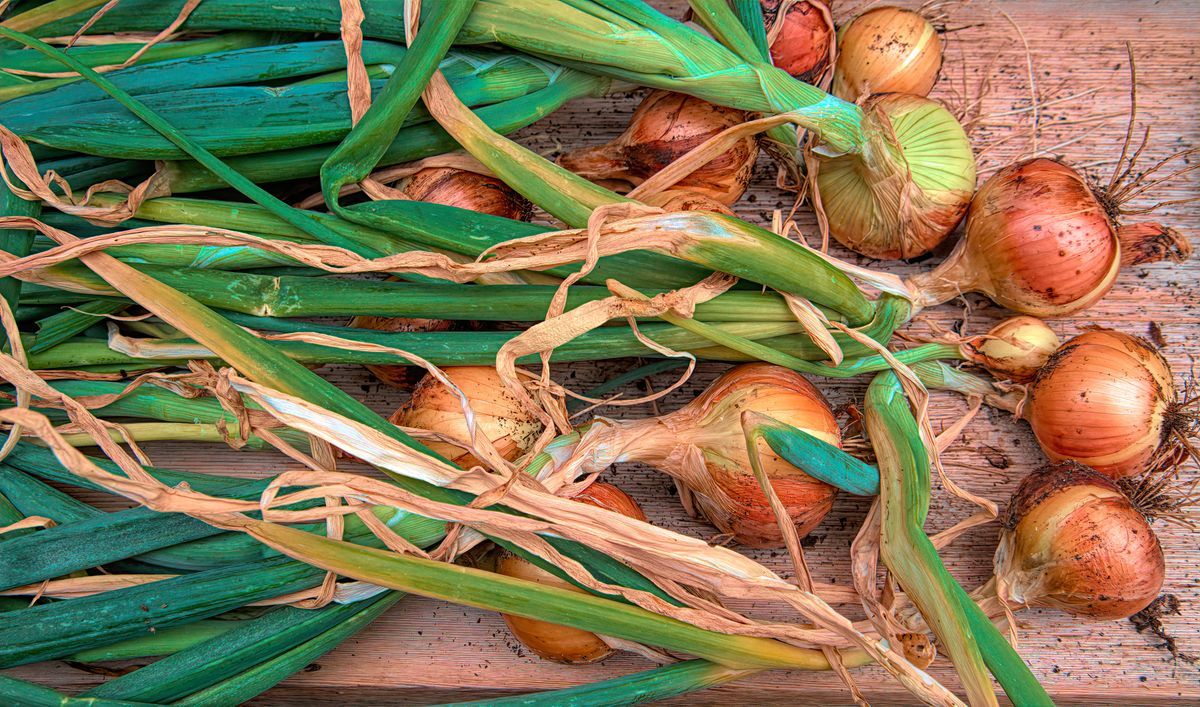
Freshly harvested onions with green stems on a wooden surface
Step 4: Read the Tops, Harvest, and Cure
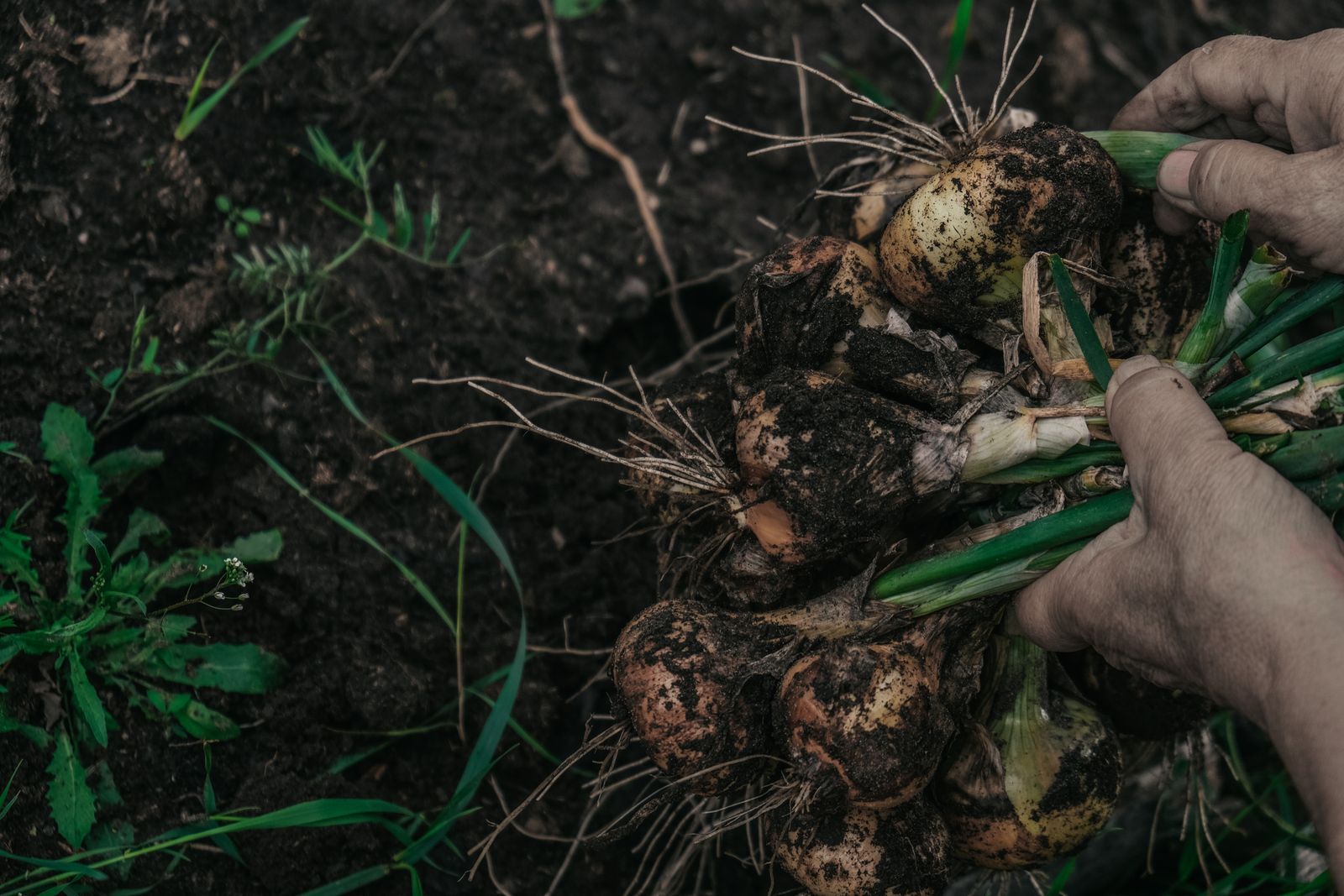
The harvest signal is unmistakable once you know it: the tops fall over. When the necks soften and the foliage flops to the ground, the bulb has finished growing. In a well matched planting, most of the row falls within a week or two. Leave the bulbs in the ground for a few days after the fall if the weather is dry, then lift them gently with a fork on a dry morning.
Curing is what turns an onion into a storage onion. Spread the lifted bulbs, tops attached, in a single layer somewhere warm, dry, and shaded with moving air, a porch, a garage, a screen under a tree, for two to three weeks, until the necks are tight and dry and the outer skins rustle. Then trim the tops to about an inch, brush off loose soil, and store the sound bulbs in a cool, dry, airy place in mesh bags or open crates. Sweet, short day types store for a month or two; pungent long day storage types, cured well, keep for many months. Eat any bulb with a soft neck or a cut first, and never store a damaged one with the keepers, because rot is contagious in a quiet way.
Troubleshooting the Three Usual Failures
Small bulbs, the commonest complaint, trace back to the big three: the wrong day length type for the latitude, crowding, or a dry and weedy early season. The diagnosis order matters, because the first cause is decided at purchase and cannot be fixed in the garden. Bolting, a thick flower stalk through the center, follows sets that experienced cold snaps or oversized sets; bolted bulbs do not store, so eat them first and favor transplants next year. Thick necks that refuse to cure come from too much nitrogen late in the season or watering past the tops falling; they are kitchen onions, not storage onions. Notice that every one of these failures is decided by a choice this article put in your hands: type, spacing, water, and the discipline to stop. Onions are easy. They are just easy in advance.
The Latitude Rule in Plain Words
The day length rule confuses beginners because seed catalogs print it as zones and jargon, so here it is as geography. The farther north you garden, the longer your summer days are; the farther south, the shorter. An onion variety is bred to start bulbing when days reach its trigger length, and it needs enough growing time after the trigger to size the bulb before the season ends. A long day variety in a southern garden waits for a 14 to 16 hour day that barely arrives, and by the time bulbing starts, the heat has finished the plant, so the harvest is a handful of scallions with ambitions. A short day variety in a northern garden triggers at 10 to 12 hours, in early spring, when the plant is still small, and bulbs a marble sized onion with great determination. Neither plant failed. The match failed, in a seed order placed in January.
The practical method is to buy from a supplier who sorts varieties by region and to trust the sort over the photograph. National seed companies print day length maps and label every variety with its type; regional suppliers go further and simply stock what works where you live. If a variety's description does not state its day length type anywhere, treat that silence as information: it is usually a generic set or an unlabeled transplant, and for a crop whose whole success is this one decision, an unlabeled onion is a lottery ticket. Gardeners in the middle band of the country have the widest choice, since intermediate day types were bred for them and both neighbors' types sometimes succeed in forgiving years, but even there, the intermediate is the reliable pick and the others are experiments.
Onions in Small Spaces and Between Other Crops
Onions are the vegetable garden's best citizens in tight quarters, because their footprint is a few inches, their leaves are vertical and cast almost no shade, and their shallow roots occupy a layer many deeper rooted crops ignore. They tuck along the edges of raised beds, between rows of slower crops, and in the corners other plants cannot use, and a gardener with one small bed can grow a meaningful supply in the margins alone. In containers, a wide, shallow pot suits them, since the roots never ask for depth, and a window box of onions at close spacing, thinned and eaten as green onions all season, is a legitimate crop strategy rather than a compromise.
They also interplant honestly. Onions beside carrots are the classic pairing of garden folklore, each said to confuse the other's pests, and whatever the folklore's truth, the spacing logic is sound: the two crops occupy different depths and different silhouettes and neither shades the other. Onions beside lettuce and other quick greens work the same way, with the greens harvested out just as the onions need the room to swell. The one pairing to avoid is onions with peas and beans, which garden tradition and many growers' experience agree grow worse together; give the legumes their own row. A crop this undemanding about space, started right on day length and kept weeded, is how small gardens produce a stored harvest that lasts into winter, and there are not many crops of which that can be said.
Frequently Asked Questions
What is the difference between short day and long day onions?
It is the daylight length that triggers bulbing. Short day varieties start forming bulbs at 10 to 12 hours of daylight and suit southern gardens. Long day varieties need 14 to 16 hours and suit northern gardens, where summer days are long. Intermediate types fall between and cover the middle of the country. Match the type to your latitude or the bulbs stay small.
When should I plant onions?
Early. Sow seed indoors 8 to 12 weeks before your last frost; North Dakota State University Extension H1139 uses 10 weeks before, with plants set out 2 weeks before the last frost. Sets and transplants go directly in the garden 2 to 4 weeks before the last frost in most regions, because onions tolerate frost and want a long, cool growing season.
How far apart should onions be planted?
Space plants 3 to 4 inches apart for full sized bulbs, in rows 8 to 16 inches apart, per Utah State Extension, matching the University of Georgia standard in the spacing planner on this page. Plant sets and transplants about 1 inch deep, and seed a quarter to a half inch deep. Thin crowded seedlings and eat the thinnings as green onions.
Should beginners grow onions from seed, sets, or transplants?
Transplants are the best first choice: named varieties with known day length types, no indoor seed starting, and reliable results. Seed is cheapest and offers the most varieties but needs an early indoor start. Sets are easiest to plant but offer the least variety choice, sometimes hide their day length type, and bolt more readily.
How do I know when onions are ready to harvest?
When the tops fall over. The necks soften, the foliage flops, and the bulb has finished growing. Lift the bulbs a few days later in dry weather, then cure them in a warm, dry, shaded, airy place for two to three weeks until the necks are tight and the skins rustle before storing.
Why did my onions stay small?
Check three causes in order: the wrong day length type for your latitude, which is decided at purchase; crowding, since onions need their 3 to 4 inches to swell; and a weedy or dry early season, because onions compete poorly and each leaf becomes a ring of the bulb. Fix the type first next season; it is the cause no garden care can overcome.
Photo credits: Alexandra Kollstrem (Pexels); Townsend Walton (Pexels). Photos are served from this site; follow the credit to the library page for the original.