A sunflower is the garden's exclamation point: a plant that starts as a seed the size of a fingernail and ends taller than the gardener, with a flower you can see from the end of the street. Children understand sunflowers instantly, and so do beginners, because the plant is fundamentally easy. It wants sun, obviously, warmth, room, and one decision made correctly at the very beginning: choosing a type whose mature height fits the place you have.
Everything else in this guide is support work for that decision: sowing after frost about an inch deep, thinning honestly to the spacing on the packet, staking before the plant is tall enough to fall, and guarding your seed at both ends of the season, from birds when you sow it and from birds and squirrels again when you harvest it. Run the Sunflower Season Checklist on this page as you go; it sequences the season from packet shopping to seed harvest so nothing arrives as a surprise.
Interactive tool
Sunflower Season Checklist
Check off each step as you finish it. Your progress stays on this page.
0 of 6 complete
0% done
Step 1: Choose by Mature Height First
Sunflowers are sold as one plant and grown as several very different ones. Dwarf types top out at knee to waist height and belong in pots, edges, and small gardens. Mid sized branching types make a bush of many smaller flowers over a long season and suit borders and cutting. The classic single stem giants grow taller than a person, sometimes far taller, with one enormous head, and they belong against a fence, a wall, or the north side of a bed where they will not shade everything else.
The packet prints the mature height for the variety in your hand, and that number is the first thing to read, before the photograph. Plan the spot from it: giants at the back or the north edge, dwarfs at the front or in containers, branching types where a summer hedge of flowers is welcome. Also read the days to bloom, because a giant sown late in a short season garden may meet frost before it flowers. Height first, then everything else, is the sunflower rule, and gardeners who learn it in year one never have the classic accident of a twelve foot plant in a four foot bed shading the tomatoes into surrender.
Consider also what the flowers are for. Branching and pollenless varieties are bred for cutting, holding well in a vase and dropping no pollen on the table. Seed varieties are bred for large, well filled heads for birds and kitchens. The classic giants are grown for the sheer spectacle, and spectacle is a legitimate purpose in a garden.
Step 2: Sow After Frost, About an Inch Deep
Sunflowers are warm season plants with no frost tolerance, and they grow so fast that there is no prize for early sowing. Sow after your last spring frost, when the soil has warmed to at least 60 degrees Fahrenheit. In cold soil the seed sits and risks rotting; in warm soil it germinates in about a week and never looks back.
Sow directly where the plants will grow. Sunflowers drive a taproot early and resent transplanting, so the garden bed, not the windowsill, is their nursery. Plant the seed about 1 inch deep, firm the soil over it, and water the spot well. Sow a couple of seeds per station where you want one plant, because germination is good but birds, slugs, and chance take their share, and thinning a spare seedling is easier than filling a gap. Mark the stations: a row of sunflower seeds is invisible for its first week, and the hoe does not know where you sowed.
Step 3: Thin to the Packet Spacing
When seedlings are up and growing, thin each station to the single strongest plant, snipping the spares at soil level rather than pulling them, so the keeper's young taproot is never disturbed. Then check your spacing against the packet: sunflower spacing varies widely by type, dwarfs close, giants wide, and the packet's figure is written for the plant you are actually growing. Crowded sunflowers grow thin, tall, and weak stemmed, racing each other for light and falling over in the first storm. Properly spaced plants grow thick stemmed and self supporting for most of their height.
This is also the moment to think about succession. A single sowing of branching types flowers for weeks, but a second sowing a few weeks after the first extends the display and the seed harvest across the season. In long season gardens, two or three sowings turn sunflowers from an event into a season long feature.
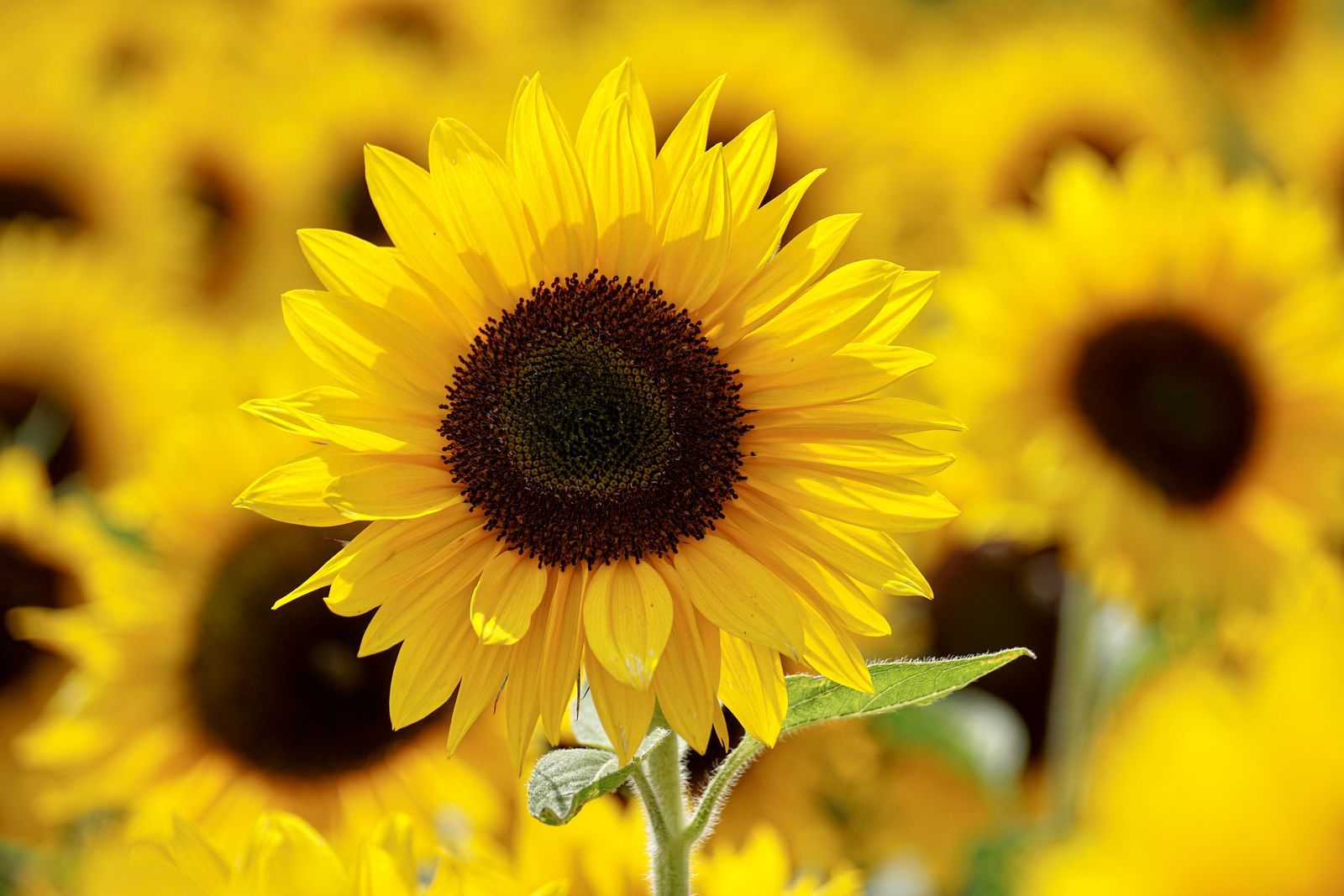
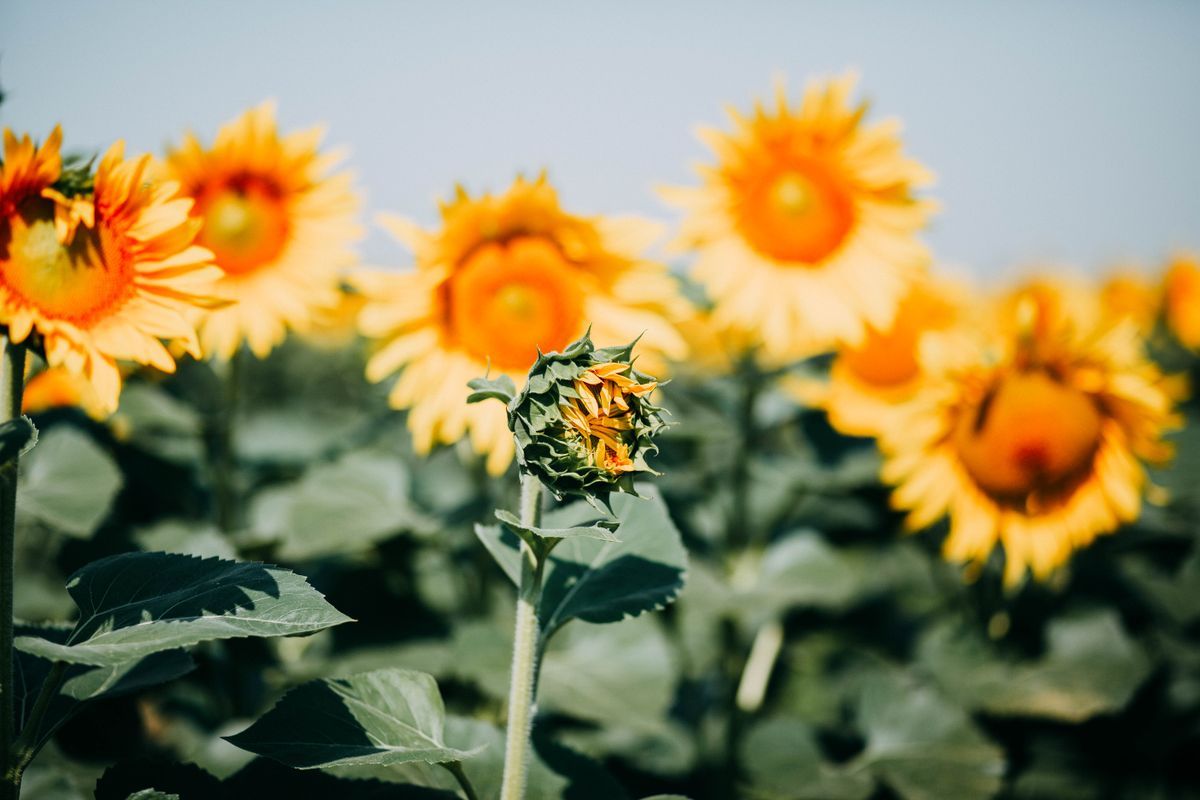
Bright yellow sunflowers in a summer field, spaced so each plant grew thick stemmed and strong
Step 4: Water Deeply, Feed Lightly
A sunflower's roots go deep and wide, which makes the established plant surprisingly drought tolerant, but the young plant is neither. Keep seedlings and young plants evenly watered until they are established and growing strongly, following the garden's rule of about 1 inch of water per week, delivered deeply at the base. Once a plant is chest high with its root system down, it asks much less often, though a deep watering in a long drought keeps flower size and seed fill at their best.
Feed lightly or not at all. Sunflowers evolved in lean soils and grow perfectly well in ordinary garden ground with compost worked in. Heavy feeding, especially with nitrogen, produces soft, sappy growth that invites the plant to fall and delays flowering. The sunflower's vigor is its own; your job is water early, room always, and support next.
Step 5: Stake Before They Need It
A giant sunflower in full head is a sail in a storm, and the time to stake it is while it is still shorter than you, not after the first fallen plant teaches you. Push a stout stake or post into the ground beside each tall plant early, deep enough to hold real weight, and tie the stem loosely to it with soft material as the plant grows, adding ties up the stem through the season. Loose matters: the stem thickens enormously, and a tight tie becomes a garrote.
Dwarfs and most branching types in a sheltered spot may never need support, which is one of their quiet virtues. In exposed, windy sites, even mid sized plants appreciate one stake. Judge by your wind, not by optimism. A sunflower that falls at the root in August rarely stands again with its head intact, and prevention costs one stake and five minutes in June.
Step 6: Guard the Seed at Both Ends of the Season
Birds have read this guide too, and they attend both ends of it. At sowing, birds and rodents dig up freshly planted sunflower seeds with unnerving accuracy. Cover the sown row or stations with netting, a light fabric cover, or even an upturned berry basket over each station until the seedlings are up and growing; a seedling with real leaves is of no interest to them. At harvest, the same birds, plus squirrels, take ripe seed directly from the head, which is either theft or the entire point, depending on your purpose.
Decide your purpose before the heads ripen. For seed you intend to eat or save, cover maturing heads with a paper bag or fine net tied around the head once the petals fall, which lets air move while excluding beaks. For birds, plant extra and share on purpose: a head left standing is a bird feeder that fills itself, and watching goldfinches work a sunflower head is one of the garden's best shows. Squirrels are the honest thieves of the system; the bag is your only real defense, and even that is a negotiation.
Step 7: Harvest the Heads
A sunflower head is ready when the back of it turns from green to yellow and then brown, the petals have fallen, and the seeds are plump and showing their striped or solid colors firmly. Rub a few seeds from the face: ripe seeds release easily and feel full rather than papery. Cut the head with a length of stem attached, before the birds finish the audit described above if the seeds are yours.
Dry heads in a warm, airy place protected from mice, then rub the seeds free over a tray or bucket with your hands or a stiff brush. Seeds for the kitchen can be eaten raw or roasted; seeds for next year's garden should be the largest and fullest, stored dry and cool in a labeled envelope. Seeds for the birds can simply stay in the dried heads, hung or mounted where you can watch the customers. One giant head, well filled, holds a startling amount of seed, which closes the season's circle: a fingernail sized seed in May, a dinner plate of seeds in September, and next year's row already in your hand.
Sunflowers for Cutting, and for Kids
For cut flowers, choose branching or pollenless varieties, cut stems in the morning just as the flowers open, and put them straight into deep water; vase life rewards the early cut. A row of branching sunflowers along a fence is the easiest cutting garden a beginner can grow, producing armfuls while the show in the border continues.
For children, sunflowers are the perfect first crop: seed big enough for small fingers to plant precisely, growth fast enough to measure weekly against a mark on the fence, and a flower that follows the sun when young, which never fails to astonish. A circle or a horseshoe of giants, sown with a gap for a door, grows into a sunflower house by midsummer, a room with flower windows that a child designed by planting. Mark heights on the door frame of the real house as the plants pass them. Few garden lessons survive childhood intact; that one does.
Troubleshooting: Leaners, Blank Heads, and Vanishing Seedlings
Seedlings that vanish overnight were usually eaten, by slugs at the stem base or by birds and rodents at the seed; the covers in Step 6 and a slug round at dusk solve most of it, and sowing a few spare stations covers the rest. Plants that lean without falling are reaching for light around an obstruction or growing in soil too loose to anchor them; firm the soil at the base, add the stake you were postponing, and accept a slight lean as cosmetic. Plants that grow tall and leafy but flower late were probably fed too richly or sown into a spot that lost sun as the season's shadows moved; note the spot's true sun for next year rather than feeding more.
A head with many empty, papery seeds was under pollinated or stressed while filling, most often by drought at flowering time; deep watering during bloom is the prevention. A head that molds in wet weather was harvested too late or dried too slowly; cut earlier once the back yellows and dry heads where air moves freely. And the classic mystery, a whole head emptied in a single day, is squirrels, who are thorough, quick, and entirely unmoved by scarecrows. Bag the heads you care about. The rest of the sunflower's problems are remarkably few for a plant that size, which is why it keeps its place as the beginner's monument: most of what it asks is decided in the first ten minutes with the packet in your hand.
Frequently Asked Questions
When should I plant sunflowers?
Sow after your last spring frost, when the soil has warmed to at least 60 degrees Fahrenheit. Sunflowers have no frost tolerance and grow so fast that early sowing gains nothing; seed in cold soil risks rotting, while seed in warm soil germinates in about a week. Sow directly in the bed where they will grow, about 1 inch deep, because sunflowers drive a taproot early and resent transplanting.
How far apart do sunflowers need to be?
Follow the spacing printed on your packet, because it varies widely by type: dwarf varieties grow close together, while the giant single stem types need wide spacing to develop thick, storm worthy stems. Crowded sunflowers grow thin and weak and fall in the first storm. Thin each station to the single strongest seedling, snipping spares at soil level so the keeper's taproot is never disturbed.
Do sunflowers need staking?
Tall and giant types do, in most gardens. Stake early, while the plant is still shorter than you, with a stout post set deep, and tie the stem loosely with soft material at intervals as it grows, leaving room for the stem to thicken. Dwarf and branching types in sheltered spots often stand alone, but in windy sites even mid sized plants appreciate one stake. A sunflower that falls in August rarely recovers its head.
How do I keep birds from eating my sunflower seeds?
At both ends of the season. Cover freshly sown stations with netting, fabric, or an upturned basket until seedlings are up and leafy. For ripening heads you want for yourself, tie a paper bag or fine net over the head once the petals fall. Or plant extra and share deliberately: a head left standing is a self filling bird feeder, and only the squirrels are truly non negotiable, against which the bag is the defense.
When are sunflower seeds ready to harvest?
When the back of the head has turned yellow and then brown, the petals have fallen, and the seeds are plump, firmly colored, and release easily when rubbed. Cut the head with a piece of stem, dry it somewhere warm, airy, and mouse proof, then rub the seeds free. For saving seed, keep the largest and fullest, stored dry and cool in a labeled envelope.
Can I grow sunflowers in pots?
Yes, with the dwarf varieties bred for containers. Choose a large, deep pot, fill it with potting mix, sow directly in it after frost, and keep it watered, since pots dry faster than beds and a sunflower is a thirsty young plant. Place the pot where it gets full sun and some shelter from wind, and even a dwarf benefits from a small stake in an exposed spot. Giants do not belong in pots; their roots and height both say so.
Photo credits: Susanne Jutzeler, suju-foto (Pexels); Natalie Bond (Pexels). Photos are served from this site; follow the credit to the library page for the original.