Zucchini has a reputation problem, and it is the opposite of most vegetables: it produces too well. Every gardener knows the joke about leaving zucchini on neighbors' porches in the night, and every beginner plants six seedlings anyway, because the plants look so small in April. By August those six plants are a hedge, the fruit are the size of bowling pins, and the gardener is grating zucchini into foods where zucchini has no business being. This guide is about growing zucchini well, which mostly means growing the right number of plants, in the right amount of room, and picking them at the size where they are food rather than furniture.
The plant itself could not be easier. Zucchini is a warm season squash that grows fast, forgives mediocre soil if fed, and begins producing roughly 45 to 65 days after sowing, then does not stop until frost or mildew slows it. It asks for three things: warm soil to start, real space to spread, and a gardener who picks it young. Give it those and one plant will keep a household in zucchini. Give it a crowd and neglect, and it will still produce, which is why the jokes exist.
The Plant Spacing Planner on this page carries zucchini at the University of Georgia Circular 963 spacing of 24 inches between plants and 36 inches between rows. Enter your bed and look honestly at the count it returns. For most households the correct number is one or two, and the planner will show you exactly how much of your bed even that many will claim.
Interactive tool
Plant Spacing Planner: Room for Zucchini
Zucchini is in the crop list below at the University of Georgia Cooperative Extension spacing of 24 inches between plants. Enter your bed size and see how few plants you actually need: for most households the answer is one or two.
8 tomato plants fit this bed
4 plants per row across 2 rows, on a 24 inch grid. Extension spacing for this crop: 24 in between plants, 48 in between rows.
The grid uses the in-row spacing in both directions, the standard square foot layout for raised beds. In open ground, keep the wider row spacing in the note above so you can walk and weed between rows.
Spacing figures: University of Georgia Cooperative Extension, Circular 963, Vegetable Planting Chart, source.
Step 1: Sow Into Warm Soil, Directly in the Garden
Zucchini dislikes transplanting, its roots resent disturbance, and it grows so fast from seed that starting it indoors buys almost nothing. Sow it directly where it will grow, after your last spring frost, when the soil has warmed to at least 60 degrees and ideally 65 to 70. Cold soil is the one real way to fail at the start: seed sown into cold, wet ground can rot before it germinates, and a plant that emerges into cold nights sits and sulks while a later sowing races past it.
Sow seeds about 1 inch deep, two or three seeds at each spot where you want a plant, because germination insurance is cheap at sowing time and thinning is easy later. Water the spot and keep it moist until the seedlings stand up, usually within a week or so in warm soil. Then thin to the single strongest seedling per spot, snipping the others at the base rather than pulling them, so the keeper's roots are never disturbed. This thinning, like all thinning, feels wasteful and is actually the harvest being decided early.
If your season is very short, starting a plant indoors in a large biodegradable pot a couple of weeks before planting out is the acceptable compromise, the whole pot going into the ground so roots never feel the move. But for most gardens, the seed packet and warm soil are the entire technology, and the gardener who waits for warmth beats the gardener who starts early, every year, with this crop above all.
Step 2: Give It the Full 24 Inches, and Feed It
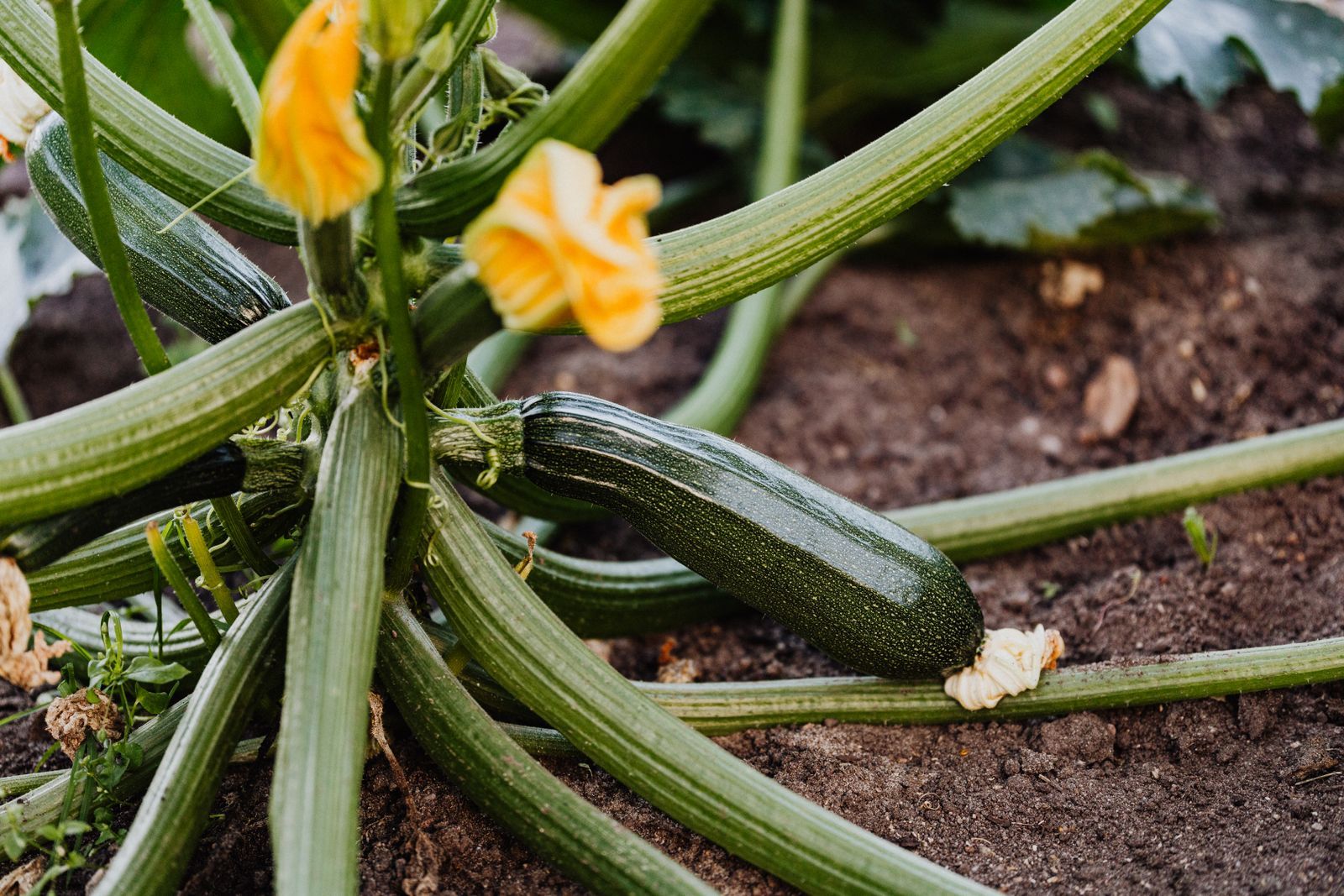
A zucchini plant at midsummer is a fountain of leaves 3 feet across, and it plans to be that size whether you budgeted for it or not. Space plants 24 inches apart with 36 inches between rows, per University of Georgia Circular 963, and understand that even this spacing will look crowded by July; the leaves of neighboring plants will touch and form a canopy, which is fine, because that canopy shades its own soil and holds moisture. What crowding beyond this spacing buys you is disease: leaves that never dry, air that never moves, and powdery mildew arriving early to a plant that should have shrugged it off until September.
Zucchini is a heavy feeder, a fast growing plant building fruit out of soil at industrial speed. Work 2 to 3 inches of compost into the planting area before sowing, more if your soil is tired, and aim for the slightly acidic to neutral range the plant prefers, around pH 6.0 to 7.0. A plant that pales and slows midseason, in a garden that started lean, is asking for food; a side dressing of compost around the base, watered in, is the measured answer. In rich soil, zucchini needs nothing but water and picking, which is the other half of its reputation.
Site it in full sun, 6 or more hours, and where you can reach it from at least two sides. You will be visiting this plant every two days at harvest peak with a knife in your hand, hunting fruit hidden under leaves the size of dinner plates, and a plant you cannot walk around is a plant whose fruit you find at canoe size.
Step 3: Water at the Base, About an Inch a Week
Zucchini wants the garden's standard measure, about 1 inch of water a week including rain, up to 2 inches in sandy soil or serious heat, per Mississippi State University Extension. Deliver it at the base of the plant, not over the leaves. Wet squash foliage is an invitation to powdery mildew and the other leaf diseases that end zucchini seasons, and a watering can or a soaker hose aimed at the soil gives the plant everything it needs while keeping the leaves dry. Water in the morning when you can, so any splash dries quickly in the sun.
Mulch under the plant once it is established, a layer of straw that keeps fruit off wet soil and holds the moisture your watering delivers. Fruit resting on damp ground rots at the contact point and invites slugs; fruit resting on dry straw stays clean. As the plant grows, its own canopy does much of the mulching, one of the plant's many self sufficiencies.
Stay steady. A zucchini that swings between drought and flood produces misshapen fruit and drops young ones. The plant is tolerant, but even tolerance has a rhythm, and the weekly deep watering is it.
Step 4: Read the Flowers Before You Worry About Them
Every zucchini beginner has the same two flower panics, and both are the plant behaving normally. The first: flowers open, then fall off, and no fruit appears. Those are male flowers, held on long straight stems, and they arrive first, sometimes a week before any female. Their whole job is pollen, and falling afterward is their design, not your failure. The females follow, each recognizable by the miniature zucchini swelling directly behind the petals, a tiny fruit waiting for pollination to give it permission to grow.
The second panic: a young fruit grows a few inches, then yellows from the blossom end, shrivels, and drops. That fruit was not pollinated, or not pollinated enough. Bees do this work, and in rainy weeks, in gardens with few pollinators, or early in the season, some fruit miss out. The plant produces far more female flowers than it could ever ripen, so the losses are budgeted by the plant itself. If nearly every fruit shrivels, you can play bee with a small brush, moving pollen from a male flower to the center of a female on a dry morning, a two minute job that genuinely works. But judge by the trend across a week, not by one fallen fruit.
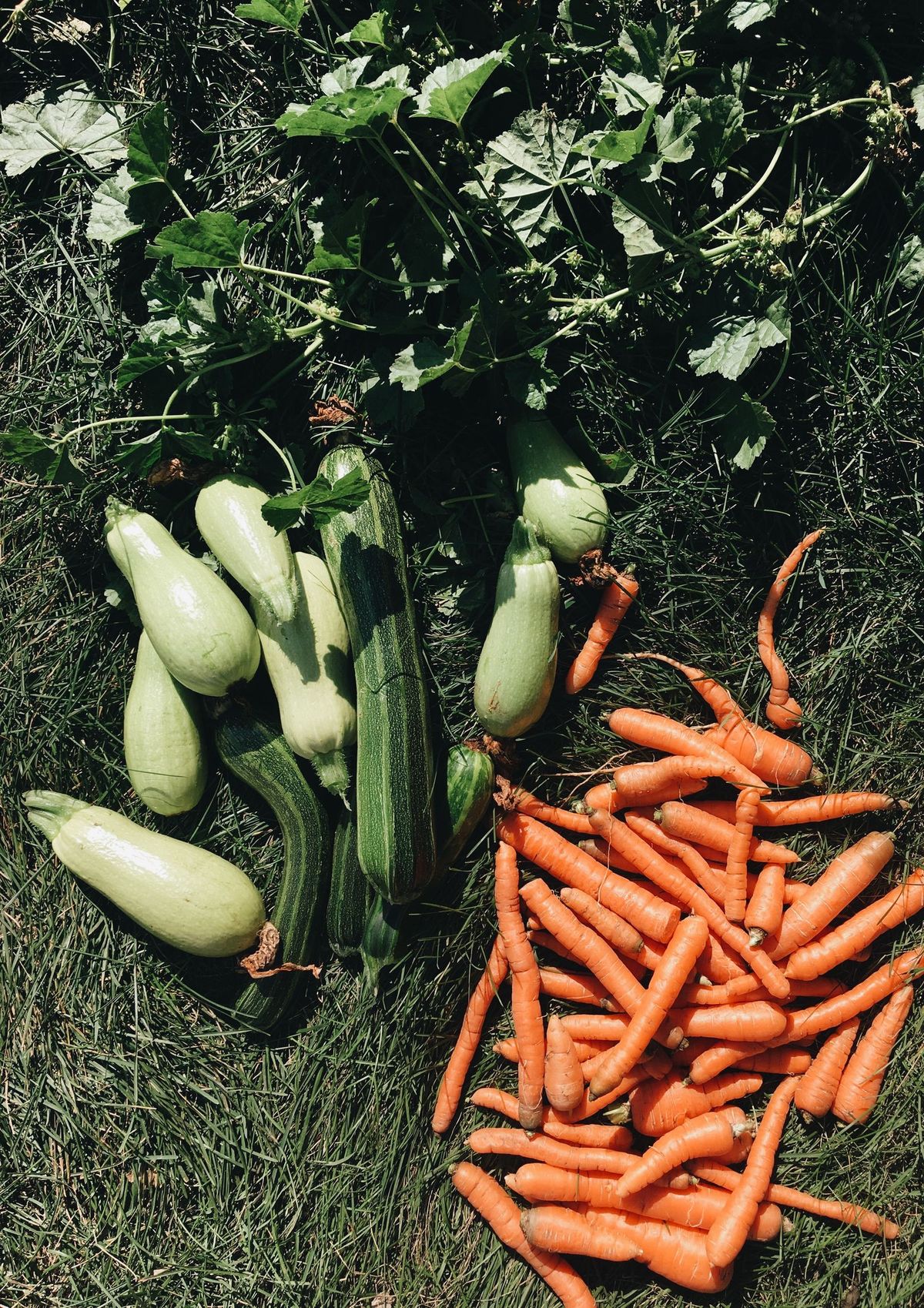
Freshly harvested zucchini and carrots laid on grass
The Two Enemies Worth Naming: Mildew and the Borer
Zucchini's troubles are many and minor, with two exceptions that deserve names. The first is powdery mildew, the white dusting that appears on leaves in humid weather, usually from midsummer on. On zucchini it is more eyesore than executioner: a producing plant outgrows it for weeks, and the practical responses are the ones already built into this guide, spacing for air, watering at the base, and removing the worst leaves to open the canopy. Judge the plant by its fruit, not its foliage. A mildewed plant still setting clean zucchini is a plant winning on points.
The second enemy is quieter and fatal: the squash vine borer, a moth whose larvae tunnel inside the stem at the plant's base. The announcement is sudden: a thriving plant wilts wholesale on a sunny day, and at the stem's base you find a hole and yellowish, sawdust like frass. There is no spray that reaches a larva inside a stem. Gardeners in borer country learn three defenses: rotate squash away from last year's spot, since the pupae wait in that soil; watch the base weekly in early summer and slit a stem lengthwise to extract a larva if frass appears early, then bury the wounded stem section in soil so it can root again; and sow a second plant a few weeks after the first, so that if the borer takes one, the succession plant, too young to have been found during the moth's flight, carries the season. That last defense is the beginner friendly one, because it asks for a packet of seed and a calendar note rather than surgery, and it converts a catastrophe into a two week gap in the harvest.
Neither enemy changes the plant's essential character. Zucchini remains the most forgiving producer in the garden; it merely keeps, like everything generous, a couple of specific vulnerabilities that a weekly walk catches early.
Step 5: Harvest at 6 to 8 Inches, Every Other Day
Harvest is where zucchini is won. Pick fruit at 6 to 8 inches long, when the skin is glossy and tender enough to dent with a thumbnail. At that size the seeds inside are soft, the flesh is dense and sweet, and the plant, relieved of its fruit, immediately sets more. Check the plant every other day at the peak of the season, and look properly, parting the leaves, because zucchini hide. The fruit you miss on Monday is a marrow by Friday, and a plant carrying a ripening marrow slows its production of new fruit, believing its reproductive work is nearly done.
Cut fruit off with a knife or pruners, leaving a short stub of stem; twisting tears the plant's brittle stems. Oversized fruit are not a disaster, merely a different ingredient: grate them for baking, where their water and mildness are assets, and let the lesson about checking under leaves go into the notebook. At season's end, frost kills the plant in one night, and the last harvest is everything on the vine that morning. There will be enough. There was always going to be enough. That is zucchini.
Frequently Asked Questions
How many zucchini plants should I grow?
One or two for most households. A single healthy zucchini plant in full production gives you several fruit a week for months, and the classic beginner error is planting a whole packet. Two plants are insurance against losing one, and a useful stagger if sown a couple of weeks apart. More than that is a preserving project, not a garden crop.
How far apart do zucchini plants need to be?
The University of Georgia Circular 963 spacing is 24 inches between plants and 36 inches between rows. A mature plant spreads about 3 feet across, so even this spacing looks crowded by midsummer, which is normal. Tighter spacing holds damp air in the canopy and brings powdery mildew earlier, so give the plant its room.
Why are my zucchini flowers falling off with no fruit?
Those are male flowers, which arrive first and fall after a day or two by design. Female flowers, with a tiny fruit swelling behind the petals, follow within about a week. Fruit is coming. If small fruit themselves yellow and shrivel, they were not pollinated; the plant produces more flowers than it can ripen, so occasional losses are normal.
When is zucchini ready to pick?
At 6 to 8 inches long, while the skin is glossy and tender. Pick every other day at peak season and search under the leaves, because hidden fruit grow enormous in days. Fruit left to ripen seed slows the plant's production of new zucchini, so prompt picking is what keeps the harvest coming until frost.
How much water does zucchini need?
About 1 inch of water a week including rain, up to 2 inches in sandy soil or serious heat, per Mississippi State University Extension. Water at the base of the plant rather than over the leaves, in the morning when possible, and keep the rhythm steady. Wet foliage invites powdery mildew, and swings between drought and flood deform fruit.
Why is my zucchini fruit rotting or shriveling at the end?
A young fruit that yellows and shrivels from the blossom end was usually not pollinated, common early in the season and in rainy weeks when bees stay home. You can hand pollinate with a small brush on a dry morning. Fruit rotting where it touches the ground is a different problem, solved by mulch: a layer of straw keeps fruit on a dry surface instead of damp soil.
Photo credits: Kaboompics (Pexels); Alina Autumn (Pexels). Photos are served from this site; follow the credit to the library page for the original.