Brussels Sprouts Plant Spacing: Room for a Two Foot Plant With a Fall Job
By the Windchime Walker editorial team
Photo: Chris F / Pexels
Brussels sprouts are the garden's long game: a crop planted into summer heat for a harvest that only becomes good after frost, on a plant that needs elbow room in September and patience from June. The spacing question arrives early in that game and the search results answer it loosely, 18 to 24 inches here, 15 to 18 there, and the beginner cannot tell whether the difference matters. It does, mildly, and the reasoning is worth more than the inches. This page follows our single crop pattern: one named standard, Utah State University Extension's Brussel Sprouts in the Garden, read in full for this batch and added to this site's data as the source key usu-brussels, with the common wider figures flagged rather than averaged, and the whole unusual season, the nitrogen schedule, the topping, the frost harvest, built around the spacing.
Our plant spacing chart owns the multi crop table. This page owns the sprouts row.
Interactive tool
Plant Spacing Planner: The Brussels Sprouts Row
Brussels sprouts are in the crop list below at the Utah State University Extension spacing, 18 inches between plants in 30 inch rows, inside the source range of 12 to 18 inches and 2 to 3 feet. Enter your row size and plan for a plant that stands until winter.
8 tomato plants fit this bed
4 plants per row across 2 rows, on a 24 inch grid. Extension spacing for this crop: 24 in between plants, 48 in between rows.
The grid uses the in-row spacing in both directions, the standard square foot layout for raised beds. In open ground, keep the wider row spacing in the note above so you can walk and weed between rows.
Spacing figures: University of Georgia Cooperative Extension, Circular 963, Vegetable Planting Chart, source.
The Standard: 12 to 18 Inches Between Plants, Rows 2 to 3 Feet Apart
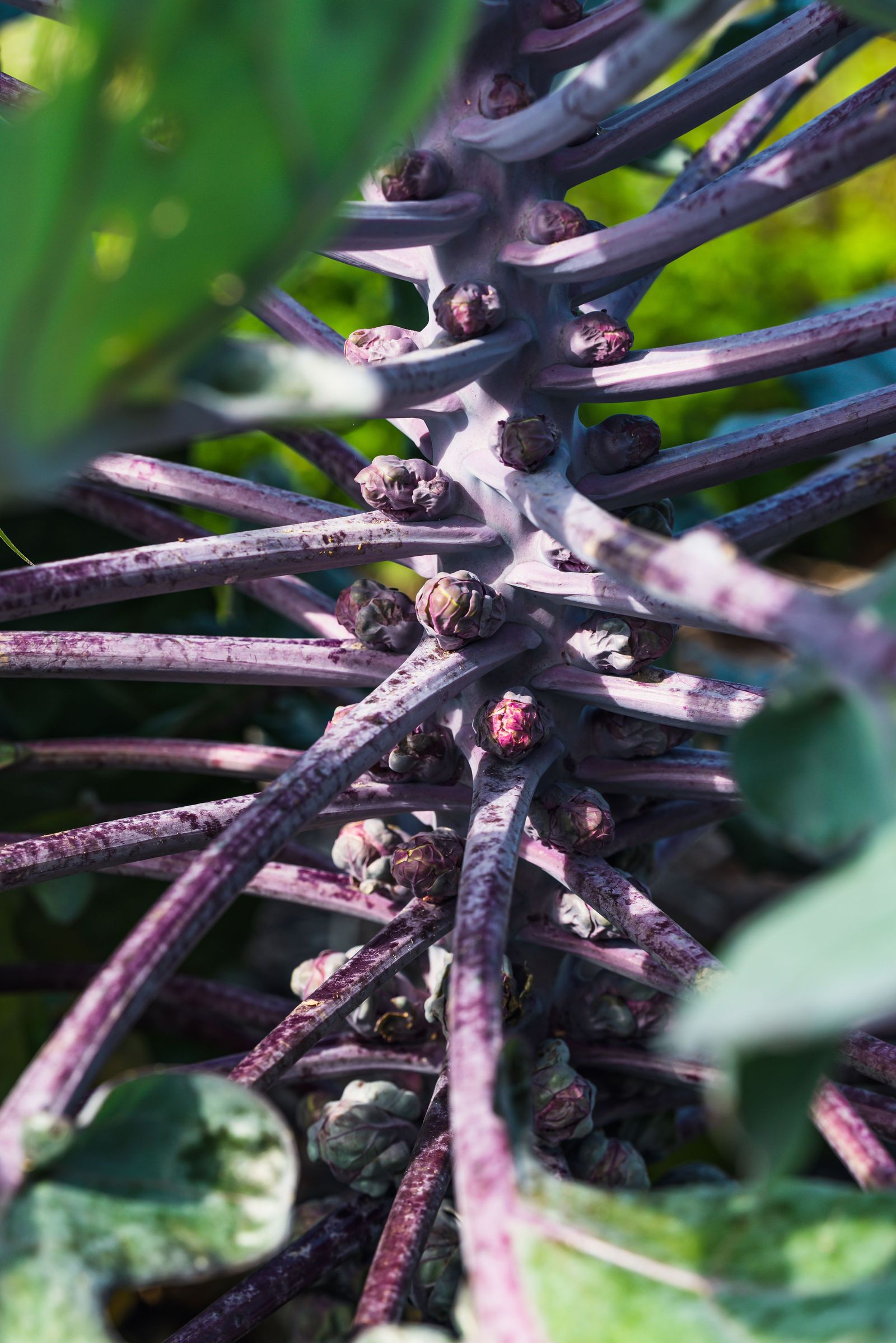
USU Extension specifies plants 12 to 18 inches apart, in rows 2 to 3 feet apart, seed sown 1/4 to 1/2 inch deep. This page's planner uses 18 inches between plants and 30 inches between rows, the roomier end of the USU in row range and the middle of its row range, because the plant it is spacing is not small: a mature Brussels sprout stands 2 to 3 feet tall on a thick stalk wrapped in large leaves, and each plant carries its sprouts in the leaf axils up that stalk. The spacing decision is really about air and access. Sprouts need airflow through the canopy to stay ahead of the mildew and aphid pressure of late summer, and the grower needs to reach the stalk repeatedly from midsummer onward: stripping lower leaves, side dressing, and eventually harvesting sprout by sprout from the bottom up. Crowded sprouts are not a disaster the way crowded okra is, but they are measurably harder to keep clean and to pick, and the sprouts themselves size more evenly with room.
The Wider Figures, Flagged
Most commercial guides and several seed catalogs quote 18 to 24 inches between plants, and Farmers' Almanac quotes 15 to 18 inches in 36 inch rows. The Almanac figure overlaps the USU range almost exactly; the 24 inch figure does not, and it comes from field and market growing where plants are given maximum room for uniform sprout size and machine access. None of this is averaged here. The planner keeps 18 inches, inside the USU standard. If your garden is windy, humid, and prone to mildew, taking the USU maximums, 18 inches in full 3 foot rows, is the prudent reading of the same standard. If you are tempted by 24, know what you are buying: slightly more uniform sprouts, paid for in ground that a home garden usually owes to another crop.
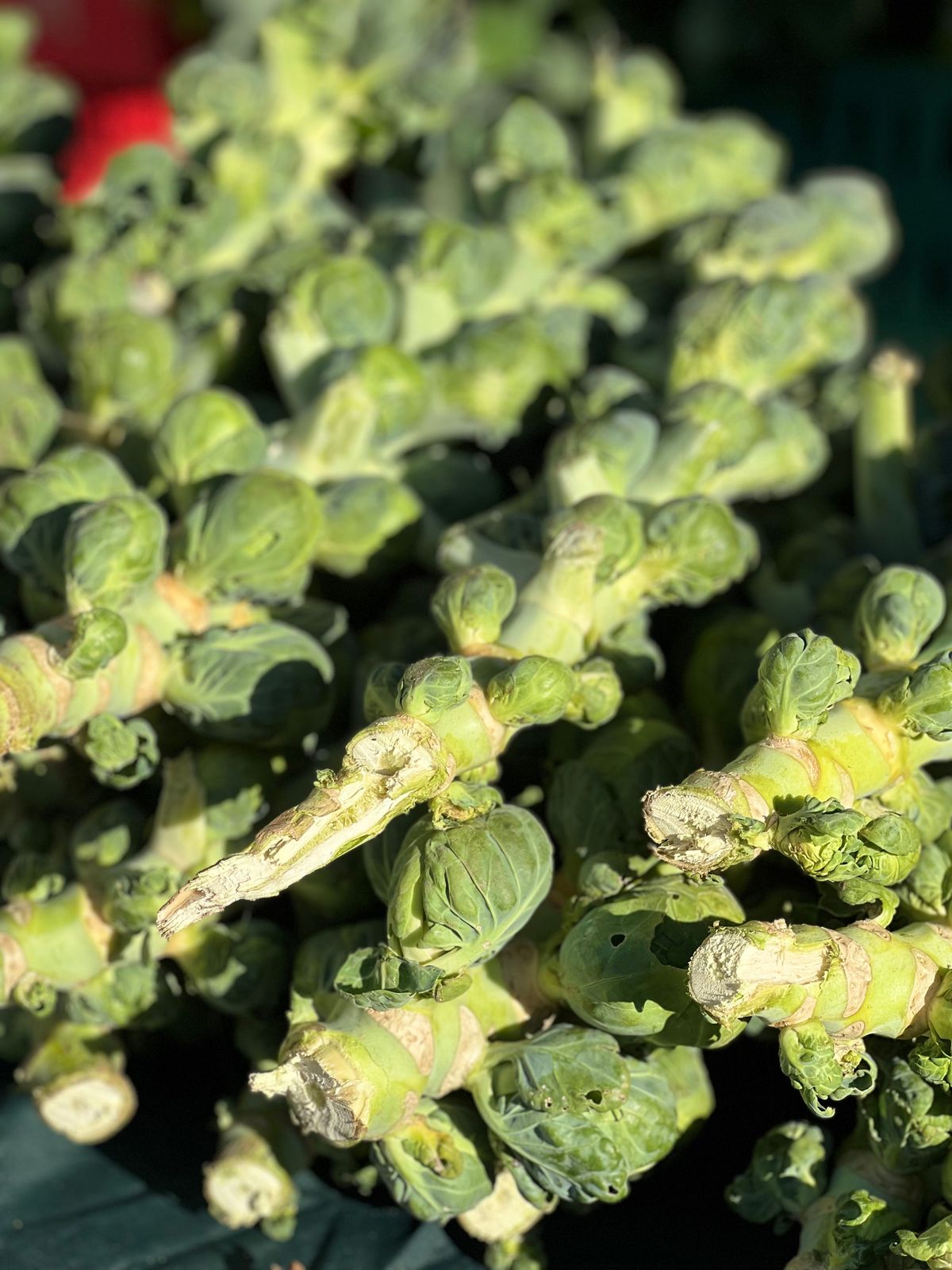
Brussels sprouts on the stalk in a garden
Timing: a Fall Crop Planted Into Summer
The calendar is this crop's real difficulty, and USU's guidance is specific: plant in early summer for a fall harvest, because sprouts matured in heat are loose, bitter, and prone to bursting, while sprouts that size up as the weather cools grow tight and sweet. Work backward from your first fall frost: the varieties USU names run Long Island Improved at 90 days, Jade Cross at 100, and Diablo at 110, and the plant should be standing established and growing hard when autumn arrives, with its sprouts forming into the cool. Most home growers start seed indoors or buy transplants, setting plants out in early summer rather than direct sowing, which buys the long season the crop demands; direct sowing per the chart depth, 1/4 to 1/2 inch, works where summers are long and falls are late. USU's planning figures give the household scale: plant 3 to 5 plants per person for fresh use and 5 to 7 more per person if you intend to store or freeze, with an expected yield of 5 to 8 pounds per 10 feet of row.
Water and the Nitrogen Schedule, With Its Stop Rule
USU's water guidance for the crop is deep and infrequent: 1 to 2 inches of water per week, applied deeply rather than in daily sprinkles, so the large root system chases moisture downward and the surface dries enough between waterings to discourage disease. The fertility program is the detail this crop is famous for among extension guides, because it has an end date. Side dress with nitrogen, USU specifies 1/2 cup of 21-0-0 fertilizer per 10 feet of row, at 4 weeks and again at 8 weeks after transplanting. Then stop. No nitrogen after the sprouts begin to form: late nitrogen pushes leafy growth and loose, leafy sprouts at exactly the stage when the plant should be tightening its harvest. Growers who feed all season out of general kindness get handsome plants and disappointing sprouts, and the stop rule is the difference between this page's season and that one. A soil rich in compost at planting covers the crop's other needs in most gardens; the scheduled nitrogen is the supplement, not the foundation.
Topping, Stripping, and the Growing Stalk
Two interventions shape the harvest. Through the season, snap off the lowest leaves as they yellow or crowd the stalk, working upward gradually; this opens the axils to light and air and is where the sprouts are forming. Then, when the lower sprouts have begun to form and size, top the plant: pinch or cut out the growing tip at the very top of the stalk. Topping tells the plant to stop growing taller and pour its remaining season into the sprouts already set, so they mature more uniformly instead of the bottom ones finishing while the top ones are still buttons. USU's sequence is the one to follow: sprouts form from the bottom of the stalk upward, lower sprouts first, and topping happens when those lower sprouts exist, typically a month or so before the main harvest. Skip topping and the plant still produces, over a longer, scragglier window; top too early and you cap the plant's total count. It is a judgment call with a visible trigger, which is the best kind.
Harvest From the Bottom Up, Better After Frost
Harvest sprouts at about 1 inch in diameter, firm and tight, twisting them off the stalk with a downward snap, and harvest from the bottom of the stalk upward as they size, because that is the order they mature. The beginner's mistake is waiting to harvest the whole stalk at once, by which time the bottom sprouts have opened, yellowed, or rotted while the top ones finished. Picked progressively, one plant delivers over many weeks. And hold the famous patience: sprouts that have been through frosts taste sweeter and milder than any picked in warm weather, because the plant converts starches to sugars as protection against the cold. In mild climates the harvest runs into winter on the standing stalk, the garden's own storage. For the refrigerator and freezer, USU's storage figures are precise: hold sprouts at 32 degrees F and 95 percent relative humidity and they keep 2 to 6 months on or off the stalk, and keep them away from ripening fruit, whose ethylene gas yellows and spoils them. Blanch and freeze the surplus at peak rather than letting it age past firm on the stalk.
The Long Season's Pests
A crop that stands in the garden from June to December collects the brassica family's whole pest list, and the spacing on this page is part of the defense, because air and access make inspection possible. Cabbage worms and loopers, the green caterpillars of white butterflies, feed from midsummer onward; a floating row cover from transplant until the plants are large excludes the butterflies entirely and is the cleanest answer, and handpicking is realistic at garden scale precisely because you can reach the stalk at this spacing. Aphids colonize the sprouts themselves in late summer, clustering in the axils where sprouts form; a hard jet of water dislodges most colonies, and sprouts destined for the table get a soak in salted water before cooking, which evicts any residents the harvest missed. Flea beetles pepper young transplants in the first weeks and are the other argument for the row cover's early shift. None of these pests is usually fatal to the plant; all of them are cheaper to prevent at the spacing that lets you see the stalk than to cure in a thicket, which is the unglamorous truth under most spacing advice for this crop: the inches buy you eyes on the plant for six months.
Frequently Asked Questions
How far apart should I plant Brussels sprouts?
At the Utah State University Extension standard this page follows: 12 to 18 inches between plants in rows 2 to 3 feet apart. The planner uses 18 inches in 30 inch rows. The 18 to 24 inch figures in many guides come from field growing and are flagged here, not averaged into the standard.
When do I plant Brussels sprouts?
In early summer, for a fall harvest. Sprouts matured in heat are loose and bitter; sprouts sizing up into cooling weather grow tight and sweet. Count back from fall frost using your variety's days: Long Island Improved 90, Jade Cross 100, Diablo 110, per USU, and set out transplants so the plant is established and growing hard when autumn comes.
How do I fertilize Brussels sprouts?
Compost at planting, then side dress nitrogen on a schedule with a stop rule: 1/2 cup of 21-0-0 per 10 feet of row at 4 weeks and again at 8 weeks after transplanting, per USU, and no nitrogen after sprouts begin to form. Late feeding grows leaves and loose sprouts instead of a tight harvest.
What does topping a Brussels sprout plant do?
Removing the growing tip once the lower sprouts have formed stops upward growth and redirects the plant's remaining energy into sizing the sprouts already set, so they mature more uniformly. Top when lower sprouts exist, roughly a month before the main harvest; too early caps the plant's total yield.
When are Brussels sprouts ready to pick?
At about 1 inch in diameter, firm and tight, picked from the bottom of the stalk upward as they mature, not all at once. Frost improves them: sprouts harvested after frosts are noticeably sweeter. A picked over several weeks plant out yields a plant harvested in one pass.
How do I store Brussels sprouts?
Cold and humid: 32 degrees F at 95 percent relative humidity keeps them 2 to 6 months, per USU, and keep them away from ripening fruit, whose ethylene yellows them. In mild climates the standing stalk in the garden is itself good storage into winter; blanch and freeze any surplus at its peak.
How many Brussels sprout plants should I grow?
USU's planning figures: 3 to 5 plants per person for fresh eating, plus 5 to 7 per person if you plan to store or freeze, with an expected yield of 5 to 8 pounds per 10 feet of row. At this page's spacing, a 10 foot row holds about 6 plants, so one row is a household's fresh supply with a little surplus.
Photo credits: Chris F (Pexels); Natalia S (Pexels). Photos are served from this site; follow the credit to the library page for the original.