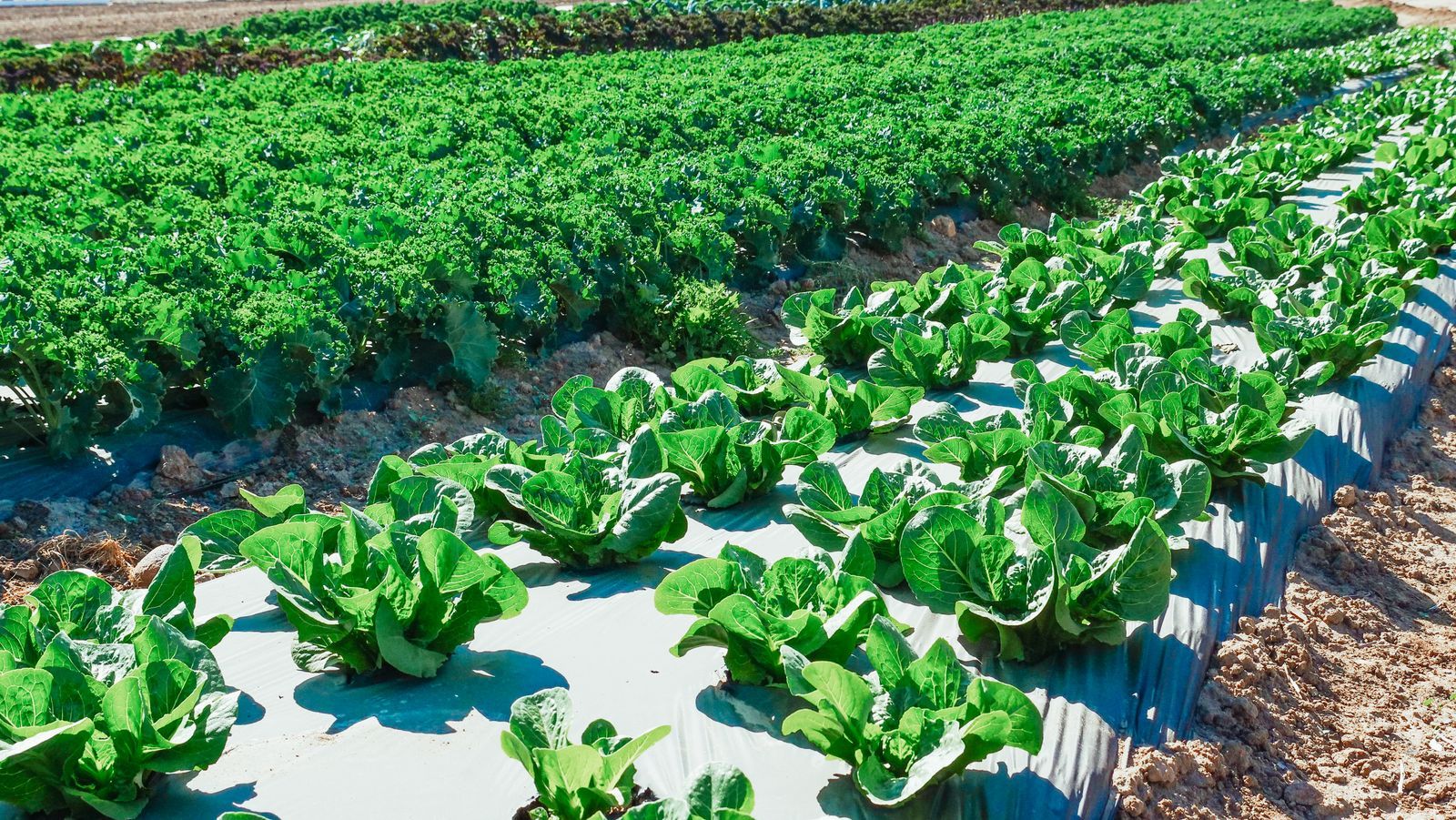
Spacing is the decision you make once, in about ten minutes with a tape measure, that your plants live with all season. Plant too close and the bed becomes a damp, shaded thicket where leaves stay wet, air cannot move, and roots fight for the same water. Plant too far apart and you waste bed space, leave bare soil to dry out and grow weeds, and harvest less from ground you prepared well. The right distance is not a guess and it is not the same for every crop. A radish needs 1 inch. A cucumber row needs 60 inches to the next row. Both numbers are correct, for the plant they belong to.
This page prints one complete chart from one source you can check, explains the two distances every crop needs, and shows you how to lay them out in a real bed. The chart below is the vegetable planting chart in University of Georgia Cooperative Extension Circular 963, reproduced for the 12 crops our planner covers. Basil is the one exception: its figure comes from University of Maryland Extension, because Circular 963 does not list basil the same way, and that exception is marked in the table notes.
Before you mark a single spot, enter your bed size and your crop list in the SpacingPlanner on this page. It uses the exact figures from the chart below, the in-row distance between plants and the grid distance the planner lays out, and returns how many plants fit in the bed you actually own, so the chart and your plan cannot disagree.
Interactive tool
Plant Spacing Planner
Pick a crop and your bed size. The planner lays the bed out on a square grid at the spacing university extension services recommend, and tells you how many plants fit, row by row.
8 tomato plants fit this bed
4 plants per row across 2 rows, on a 24 inch grid. Extension spacing for this crop: 24 in between plants, 48 in between rows.
The grid uses the in-row spacing in both directions, the standard square foot layout for raised beds. In open ground, keep the wider row spacing in the note above so you can walk and weed between rows.
Spacing figures: University of Georgia Cooperative Extension, Circular 963, Vegetable Planting Chart, source.
The Two Distances Every Crop Needs
Every spacing figure is really two figures. In-row spacing is the distance between individual plants within a single row, measured from the center of one plant to the center of the next. Between-row spacing is the distance from one row to the next row, measured the same way, center to center. Beginners most often use only the first number, plant a neat row, and then place the next row by eye, too close. Both dimensions matter, because a plant grows in every direction, and the row gap is where air moves, where you reach in to harvest, and where roots from two rows meet.
Seed packets usually print both numbers, sometimes as "thin to" and "rows apart." Thin to means the final in-row spacing after you remove extra seedlings, which is why carrot and radish rows are sown thick and thinned later. When a source gives a range, such as lettuce at 8 to 12 inches between plants, the range is real information: use the tighter end in a raised bed with rich soil and good watering, and the wider end in poorer soil, in hot weather, or when you want full sized heads rather than cut leaves. Our chart keeps the range notes from the source instead of pretending every crop has one magic number.
The Full Spacing Chart
The table below is the complete chart for the 12 crops in our planner, from University of Georgia Cooperative Extension Circular 963, Vegetable Planting Chart, with basil from University of Maryland Extension as noted. In-row spacing is the distance between plants in the row. Between-row spacing is the distance between rows in an open garden. The planner grid column is the equal spacing the SpacingPlanner uses to lay out a bed, where plants sit on a square pattern instead of in wide rows.
Crop
Between plants in the row
Between rows
Planner grid spacing
Tomato
24 inches
48 inches
24 inches
Pepper (bell or hot)
24 inches
36 inches
24 inches
Cucumber
12 inches
60 inches
12 inches
Zucchini and summer squash
24 inches
36 inches
24 inches
Green beans (bush)
2 to 4 inches
36 inches
3 inches
Lettuce
8 to 12 inches
18 to 36 inches
10 inches
Carrot
2 to 3 inches after thinning
18 to 36 inches
2.5 inches
Radish
1 inch
24 inches
1 inch
Basil
12 inches
18 inches
12 inches
Kale
8 to 16 inches
36 inches
12 inches
Broccoli
12 inches
36 inches
12 inches
Onion (dry bulb)
3 to 4 inches
18 to 36 inches
3.5 inches
Source notes, kept from the publications so you can judge the numbers yourself. For bush beans, Circular 963 gives 2 to 4 inches between plants, and the planner uses 3 inches, the middle of the range. For lettuce it gives 8 to 12 inches between plants and 18 to 36 inches between rows, and the planner uses 10 inches in the row and a 27 inch row midpoint for reference. For carrots it gives 2 to 3 inches after thinning, and the planner uses 2.5 inches. For kale it gives 8 to 16 inches, and the planner uses 12 inches. For dry bulb onions it gives 3 to 4 inches, and the planner uses 3.5 inches. Basil at 12 inches between plants and 18 inches between rows comes from University of Maryland Extension guidance for growing basil in a home garden. Cucumber at 12 inches between plants and 60 inches between rows assumes vines have room to run in an open garden; in a bed, trellis the vines upward and the row figure matters far less, which the next section explains.
Why the Numbers Are What They Are
Spacing is set by the size of the mature plant, not the seedling. A tomato transplant in a 4 inch pot looks lost at 24 inches from its neighbor. By midsummer that same plant is a large, leafy vine that fills the space, and the gardener who planted at seedling size spends August fighting disease in a jungle of touching leaves. Always picture August when you measure in May.
Three needs set the distance. The first is light: leaves that shade each other produce less, and fruit ripens slowly in shade the plant casts on itself. The second is air: moving air dries leaves after rain and watering, and dry leaves resist the fungal diseases that are the main spacing related killer in a home garden. Crowded plants hold a pocket of still, humid air around their leaves, which is exactly what those diseases want. The third is below ground: roots spread roughly as wide as the plant above, and crowded roots compete for the same water and nutrients, so every plant in an overcrowded bed yields less, often less in total than fewer, well spaced plants would have given.
That is why the chart is not uniform. Radishes are small, fast, and harvested young, so 1 inch is honest spacing. Carrots need only 2 to 3 inches because the harvested part grows downward, not outward. Lettuce, kale, and broccoli are leaf and head crops of middling size. Peppers and zucchini are substantial bushes. Tomatoes are the largest common garden plant on the list, and their 48 inch row gap is mostly air and access: room for the vine, the support, and you.
A gardener planting seedlings in a garden row with a trowel, spacing each plant by hand
Rows in an Open Garden Versus a Grid in a Raised Bed
The between-row figures in Circular 963 belong to an open garden, where rows are separated by paths you walk on and soil between rows is worked from the path. A raised bed is different: you never walk on the soil, the whole surface is planted, and you reach in from the edges. In a bed, the useful question is not "how far apart are my rows" but "how many plants fit on a grid at the in-row distance." That is the math the planner does, using the grid spacing column in the chart.
Do the arithmetic once by hand so the planner output makes sense. Take an 8 by 4 foot bed and tomatoes at a 24 inch grid. The bed is 96 inches long and 48 inches wide. Along the length, 96 divided by 24 gives 4 plants per row. Across the width, 48 divided by 24 gives 2 rows. Four times two is 8 plants. The same bed at the open garden row spacing, 48 inches between rows, would hold only 1 row of 4 plants, because half the bed becomes path. Neither answer is wrong. They belong to two different systems, and mixing them, using grid counts with row spacing or row counts in a bed, is the most common planning error beginners make. Decide which system you are planting, then use its numbers all the way through.
Small crops show the opposite extreme. The same 8 by 4 foot bed holds rows of radishes at 1 inch in the row, which is why radishes and carrots are planned by the row or by the square foot patch rather than by the individual plant. Sow them, then thin without mercy to the chart distance: 1 inch for radishes, 2 to 3 inches for carrots. Thinning feels wasteful and is not. A carrot left at half an inch from its neighbor becomes a thin, forked root. A carrot thinned to 2.5 inches becomes dinner.
How to Mark Out Spacing in a Real Bed
Numbers on a page become plants in the ground through marking, not estimating. Work in this order. First, stretch a string between two stakes along the line of your first row, at the edge of the bed or the distance in from the edge that your plan calls for. A string line keeps a row straight, and straight rows make every later measurement easier. Second, make a measuring stick: take a plain stick or a spare piece of wood and mark your in-row spacing on it with a pen, for example a clear mark every 24 inches for tomatoes or every 12 inches for broccoli. Lay the stick along the string and mark each planting spot in the soil with a fingertip dent or a small pile of sand. Third, step across by your between-row or grid distance, stretch the string again, and repeat until the bed is marked. Only then dig holes and plant.
Plant transplants at the depth they grew in the pot, with the single common exception of tomatoes, which can be planted deeper because the buried stem roots. Water each plant in well at planting to settle soil around the roots. For direct sown crops, sow along the string line at the packet depth, water gently so seeds are not washed together, and thin to the chart spacing when seedlings are large enough to judge, snipping extras at the soil line for root crops so you do not disturb the roots you keep.
Two field checks catch most errors. Stand back and look at the marked bed before you plant: the pattern should look even, with no accidental wide or tight patches. Then ask the August question for the largest crop in the bed: will these plants, at full size, touch? For tomatoes, peppers, and zucchini at chart spacing, leaves may just meet at full growth, which is fine. Stems and main branches should never be crowded from the start.
Adjusting the Chart Without Breaking It
The chart is a default, not a law, and three adjustments are legitimate. Trellising changes row needs: cucumbers grown up a trellis in a bed do not need 60 inches to the next row, because the vines occupy air instead of ground, though the 12 inch in-row distance still applies. Variety changes plant size: a compact determinate tomato is smaller at maturity than a vigorous indeterminate one, and a dwarf variety can sit at the tight end of a range. Harvest style changes leaf crops: lettuce picked leaf by leaf for salads can sit tighter than lettuce grown for full heads, which is part of why its range runs from 8 to 12 inches.
What does not work is shrinking spacing to fit more plants into a bed you have already built. If the planner says your bed holds 8 tomatoes and you bought 12, the correct move is a second location, a container for the extras, or giving plants away, not 12 tomatoes at a spacing the chart never gave. Crowding does not produce 12 plants worth of harvest in an 8 plant bed. It produces 8 or fewer plants worth, with more disease, picked from a bed that is unpleasant to work in.
Frequently Asked Questions
What is the difference between in-row spacing and between-row spacing?
In-row spacing is the distance between plants within one row, center to center. Between-row spacing is the distance from one row to the next. Both come from the mature size of the plant, and both matter: using only the in-row number and guessing the row gap is the most common cause of a crowded bed. The chart on this page gives both for every crop.
Where do the numbers in this chart come from?
Eleven of the twelve crops come from University of Georgia Cooperative Extension Circular 963, the Vegetable Planting Chart, including its range notes, which this page keeps rather than rounding away. Basil, at 12 inches between plants and 18 inches between rows, comes from University of Maryland Extension. Where a source gives a range, the planner uses a stated midpoint, such as 10 inches for lettuce from an 8 to 12 inch range.
How many plants fit in an 8 by 4 foot raised bed?
It depends on the crop grid spacing. At 24 inches, as for tomatoes, peppers, and zucchini, the bed holds 4 plants along its length and 2 across, for 8 plants. At 12 inches, as for broccoli, kale, and basil, it holds 8 by 4, for 32 plants. Small crops such as radishes at 1 inch and carrots at 2 to 3 inches are planned by the row or the patch, not counted plant by plant. Enter your bed in the planner for any crop on the chart.
Can I plant closer than the chart in a raised bed?
A raised bed removes the walking path, so you use a grid at the in-row distance instead of the wide open garden row spacing. That is already the closer, bed appropriate system, and it is built into the planner. Planting closer than the in-row distance itself is different: it crowds roots and leaves, holds damp air around foliage, and usually lowers total harvest. Use the tight end of a published range if your soil is rich and you water well, and do not go below it.
Why do carrots and radishes need thinning if I sowed them carefully?
Because germination is uneven and small seeds are hard to place one by one, rows are sown thick on purpose and thinned to the final spacing: 1 inch for radishes and 2 to 3 inches for carrots after thinning, per Circular 963. Snip extras at the soil line instead of pulling them, so the roots of the plants you keep are not disturbed.
Photo credits: Kindel Media (Pexels); Helena Lopes (Pexels). Photos are served from this site; follow the credit to the library page for the original.