Ask when to plant a garden and the internet answers with a month, as if a gardener in Minnesota and a gardener in Georgia shared a calendar. They do not. Planting time is local, sometimes down to the difference between a valley floor and the hill above it, and the good news is that your local timing hangs on two dates you can look up in five minutes: your average last spring frost and your average first fall frost. Everything else in the planting year is arithmetic around those two anchors.
This guide shows you how to find your dates, how to sort a plant list into the three groups those dates create, and how to run the arithmetic crop by crop until you have a calendar for your own yard. It also covers the second opinion that matters almost as much as the calendar, soil warmth, and the late summer second planting that doubles a garden's year and that most beginners never learn exists.
Start with the Seed Starting Date Planner on this page. Enter your average last spring frost date once, then pick each crop on your list: the planner counts back to your indoor sowing date and forward to the day each plant can move outside, using the week offsets published in North Dakota State University Extension H1139. Your dates, your crops, your calendar, computed while you read.
Interactive tool
Seed Starting Date Planner: Your Garden Calendar
Enter your average last spring frost date, then pick each crop on your list. The planner counts back to your indoor sowing date and forward to the day each plant can go outside, using the week offsets in North Dakota State University Extension H1139.
Sow tomato indoors: Fri, March 20, 2026
Move seedlings outdoors: Fri, May 15, 2026.
Sow indoors 6 weeks before last frost; set out 2 weeks after last frost.
Week offsets: North Dakota State University Extension, H1139, garden seed starting chart, source. Frost dates are averages: in any given year the last frost can land two weeks either side of the date you type, so keep an eye on the forecast as transplant day approaches.
The Two Dates That Run Your Whole Calendar
Your average last spring frost date is the date after which frost becomes unlikely in your area, built from decades of local weather records. Your average first fall frost date is its autumn mirror. Between them lies your frost free season, the window in which tender plants can live outdoors. Every planting decision you make is a position inside or deliberately outside that window.
Find both dates from a local source: your state or county extension office publishes them, regional almanac frost tables list them by town or ZIP code, and your state extension's planting calendar builds whole crop schedules from them. Treat both dates as averages, not promises. In any given year, the last frost can arrive two weeks after its average date, which is why experienced gardeners keep one eye on the forecast in the weeks around it and a sheet or bucket ready for a surprise cold night.
Write your two dates at the top of your garden notes. They are the most valuable numbers in your gardening life, worth more than any zone map, because nearly every other date you need is counted from them.
Group One: Plant Before the Last Frost
Cool season crops evolved in mild climates and shoulder seasons, and they prefer to grow while the weather is still cool. Lettuce, peas, radishes, kale, carrots, broccoli, cabbage, and onions belong to this group. They tolerate light frost, germinate in cool soil, and actually suffer in summer heat, going bitter, tough, or bolting to seed. Planting them before the last frost is not a gamble. It is what they are for.
The planner shows the pattern for the crops it lists: broccoli, cabbage, and kale transplants go out about 3 weeks before the last frost, onions about 2 weeks before, and lettuce transplants about 4 weeks before, with their seeds started indoors weeks earlier still. Direct sown cool crops follow the same spirit: peas, radishes, and carrots go into the ground as soon as the soil can be worked in spring, which your hands can judge with the squeeze test, soil that crumbles instead of smearing.
The beginner's error with this group is waiting for warm weather out of caution, then watching lettuce bolt and peas stall in the first heat. Cool crops planted late lose their season. Plant them bravely, early, while you are still wearing a jacket.
Group Two: Plant After the Last Frost
Warm season crops come from frost free climates and have no defense against cold at all. Tomatoes, peppers, beans, cucumbers, squash, zucchini, basil, and marigolds belong here. One frosty night can kill them outright, and even without frost, cold soil and chilly nights stall them for weeks, so planting them early gains nothing even when they survive.
The group has an internal order worth learning. Beans, cucumbers, squash, and zucchini are sown or planted right around the last frost date once soil has begun to warm. Tomatoes and peppers, the most cold shy of the common crops, wait longer: North Dakota State University Extension H1139 sets tomato and pepper transplants at 2 weeks after the last frost, and basil, the most tender herb of all, also waits for that warmer window, with nights reliably mild. Peppers are famously patient about this and famously unforgiving if rushed.
Garden centers will sell you tomato plants weeks before it is safe to plant them. The plants are not a planting signal. Your frost date plus two weeks is the signal, confirmed by a forecast with no cold nights in it.
Group Three: The Late Summer Second Planting
Here is the season inside the season. In late summer, while the tomatoes are still producing, the cool season crops get a second turn. Lettuce, radishes, kale, carrots, and broccoli planted in late summer grow into the cooling fall, which is the weather they love most, often outproducing their spring versions because pests are fewer and the soil is warm for fast germination while the air cools for sweet growth.
The arithmetic runs backward from your first fall frost date. Take each crop's days to maturity from its seed packet, add a margin because fall days are shorter and growth slows, and count back from the frost date to find your last sensible sowing day. Hardy crops like kale and carrots stretch the window further, tolerating frosts that end tender plants, and can carry a garden's harvest well past the first frost date. A garden with a second planting is not a spring event. It is a nearly year round food system, and it starts with knowing one autumn date.
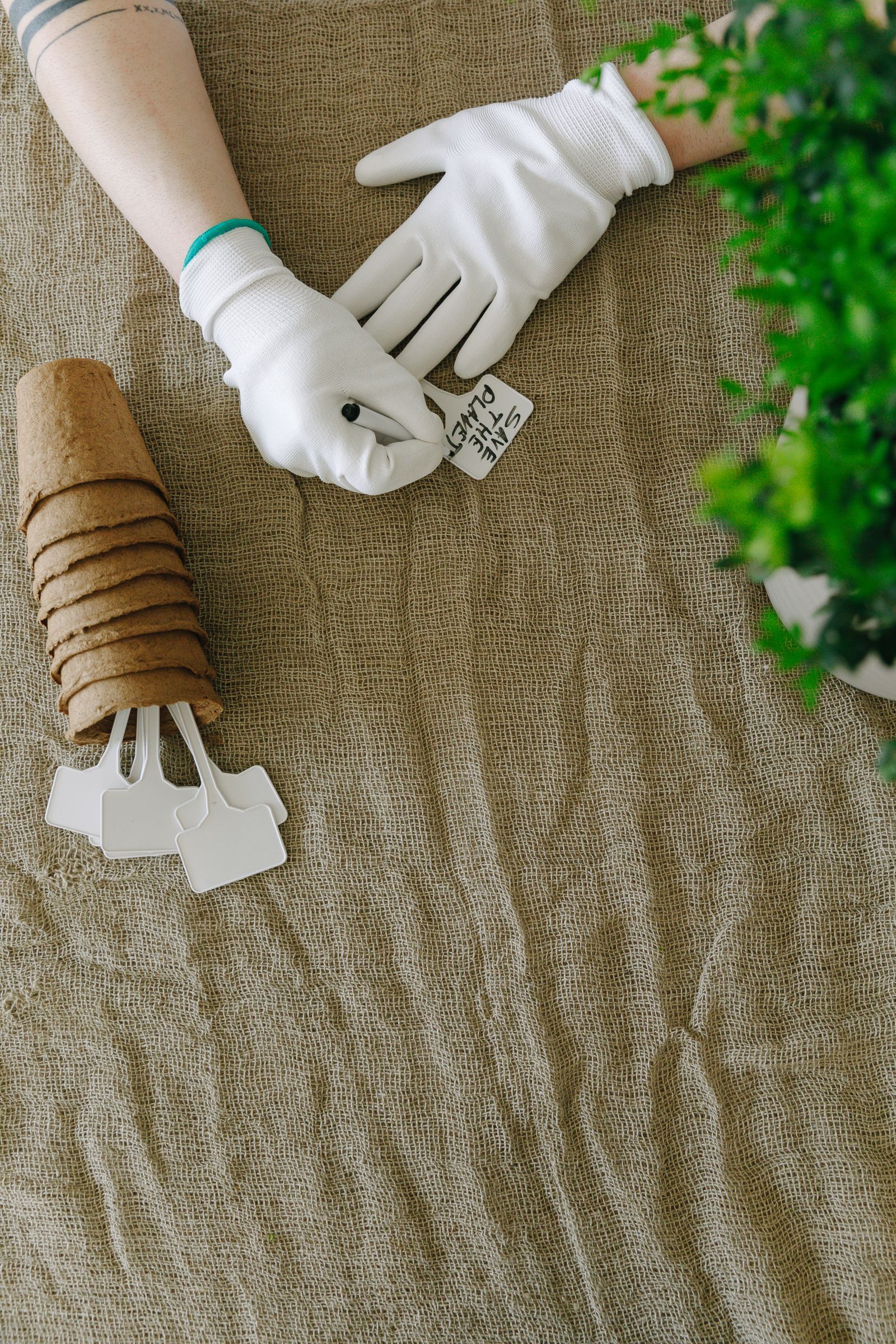
Hands preparing seed labels and pots on burlap, the planning work that turns two frost dates into a season
Soil Temperature: The Second Opinion
The calendar says when frost is unlikely. The soil says whether warm season seeds will actually grow. Beans and cucumbers sown into cold soil rot or crawl, while the same seeds sown a week later into warm soil leap up. Cucumbers, for example, want soil warmed to at least 65 to 70 degrees Fahrenheit before planting out, and tomatoes are happiest set into soil around 60 degrees with nights above 50.
You do not need a soil thermometer, though they are inexpensive and genuinely useful. A hand buried a few inches down gives a rough verdict: soil that feels cold enough to numb your fingers is too cold for warm season seed. Gardeners also use the barefoot test and the overnight test, but the honest summary is that warm season planting should feel like late spring in the ground, not just on the calendar. When the date and the soil disagree, believe the soil and wait the few days. The plants will repay the patience within a week of growth.
A Worked Example: One Calendar, Start to Finish
Suppose your average last spring frost is April 20 and your first fall frost is October 20. Those are invented example dates; yours will differ, and the planner computes with your real ones. Watch how the year builds.
Indoors, the work starts in late winter. Broccoli, cabbage, kale, and onion seeds are sown about 10 weeks before April 20, tomatoes about 6 weeks before, peppers about 8 weeks before, lettuce about 8 weeks before, each per the NDSU offsets. Outdoors, the first sowings, peas, radishes, and carrots, go in as soon as the soil can be worked, several weeks before April 20. Lettuce transplants follow about 4 weeks before the frost date, broccoli and its cousins about 3 weeks before.
After April 20, the warm season moves out in order: beans and cucumbers around the date as soil warms, then tomatoes, peppers, and basil transplants about 2 weeks after, in early May. Through summer, short rows of lettuce and beans are sown every couple of weeks for steady harvests. In late July and August, the second planting goes in, fall lettuce, kale, carrots, and broccoli counted back from October 20. The tender crops end at that frost; the kale and carrots keep going past it. One pair of dates, and the whole year has a shape.
Zones: Useful, But Not the Boss
Your USDA hardiness zone describes how cold your winters get, which decides which perennial plants, trees, shrubs, and herbs that return yearly, can survive in your yard. It is the right tool for choosing a rosemary plant or a fruit tree. For annual vegetables, it is background at best, because two towns in the same zone can have last frost dates weeks apart, thanks to elevation, water, and latitude within the zone.
Use the zone for perennials and the frost dates for everything you plant each year. When a seed packet, a plant tag, and a national website disagree about timing, the most local source wins: your extension calendar first, your own notes second, and national advice last. Local beats general every time, including when the general advice is this page.
Reading a Seed Packet's Timing Language
Seed packets speak in a small set of phrases, and learning them turns every packet into a local instruction once you know your frost dates. "Sow indoors 6 to 8 weeks before last frost" means count back from your date and start the tray then. "Plant out after all danger of frost" means your last frost date, plus judgment about the forecast. "Direct sow 2 weeks before last frost" is a cool crop instruction: the seed tolerates cold soil and light frost. "Days to maturity" counts, for most crops, from transplanting or from germination, and the packet usually says which; it is the number you count backward from your first fall frost to time the second planting.
When a packet's range is wide, such as sow 6 to 8 weeks before frost, beginners should take the middle and write down what they did. Your notes convert a range into your garden's exact number within a season or two. The packet gives the species' needs. Your yard gives the final adjustment, and your notebook is where the two meet.
Succession Planting: The Third Dimension of When
When to plant has a third answer beyond spring and fall: repeatedly. Fast, small harvest crops, lettuce, radishes, bush beans, and cilantro among them, are best sown in small amounts every couple of weeks through their season rather than all at once. One big sowing of lettuce matures in one overwhelming week and then bolts; six small sowings feed you salads from spring to fall.
Succession planting also insures you. A sowing that meets a freak cold snap, a pest outbreak, or your vacation week is a small loss with the next round already sprouting. Build succession into your calendar from the start: when you write a crop's first sowing date, write its rhythm beside it, and let the calendar remind you instead of relying on memory in a busy June.
Microclimates: Your Yard Has Several Calendars
One yard can hold several planting dates at once. A bed against a south facing wall stores the day's heat and releases it at night, running a week or more ahead of the yard's average. A low corner where cold air pools on still nights runs behind, and frost settles there first in fall. Wind exposed spots dry and cool soil; sheltered spots warm it.
Use the map this creates. Tender crops get the warm wall bed in spring, where the extra heat protects them and speeds them. Cool season crops get the lower, cooler ground in summer, where the shade of the season lingers. Note in your garden journal which beds run early and which run late, because that knowledge is worth a week or two of growing season every year, and no website can give it to you. It is the purest form of local knowledge: your own yard, read closely.
What If You Plant Too Early or Too Late?
Too early, the tender crops die or stall, and the remedy is unglamorous: replant. Seeds are cheap and transplants are replaceable, and a replanting a week later into warm soil often overtakes a stalled early plant that sat in the cold. Keep spare seed of your fast crops for exactly this reason, and do not mourn a frosted tomato. Mourn the lesson only if you refuse to learn it.
Too late, the cost is a shorter harvest rather than a dead plant, and partial remedies exist. Choose faster maturing varieties for late plantings, since seed packets print days to maturity for exactly this calculation. Buy transplants instead of sowing seed to buy back weeks. And remember the second planting: a gardener who missed spring lettuce entirely has a better lettuce season waiting in fall. The calendar forgives, as long as you keep counting.
Keeping a Planting Calendar That Survives Real Life
A calendar only helps if it still exists in June. Keep yours where your gardening actually happens: a single page in your garden notebook, a note on your phone, or a sheet on the refrigerator if the kitchen is your planning desk. One page, not a system. On it, three columns are enough: the crop, its key dates computed from your frost dates, and what actually happened, filled in as the season runs.
The third column is the treasure. Next winter, when you plan again, last year's actuals correct every estimate: the tomatoes that went out May 9 and thrived, the beans sown April 25 that rotted and were resown May 12. Two or three years of that column and your calendar stops being national advice with your dates pasted in. It becomes your yard's own almanac, more accurate for your beds than anything published, because it was measured there.
Update it in the moment, in pencil, with dirty hands if necessary. A calendar updated weekly in rough handwriting beats a beautiful spreadsheet abandoned in May, every season, without exception.
Frequently Asked Questions
How do I find my last spring frost date?
Look it up from a local source: your state or county extension office publishes frost dates, regional almanac frost tables list them by town or ZIP code, and state extension planting calendars are built on them. Use the average date as your planning anchor, then confirm with the actual forecast before moving tender plants outside, because any single year can run early or late by a couple of weeks.
What is the difference between a frost date and a hardiness zone?
A frost date tells you when tender annual plants can live outdoors in spring and when they will die in fall. A hardiness zone tells you how cold winter gets, which decides which perennial plants survive year to year. Annual vegetables run on frost dates. Two towns can share a zone and have last frost dates weeks apart, so the zone alone cannot time your plantings.
Can I plant everything on my last frost date?
No, because the date is the hinge, not the whole calendar. Cool season crops like lettuce, peas, and broccoli belong in the ground weeks before it, and cold shy crops like tomatoes, peppers, and basil belong out about 2 weeks after it, per North Dakota State University Extension H1139. Planting everything on one date shortens the cool crops' season and risks the tender ones in the same afternoon.
When do I plant tomatoes, exactly?
Count from your last spring frost. Start seeds indoors about 6 weeks before it, or buy transplants, and set them outside about 2 weeks after it, when the forecast shows nights staying mild, above about 50 degrees Fahrenheit, and the soil has warmed to around 60 degrees. The Seed Starting Date Planner on this page computes both dates from your frost date when you pick Tomato.
What can I plant in late summer for fall?
The cool season group gets a second season: lettuce, radishes, kale, carrots, and broccoli planted in late summer grow into cooling fall weather and often outproduce their spring versions. Count backward from your first fall frost date using each crop's days to maturity from its packet, adding margin for shorter days. Hardy kale and carrots tolerate frost and can harvest well past the first frost date.
I missed the spring planting window. Is my year ruined?
No. Warm season crops can still go in late with faster varieties or bought transplants, and the entire cool season group returns for the late summer second planting, which many gardeners find more productive than spring. Check your frost dates, count backward from fall, and plant what the remaining season can finish. A partial season harvested beats a perfect season only imagined.
Photo credits: Thirdman (Pexels); Teona Swift (Pexels). Photos are served from this site; follow the credit to the library page for the original.