When to Plant Vegetables: Your Frost Date Does the Math
By the Windchime Walker editorial team
Photo: Greta Hoffman / Pexels
Ask ten gardeners when to plant vegetables and you will get ten dates, each correct for a different yard. Planting time is not a date on the national calendar; it is an interval measured from one local event, your last spring frost. A tomato planted on May 1 in Georgia is late. The same tomato planted on May 1 in Minnesota is a casualty. This guide gives you the method instead of a date: find your frost date, sort your crops into the two seasons they actually belong to, and count forward and backward in weeks using extension timing tables. The method works in every zone because it starts from your weather, not from a magazine's.
The sorting is the insight most beginners miss. Vegetables are not one category with one planting time. Cool season crops, peas, lettuce, broccoli, carrots, evolved in mild springs and are planted before the last frost, some of them weeks before. Warm season crops, tomatoes, peppers, beans, squash, evolved in tropics and subtropics and are planted after the frost risk passes, some of them weeks after. Planting everything on one fine Saturday in May is too late for the peas and too early for the peppers, and it is the single most common timing error in a first garden.
The Seed Starting Date Planner on this page does the counting for the crops in this site's extension data. Enter your last spring frost date and it returns, for each crop, when to sow indoors and when the plants may go outside. Print the result or copy it onto your garden plan, and the question this article answers never has to be asked again.
Interactive tool
Seed Starting Date Planner: Every Vegetable on Your List
Enter your average last spring frost date, then work down your crop list. The planner counts back to each indoor sowing date and forward to each transplant date, using the week offsets in North Dakota State University Extension H1139.
Sow tomato indoors: Fri, March 20, 2026
Move seedlings outdoors: Fri, May 15, 2026.
Sow indoors 6 weeks before last frost; set out 2 weeks after last frost.
Week offsets: North Dakota State University Extension, H1139, garden seed starting chart, source. Frost dates are averages: in any given year the last frost can land two weeks either side of the date you type, so keep an eye on the forecast as transplant day approaches.
Step 1: Find Your Last Spring Frost Date
Your average last spring frost date is the pivot of the whole vegetable year. Find it from your local extension service, a nearby weather station's records, or a reputable almanac lookup for your town. It is an average across decades of springs, and it comes with a warning that belongs on every plan: an average means frost arrives after that date in roughly half of all years. The date is a planning tool, not a promise from the sky.
Two companion ideas keep the date honest. The first is that tender crops deserve the cautious side of the average: gardeners who plant tomatoes on the exact average date accept a coin flip with frost, while gardeners who wait a week or two beyond it rarely lose a plant. The second is that your yard has microclimates. A bed against a south facing wall runs warm; a low hollow pools cold air and frosts when the rest of the garden does not. Your frost date is the neighborhood's. Your beds keep their own diaries, and after a season or two of notes you will know which corners run early and which run late.
Write the date down where the plan lives. Every number in the rest of this guide is weeks counted from it.
Step 2: Sort Your Crops Into Cool Season and Warm Season
Cool season crops germinate in cool soil, grow best in mild weather, and shrug off light frost. Peas, lettuce, spinach, broccoli, cabbage, kale, carrots, radishes, and onions belong here. Many are planted before the last frost, and several taste better for a touch of cold, which sweetens greens and roots. Their enemy is not spring frost but summer heat, which bolts lettuce, toughens peas, and ends the cool season from the other side.
Warm season crops are injured or killed by frost and sulk in cold soil. Tomatoes, peppers, eggplant, beans, cucumbers, squash, corn, basil, and melons belong here. They are planted after the last frost, the tenderest of them a week or two after, and their enemy is impatience: soil and nights still cold when they go in. A warm season plant set out early does not get a head start. It gets a setback it may take a month to repay, while its later planted twin grows past it in June.
Some crops straddle the line usefully. Lettuce transplants go out about 4 weeks before the last frost per North Dakota State University Extension H1139, and lettuce sown in late summer gardens into fall. Kale transplants go out about 3 weeks before the frost date and the plant is still standing, sweeter, after the fall frosts. The straddlers are how a garden eats from April to November instead of June to September.
Step 3: Count the Weeks With the Extension Table
Here is the arithmetic, from the seed starting table of North Dakota State University Extension H1139 that this site's planner is built on. Each crop has two numbers: weeks before the last frost to sow seed indoors, and the transplant moment relative to that frost. Peppers: sow 8 weeks before, transplant 2 weeks after. Tomatoes: sow 6 weeks before, transplant 2 weeks after. Broccoli and cabbage: sow 10 weeks before, transplant 3 weeks before. Kale: sow 10 weeks before, transplant 3 weeks before. Onions: sow 10 weeks before, transplant 2 weeks before. Lettuce: sow 8 weeks before, transplant 4 weeks before. Basil: sow 3 weeks before, transplant 2 weeks after.
Work one example end to end. Last frost April 20. Broccoli sows indoors 10 weeks before, around February 9, and transplants out around March 30, three weeks before the frost, under a cover if nights threaten. Tomatoes sow around March 9 and go out around May 4. Peppers sow around February 23 and go out around May 4 as well, because peppers and tomatoes share the cautious side of the line. Basil, the most cold shy plant on the list, sows March 30 and plants out May 4. Direct sown crops skip the indoor column: beans and cucumbers sow in the garden a week or two after the frost date into warm soil, carrots and peas sow outdoors weeks before it.
Notice what the table quietly teaches: seed starting is a late winter activity with a February beginning for the slow crops. The beginner who buys seeds in April has not ruined the year; they have simply moved to the garden center's transplant shelf for this season, which is a fine place to be, and to February for next year's sowing.
Step 4: Use Soil and Nights as the Final Check
The calendar proposes; the weather disposes. Before any transplant actually goes in, run two checks. The first is soil warmth for the warm season crops: tomatoes and peppers want soil that has genuinely warmed, peppers to at least 65 degrees and ideally 70, and a handful of soil squeezed at planting depth on a morning tells you more than a forecast does. The second is the night forecast for the week ahead: a run of nights in the fifties means go; a single night threatening the thirties means wait, cover, or accept the risk with open eyes.
Hardening off bridges the indoor and outdoor worlds: seedlings raised in a still, warm room need a week of gradually lengthening outdoor hours before they can take full sun and wind. Skipping it produces scorched, stalled plants that look like a timing failure and are actually a transition failure. The frost date got them to the door. Hardening off gets them through it.
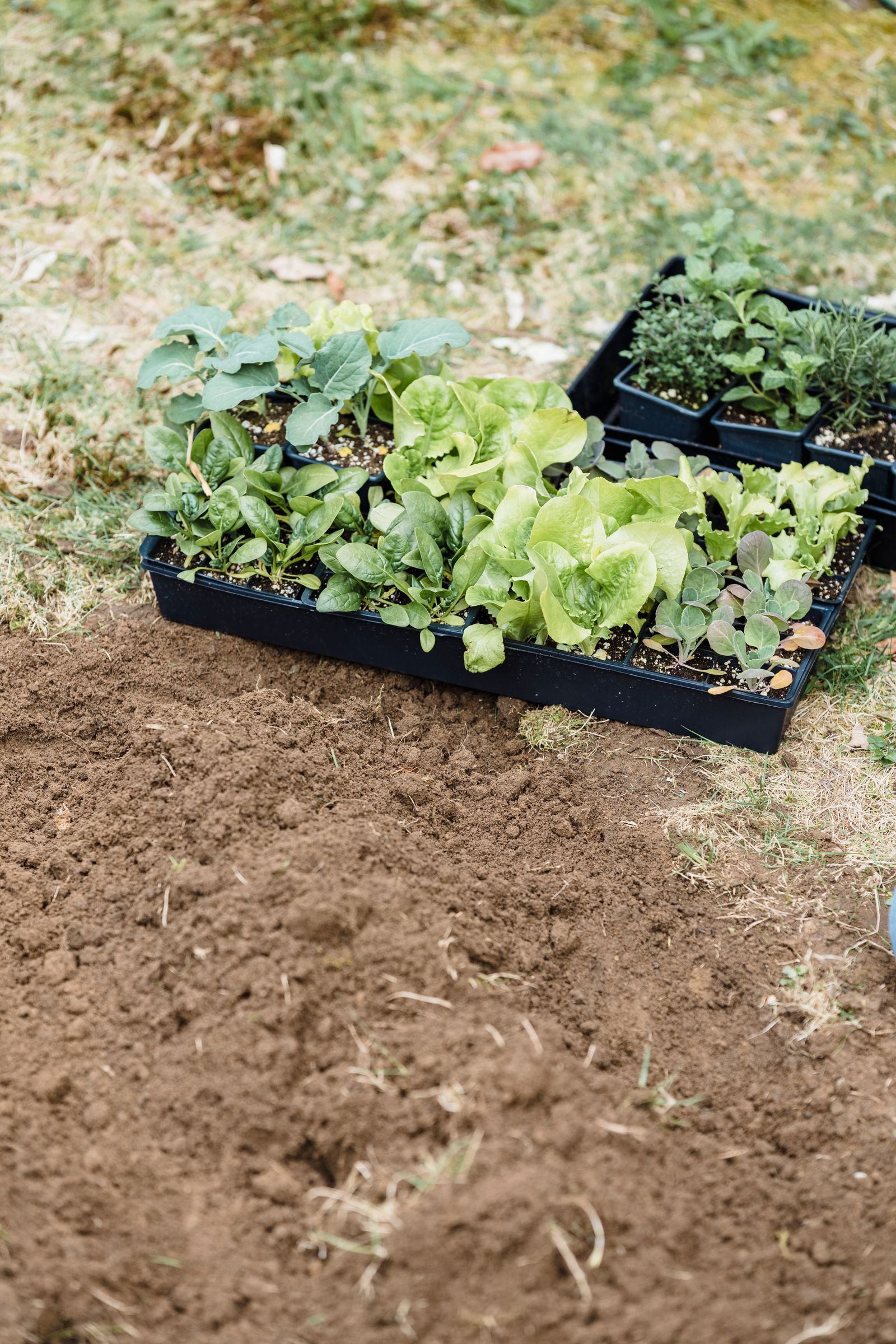
Seedlings in a black nursery tray beside soil, ready for planting outdoors
Reading a Seed Packet's Timing Language
Seed packets speak a compressed dialect of everything above, and learning to translate it removes the last excuse for planting by vibes. "Sow after all danger of frost" is the warm season instruction, and it means after your last frost date, on the cautious side for the tender crops. "Sow as soon as the soil can be worked" is the cool season instruction, peas and spinach and their kin, and it means weeks before the frost date, the moment the ground is dry enough to crumble rather than smear. "Days to germination" tells you how long to keep the seedbed moist and your nerve steady, and "days to maturity" is counted, unless the packet says otherwise, from transplant for started crops and from sowing for direct sown ones, a distinction that has made many a pepper look slower than it is.
Hardiness language matters too. A hardy annual or vegetable tolerates frost and belongs to the cool season. Half hardy survives a light frost but not a hard freeze. Tender means frost kills it, full stop, and tender crops are planted by the night forecast as much as by the calendar. When a packet's language and an extension table disagree, the table wins for your region: packets are printed for a continent, while your extension service publishes for your county's weather, which is the only weather your garden has.
Keep the packets, by the way, in a single envelope or box with the year written on it. Next winter, planning the garden with the actual packets in hand, their dates and days in front of you, is how the method in this article becomes a calendar in under an hour.
Succession Timing: The Third Dimension of When
Everything so far answers when to plant each crop once. The garden's third timing question is when to plant it again. Fast crops eaten fresh, lettuce, radishes, bush beans, cilantro, are planted in small amounts every 2 to 3 weeks through their season, so the harvest arrives as a stream instead of a flood followed by a gap. The arithmetic is unforgiving in both directions: a whole packet of lettuce sown on one April morning becomes forty heads competing to bolt in the same June week, while the same packet sown in six pinches across the spring feeds salads until summer. Write the repeat dates on the plan when you write the first one, because in the pleasure of the first harvest nobody remembers to sow the third round, and the gap three weeks later is where successions go to die.
Storage crops play the opposite game: carrots, onions, and winter squash are planted once, in quantity, timed so the whole harvest matures together into storage condition. Knowing which game each crop is playing, stream or store, is most of what separates a garden that feeds a household steadily from one that alternates between glut and emptiness while growing exactly the same plants.
The Fall Garden: The Second Planting Nobody Tells Beginners
Everything above runs again in midsummer, in reverse, and most beginners never hear about it. Cool season crops planted in late summer mature into the cooling fall, which is the weather they prefer, and taste better than their spring versions. Count backward from your first fall frost: a crop needing 60 days, sown 70 days before that frost, lands in the garden while tomatoes are still ripening.
The fall garden's enemies are heat at sowing, lettuce seed will not germinate well in hot soil, solved by sowing in shade or starting indoors, and the simple fact that nobody is thinking about planting in July. Set a note in the calendar when you plant the spring garden: fall sowing, mid July to August for most northern gardens. Peas, lettuce, spinach, kale, and carrots planted then carry the garden to Thanksgiving in mild years, and the gardener who plants twice eats twice.
Frequently Asked Questions
What is the single most important date for planting vegetables?
Your average last spring frost date. Every planting time in this guide is counted from it in weeks, using extension tables like North Dakota State University H1139. Remember it is an average: frost comes later in about half of all years, so tender crops like tomatoes, peppers, and basil belong on the cautious side of it, a week or two after.
Which vegetables can I plant before the last frost?
The cool season crops: peas, lettuce, spinach, broccoli, cabbage, kale, carrots, radishes, and onions. Per NDSU H1139, lettuce transplants go out about 4 weeks before the last frost, broccoli and kale about 3 weeks before, and onions about 2 weeks before. These crops tolerate light frost and grow best in mild weather.
Which vegetables must wait until after the last frost?
All the warm season crops: tomatoes, peppers, eggplant, beans, cucumbers, squash, corn, basil, and melons. Tomatoes, peppers, and basil transplant about 2 weeks after the last frost per NDSU H1139, and peppers additionally want soil warmed to at least 65 degrees, ideally 70. Planting these early does not give a head start; cold soil stalls them for weeks.
Does my USDA zone tell me when to plant?
No. Hardiness zones describe winter minimum temperatures, which matter for perennials surviving winter, and they say nothing about when your last spring frost falls. Two towns in one zone can have frost dates weeks apart. Planting times come from your local frost date, which your extension service or weather records provide.
Is it too late to plant if I missed the spring dates?
Almost never. Missed the indoor sowing window means buy transplants this year and sow next year. Missed spring entirely still leaves the whole warm season for beans, squash, and cucumbers, and the fall garden for cool season crops sown in mid to late summer. A garden year has more doors than the one in April.
How do I use the planner on this page?
Enter your average last spring frost date and the Seed Starting Date Planner returns, for each crop in the extension table, the week to sow indoors and the week to transplant or plant out, counted from your date. Copy the results onto your garden plan. Then check the week's night forecast and your soil's warmth before the tender crops actually go in, because the calendar proposes and the weather disposes.
Photo credits: Greta Hoffman (Pexels); Greta Hoffman (Pexels). Photos are served from this site; follow the credit to the library page for the original.