When to Start Seeds Indoors Chart: Every Crop, Counted Back from Your Frost Date
By the Windchime Walker editorial team
Photo: K / Pexels
Every seed starting chart on the internet agrees in shape and disagrees in numbers, because a chart is only as good as its source and most charts never name one. This page is the chart as a working document: the crops this site grows, their indoor sowing and transplant weeks counted from your average last spring frost date, every figure drawn from the extension sources already behind this site's planner, North Dakota State University Extension H1139 chief among them, with the sources printed on the chart instead of buried under it.
Our seed starting guide owns the method and the seedling craft in depth: the lights, the mix, the hardening off. This page owns the chart itself, the whole table on one page, with a worked example that turns weeks into calendar dates, and the planner that does the same arithmetic for your own frost date.
Interactive tool
Seed Starting Date Planner: The Chart for Your Frost Date
The chart on this page gives the weeks; this planner does the calendar math. Enter your average last spring frost date, pick each crop, and get its indoor sowing date and its transplant date from the week offsets in North Dakota State University Extension H1139.
Sow tomato indoors: Fri, March 20, 2026
Move seedlings outdoors: Fri, May 15, 2026.
Sow indoors 6 weeks before last frost; set out 2 weeks after last frost.
Week offsets: North Dakota State University Extension, H1139, garden seed starting chart, source. Frost dates are averages: in any given year the last frost can land two weeks either side of the date you type, so keep an eye on the forecast as transplant day approaches.
The Chart
Weeks are counted from your average last spring frost date. Negative transplant weeks mean the crop goes outside before the last frost, because it tolerates cool soil and light frost.
Crop
Sow indoors
Transplant out
Source
Pepper
8 weeks before last frost
2 weeks after
NDSU H1139
Tomato
6 weeks before
2 weeks after
NDSU H1139
Broccoli
10 weeks before
3 weeks before
NDSU H1139
Cabbage
10 weeks before
3 weeks before
NDSU H1139
Kale
10 weeks before
3 weeks before
NDSU H1139
Onion
10 weeks before
2 weeks before
NDSU H1139
Lettuce
8 weeks before
4 weeks before
NDSU H1139
Basil
3 weeks before
2 weeks after, once nights are warm
NDSU H1139
Marigold
6 weeks before
3 weeks after
NDSU H1139
Zinnia (head start)
4 weeks before
At last frost
Colorado State Extension
Cucumber (optional)
About 2 weeks before
1 to 2 weeks after
Derived from UNH Extension
Zucchini and summer squash (optional)
About 1 to 2 weeks before
2 weeks after
Derived from UNH Extension
Two rows deserve their footnotes in the open. The marigold row carries a genuine source disagreement, flagged rather than averaged: North Dakota State publishes 6 weeks before last frost, Colorado State publishes 4, and both work, because marigold is forgiving; the planner uses the NDSU figure. The cucumber and squash rows are derived, and the chart says so: University of New Hampshire Extension publishes that these seedlings grow 3 to 4 weeks before transplanting and go out 1 to 2 weeks after last frost, so the sow dates shown are arithmetic from those two published figures, labeled derived, and most gardeners skip the indoor start entirely and direct sow once the soil reaches about 70 degrees F.
The Count Back Method, Worked With Real Dates
Take a garden whose average last spring frost falls on April 18. The method is subtraction, crop by crop. Peppers, 8 weeks before: sow February 21, and they go out May 2, two weeks after frost. Tomatoes, 6 weeks before: sow March 7, out May 2 alongside the peppers. Broccoli, cabbage, and kale, 10 weeks before: sow February 7, and they go out March 28, three weeks before the last frost, because brassicas are hardy and want the cool. Onions, 10 weeks before: sow February 7, out April 4. Lettuce, 8 weeks before: sow February 21, out March 21, the earliest transplant on the chart. Basil, only 3 weeks before: sow March 28, out May 2, because basil is the tenderest thing on the page and cold nights below about 50 degrees F check it hard. Marigold, 6 weeks: sow March 7, out May 9. Now run the same list against your own frost date, which is the entire skill: the chart is portable because the frost date does the localizing.
The planner on this page performs exactly this arithmetic. Enter your frost date once, pick your crops, and it returns the sow and transplant dates from the same figures in this chart, which is the chart's reason for existing: printed for the wall, and computed for the calendar.
The Never Start Indoors List
Some crops are not late or early indoors; they are wrong indoors, and the chart leaves them off on purpose. Beans, peas, and corn grow so fast and resent root disturbance so much that a transplanted seedling loses to a seed sown directly in warm soil, every time. Carrots and the other taproot crops fork and stunt when their one long root meets a pot wall. Radish and the fast roots are ready in a month and gain nothing from a head start they cannot use. Cucumbers and squash sit on the border, which is why the chart carries them as optional with derived figures: their roots resent disturbance too, and the indoor start only pays in short season gardens where two weeks is the difference between a harvest and a near miss. When in doubt, the test is the root: fibrous rooted crops transplant happily, tap rooted and fast crops do not.
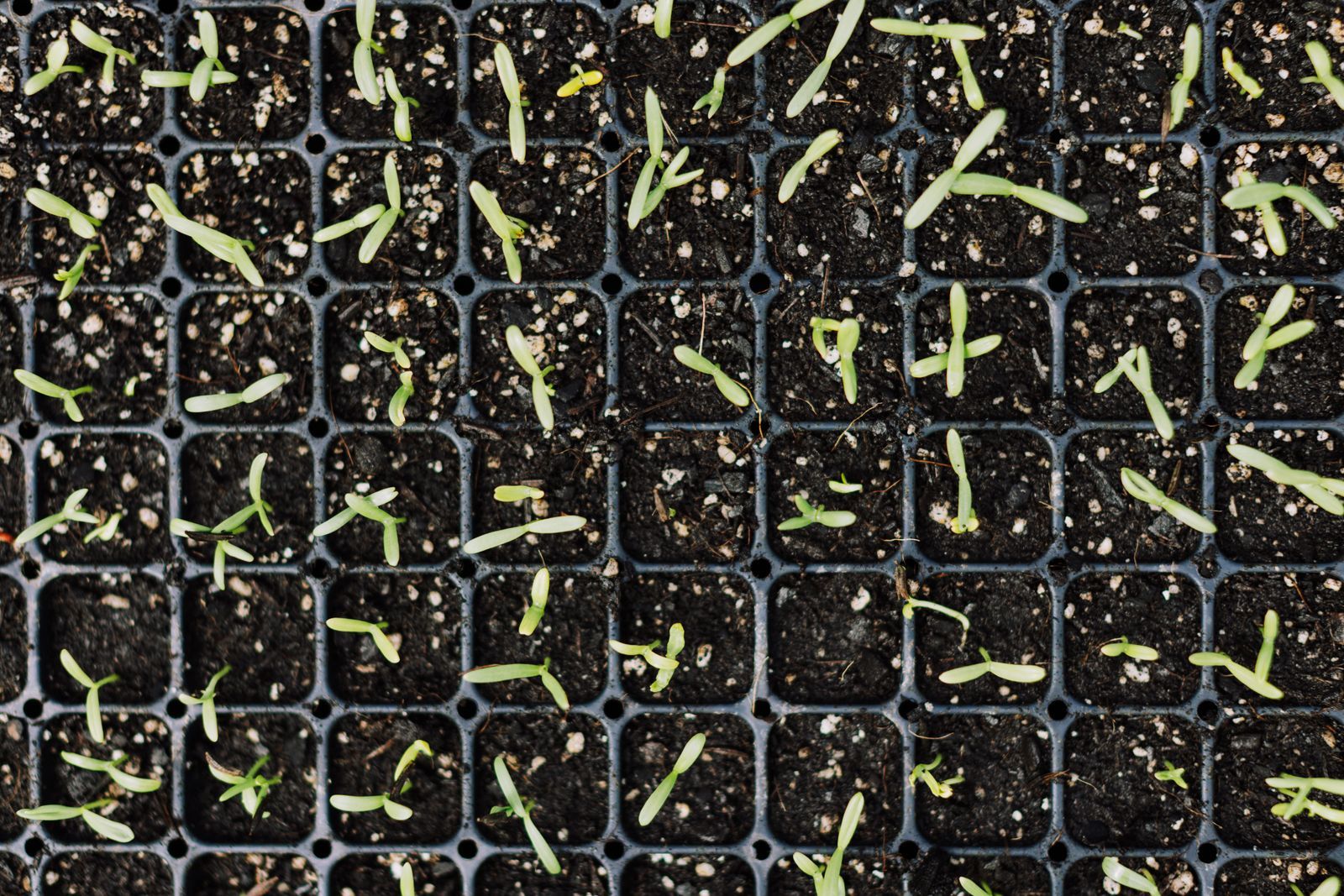
Young seedlings growing in a black plastic seed tray
The Too Early Warning
The chart's most valuable line is the one beginners argue with: the sow date is a target, not a starting gun. A tomato sown two weeks early does not become a tomato two weeks ahead; it becomes a leggy, root bound plant, stretched thin under lights it has outgrown, that sulks for a week after transplant while a compact plant sown on time walks past it. Seedlings have a size at which they transplant best, and the chart's weeks are calibrated to land each crop at that size on its transplant date, in ordinary home light. If your setup is dim, err a week late, not early: a slightly young seedling catches up in real sun, and a stretched one never fully recovers its shape. The exceptions are the slow, patient crops, onions and the brassicas, whose 10 week starts look absurd in February and are exactly right in April.
Reading the Chart With the Packets
Your seed packet is the chart's local editor. Varieties differ by days to maturity, and a packet that says its pepper matures 10 days earlier than standard can be sown a few days later without loss. What the packet cannot do is move the transplant date, which is set by frost and soil temperature, not by the variety; an early variety sown on the chart's date simply harvests earlier. Keep the chart for the framework, the packet for the variety's fine print, and your own notes for the truth: one season of writing down what you actually sowed and what actually happened tunes this chart to your garden better than any source, including this one, ever will.
Second Sowings: The Chart Runs Backward in Summer
The chart is printed for spring, and its second life begins in midsummer, when the fall garden is planned by the same arithmetic pointed the other way. The hardy rows, broccoli, cabbage, and kale, are sown again in early to midsummer, in a shaded outdoor bed or under lights kept cool, and transplanted so their harvest lands in the cooling fall, roughly 10 to 12 weeks before the first frost for the heading brassicas. Lettuce restarts in late summer in short successions as the heat breaks. The tender rows do not run backward: there is no fall pepper, because the frost that the spring chart counts down to is the same frost that ends the warm season, and the indoor weeks for basil and tomato belong to spring alone. Knowing which rows reverse and which do not is the difference between a chart on the wall and a calendar in the head, and it doubles the value of the spring work: the frost date you looked up in February is the same date, counted from the other side, that plans your July.
Keeping Your Own Edition
Print the chart, pencil your frost date at the top, and annotate it with what actually happened: the year the peppers sown on the chart's week grew stocky and perfect, the year the tomatoes stretched because the shelf light failed in week five, the variety that matured ten days ahead of its row and earns an earlier sowing next spring. Extension charts, this one included, are regional averages wearing a lab coat; your annotations are the local edition no source can publish. Three seasons of notes tune the chart to your soil, your light, and your kitchen's appetite more precisely than any revision we could issue, and the annotated page, coffee ringed and penciled, becomes the most valuable single sheet in the garden shed.
Frequently Asked Questions
How do I find my last spring frost date?
Use your local extension service or a climate station average for your area: it is the average date of the last spring frost, which means frost can and does fall after it in some years. Tender crops on this chart go out after it with a margin, the 2 weeks after column, precisely because the average is not a promise.
What if I started my seeds too early?
Grow them on cool and bright, which slows stretching without stopping growth: the strongest light you have, lights close above the leaves, and a cool room. Pot tomatoes up into deeper soil, burying stem, which roots along its length. Then transplant on the chart's date anyway; an early plant held well beats an early plant rushed into cold soil.
What if I missed a crop's sow date?
Sow it now and take the smaller penalty. A tomato sown two weeks late transplants slightly small and catches up in warm soil; it loses days, not the crop. The crops that punish lateness are the slow ones, onions and peppers, and even they are worth sowing late rather than skipping, because a late harvest is a harvest.
Can I start flower seeds with this same chart?
The two flowers on the chart, marigold and zinnia, follow it directly, and our flower seed sowing guide covers the flower specific routes, which flowers must start indoors, which must be direct sown, and the depth and light rules per route. Most other annual flowers count back 6 to 8 weeks for slow growers and 4 to 6 for fast ones, checked against the packet.
Why do sources disagree on the same crop?
Because the honest answer depends on growing conditions the chart cannot see: light intensity, room temperature, and how large a transplant the gardener wants. Marigold at 4 weeks from Colorado State and 6 weeks from North Dakota State are both right for their assumptions. This chart names its source per crop so you can see the disagreement instead of inheriting an average of it.
Do I need grow lights to use this chart?
For the long starts, effectively yes: a windowsill grows onions and brassicas acceptably and stretches tomatoes and peppers thin by week six. A simple LED or fluorescent fixture hung 2 to 4 inches above the seedlings, on 14 to 16 hours a day, is the difference between the chart's compact transplants and the leggy ones the warning describes.
Photo credits: K (Pexels); Greta Hoffman (Pexels). Photos are served from this site; follow the credit to the library page for the original.