A yellow leaf frightens new plant owners out of proportion to what it usually means, and the fear itself causes the worst outcomes. The reflex is to do something generous: more water, more fertilizer, a bigger pot, a sunnier window, all in the same week. If the real problem was too much water, the extra water pushes the plant further toward root rot. If the problem was too little light, the fertilizer feeds nothing, because the plant has no energy to use it. Yellow leaves, called chlorosis when gardeners want the technical word, are a symptom with a short list of common causes, and the plant is telling you which one it is through the pattern of the yellowing. Where the yellow appears, which leaves it takes first, how the leaf feels, and what the soil is doing will narrow the list to one or two suspects in about two minutes, before you change anything at all.
One fact calms the whole process down: a leaf that has turned fully yellow will not turn green again. The plant has already withdrawn what it wanted from that leaf. So judge every fix by the new growth and by whether the yellowing stops spreading, not by whether the yellow leaf recovers. It will not, and removing it once it is mostly yellow is fine and tidy. Your job is not to save that leaf. Your job is to stop the next one from following it.
Start the diagnosis with an audit, not a guess. Most yellowing traces back to water, and most of us misremember how much water we actually gave. Use the WateringCalculator below as a checking tool: enter the size of the pot's surface or the bed the plant sits in and the amount you have been applying, and see the weekly total in plain gallons and inches. Gardeners are routinely surprised in both directions, by how little a daily splash adds up to at root depth, and by how much a faithful weekly drench delivers to a plant that wanted to dry out between drinks.
Interactive tool
Garden Watering Calculator
Advice like "give the bed an inch of water" only helps if you know what an inch costs. Enter the bed size and the depth you want to apply, and read the answer in gallons, liters, and watering cans.
19.9 gallons
For 32 square feet at 1 inch deep. That is about 76 liters, or 10 trips with a standard 2 gallon watering can.
A rain gauge or a straight sided can set in the bed tells you when a sprinkler or soaker hose has actually delivered this depth. Time alone is a guess, because hose pressure varies from house to house.
The conversion is arithmetic, not opinion: one inch over one square foot is 144 cubic inches of water, and a US gallon holds 231 cubic inches, so each square foot at one inch takes 0.62 gallons.
The Two Minute Check Before You Change Anything
Ask three questions, in this order, and write the answers down if the plant matters to you.
First, where is the yellow? On the oldest, lowest leaves, on the newest growth at the top, in patches between the veins, at the edges and tips, or spread across the whole plant at once? Location is the strongest clue you have, because different causes attack different leaves. Problems with mobile nutrients like nitrogen, and plain old age, show on the oldest leaves first, because the plant moves what it can from old leaves to new growth. Problems with immobile nutrients like iron show on the newest leaves, because the plant cannot move iron from old tissue to new. Water problems tend to take lower leaves and overall vigor together.
Second, how does a yellow leaf feel? Soft, limp, and a little translucent points toward too much water and struggling roots. Dry, thin, and crispy at the edges points toward too little water, salt buildup, or scorch. Normal thickness but evenly pale points toward hunger or low light. Feel is the fastest way to separate the two water problems, which need opposite cures.
Third, what is the soil doing right now? Push a finger 2 to 3 inches into a pot, or 2 to 3 inches down beside a garden plant. Wet and sticky, damp and cool, or dry and dusty? Check the pot's drainage while you are there: is there a hole, is the saucer holding standing water, does the pot feel heavy or light for its size? A heavy pot with wet soil and a yellowing plant is a completely different case from a light pot with dry soil and the same yellow leaf, and the soil check is what tells them apart. Only after these three answers should you read the causes below, and you will find you can skip half of them on sight.
The Diagnosis Table
Use the table to match your plant's pattern to a cause, run the simple test to confirm it, and apply the fix in the last column. Houseplant and garden cases are listed separately where their tests differ, because a pot and a bed fail in different ways.
Yellowing pattern
Likely cause
Simple test
Fix
Houseplant: lower leaves yellow and soft, whole plant limp, soil wet for days
Overwatering
Finger 2 to 3 inches down finds wet soil; pot feels heavy; saucer holds water
Stop watering, empty the saucer, let the top of the soil dry before the next drink, confirm the pot drains freely
Garden: lower leaves yellow, soil soggy after rain or watering, plants wilt in wet ground
Overwatering or poor drainage
Dig a small hole beside the plant; water stands in it or soil stays slick and sour smelling
Water less often and more slowly, mulch to even out moisture, improve drainage with compost worked into the bed
Houseplant: leaves yellow then crispy at edges, soil pulled away from the pot rim
Underwatering
Pot feels light; soil dry all the way down; water runs straight through when poured
Water slowly until it drains from the bottom; if soil has gone hydrophobic, soak the pot in a bowl for 20 to 30 minutes, then drain
Garden: leaves yellow and crisping, soil dry and cracked at root depth
Underwatering
Finger or trowel finds dry soil 2 to 3 inches down on a morning check
Give a deep, slow watering at the base, then mulch 2 to 4 inches deep to hold it
Whole plant pale yellow green, new growth small, stems stretched toward the window
Too little light
Compare sides: the window side is greener; growth leans; the spot gets only a few hours of bright light
Move closer to a bright window in stages, turn the pot a quarter turn weekly, or add a grow light
Bleached yellow or white patches on the side facing the glass, with papery brown spots
Too much direct sun or heat
Patches match the sun's path and appear after a move to a sunnier spot or a hot spell
Pull the plant back from the glass or filter the light with a sheer curtain; acclimate moves over a week
Oldest leaves turn evenly yellow one by one, moving slowly up the plant, new growth green but small
Nitrogen hunger
The plant has not been fed in months, or the bed has grown hungry crops without added compost or fertilizer
Feed a balanced fertilizer at label strength or half strength for houseplants in the growing season; add compost to beds
New leaves yellow while the veins stay green
Iron chlorosis
Shows on newest growth; common with alkaline soil or hard tap water; old leaves stay green
Chelated iron per label for a fast response; flush salts from pots; address soil pH in beds over time
One or two of the oldest leaves yellow and drop, everything else green and growing
Natural aging
Count the damage: it is slow, low, and limited, and new growth looks healthy
Nothing. Remove the spent leaf and carry on
Overwatering: The Most Common Cause
Too much water kills more houseplants than every other cause on this page combined, and it misleads because the plant wilts, which reads as thirst. Roots need air as well as water. In soil that stays saturated, the air pockets fill and stay filled, roots suffocate, and fine root hairs begin to rot. A plant with rotted roots cannot take up water or nutrients even while sitting in water, so the leaves yellow, soften, and droop in the middle of plenty. Supporting clues: soil that stays wet a week after watering, a sour or swampy smell from the pot, tiny fungus gnats hovering at the surface, green algae on the soil, and stems that feel soft at the base.
The fix is restraint plus drainage. Stop watering and let the soil dry until the top few inches are dry to your finger. Empty any saucer or outer pot so the plant never stands in its own runoff. Confirm the drainage hole is open; a surprising number of decorative pots have none, and the honest cure is a pot that drains, slipped inside the pretty one if you love it. If the plant keeps declining, slide it out of the pot and look at the roots. Healthy roots are firm and pale. Rotten roots are brown or black, mushy, and smell bad. Trim the rotted parts with clean scissors, repot into fresh, well draining mix, and water lightly until new growth shows the roots are working again. In the garden, overwatering usually means watering too often in small amounts on soil that drains slowly; water deeply and less often, and work compost into the bed over seasons to open its structure.
Underwatering: The Opposite Problem With a Similar Face
Too little water yellows leaves too, but the details differ in ways your hands can detect. The soil is dry, in a pot it often shrinks and pulls away from the rim, and the pot feels strikingly light when lifted. Leaves yellow and then turn brown and crispy, starting at tips and edges, and they feel papery rather than soft. The whole plant may wilt dramatically and, unlike the overwatered plant, it recovers visibly within hours of a proper drink, because its roots are alive and waiting.
Water thoroughly and slowly, until water runs from the drainage hole, so the whole root ball wets rather than just a channel through it. Very dry potting mix can become water repellent, shedding water down the inside of the pot while the center stays dry; if that happens, set the pot in a bowl of water for 20 to 30 minutes to soak from below, then lift it out and let it drain fully. In the garden, give a slow deep soaking at the base of the plant, then mulch to keep the moisture you applied. Then fix the pattern, not just the day: most underwatering is a schedule problem, a plant whose pot size, sunny spot, or growth spurt quietly outgrew the watering rhythm that used to suit it.
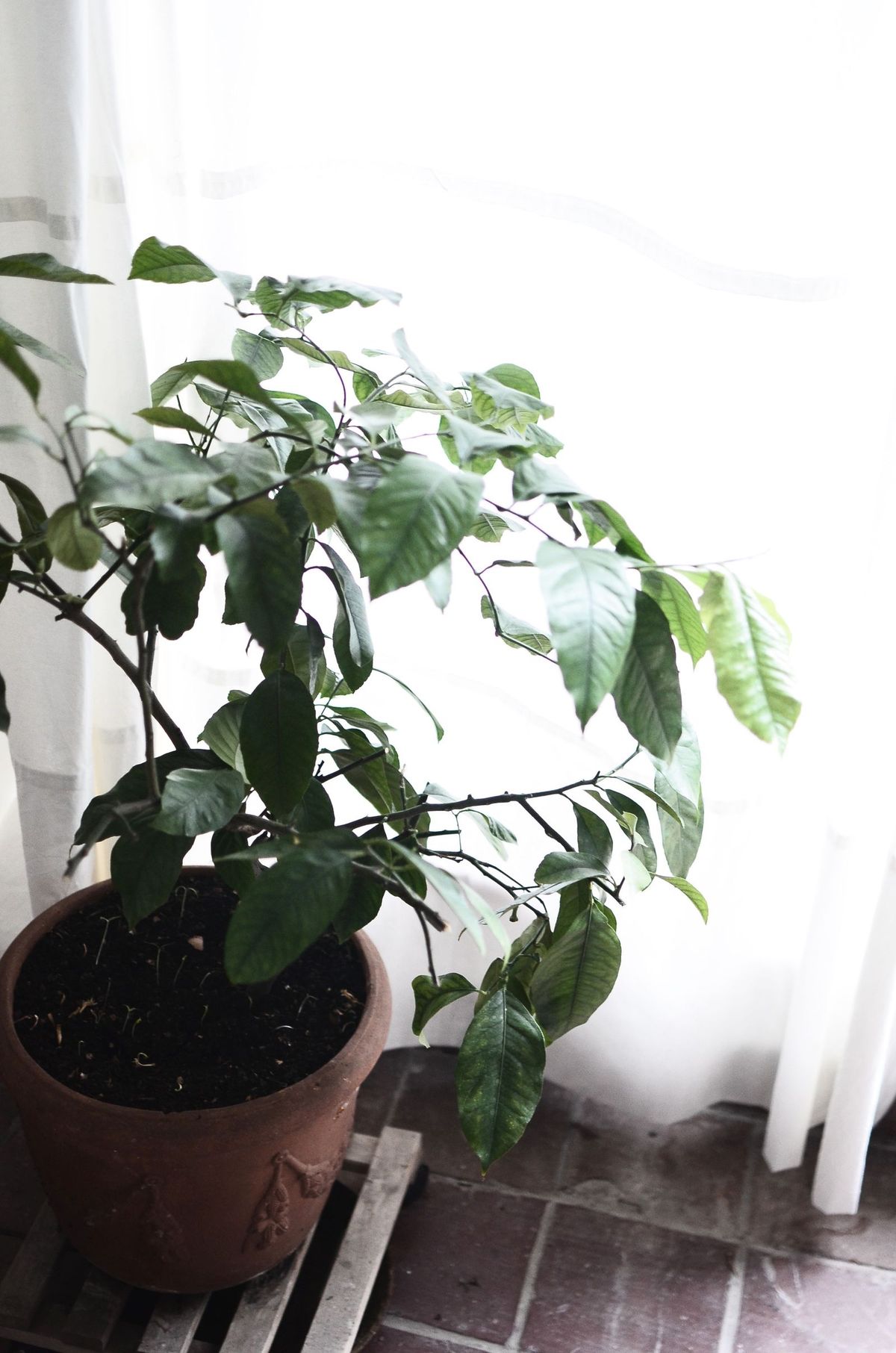
A potted houseplant in a terracotta pot beside a bright window
Light: Too Little, and Sometimes Too Much
Light problems yellow leaves slowly and evenly, which makes them easy to miss and easy to misread as hunger. A plant in too little light cannot make enough energy to maintain all its leaves, so it sheds the oldest and lowest ones, turns a pale yellow green overall, and stretches thin, leggy growth toward the window. Houseplants suffer this most often a few feet back from the glass in a room that feels bright to human eyes; our eyes adjust, and plants cannot. The fix is more light, delivered gradually: move the plant closer to the brightest window it can tolerate, in steps over several days rather than one jump into direct sun, rotate it weekly so all sides share the light, and consider a simple grow light for a plant that must live in a dim room.
Too much light yellows in the opposite pattern: bleached, yellow white patches on the leaves that face the sun, sometimes with dry brown scorch spots, appearing after a move outdoors, a shift to a south window, or a heat wave behind glass. Shade loving houseplants scorch fastest, but even sun lovers burn if moved from a dim store shelf straight into full afternoon sun. Pull the plant back a little, filter midday sun with a sheer curtain, and acclimate any big light increase over a week or two. New leaves grown in the new light will come in normal; scorched patches on old leaves are permanent, like the yellow ones.
Nitrogen and Other Hungry Plant Patterns
A plant that has simply run out of food yellows in a readable order, because nutrients differ in whether the plant can move them. Nitrogen is mobile inside the plant, so when nitrogen runs short the plant strips it from the oldest leaves to feed new growth. The result is the classic pattern of this cause: the lowest leaves turn evenly, uniformly yellow, one after another, moving slowly upward, while the top stays green for a long time. It is common in pots that have not been fed in a year, since watering flushes nutrients out of the drainage hole a little at a time, and in garden beds that grew heavy feeders without compost or fertilizer added back. The fix is feeding, at label strength for garden plants and label or half strength for houseplants during the growing season, plus compost for beds. More is not better: excess fertilizer burns roots and produces its own yellow, crispy edged damage, so measure instead of splashing.
Iron tells the opposite story. Iron is immobile, so a shortage shows on the newest leaves, which come in yellow while their veins stay green, a pattern called interveinal chlorosis, while old leaves remain green. It often appears even when iron exists in the soil, because alkaline soil and hard tap water lock iron away from roots. Chelated iron, sold for exactly this problem, gives the fastest response; in pots, a thorough flush with plain water to wash out accumulated salts also helps, and a white crust on the soil surface or pot rim is the visible signature of the salt buildup behind many slow yellowing cases. Magnesium shortage resembles iron but appears on older leaves, yellow between the veins, because magnesium, like nitrogen, is mobile. A complete fertilizer that includes magnesium and trace elements covers it; do not chase single elements with home remedies until the pattern and a feeding history actually point there.
Natural Aging: The Cause That Needs No Fix
Not every yellow leaf is a problem, and learning to leave the healthy ones alone is half of plant care. Plants retire their oldest leaves as a matter of routine. A tomato sheds its lowest leaves as the season climbs, a pothos drops an old leaf at the base of a long vine, a garden perennial yellows its first spring leaves as summer growth takes over. The pattern is the reassurance: one or two leaves at a time, always the oldest and lowest, over weeks rather than days, while new growth at the top stays green, firm, and active. A plant that was just moved or repotted may also drop a few leaves while it settles, which is shock, not decline; give it steady care and two or three weeks before judging.
Worry instead when the pattern breaks those rules: many leaves yellowing within days, yellowing that starts at the top, soft black stems at the soil line, or soil that smells rotten. Speed and location separate a plant that is aging from a plant that is failing, and the table above is built on exactly that distinction. When the pattern says aging, the correct treatment is a pair of scissors for the spent leaf and the confidence to do nothing else.
Frequently Asked Questions
Can a yellow leaf turn green again?
Almost never. Once a leaf has gone fully yellow, the plant has reclaimed the mobile nutrients from it and the green pigment is gone. A leaf caught at the pale, early stage can sometimes recover some color if the cause was mild and fixed fast, but plan on the yellow leaf being finished. Fix the cause and watch the new growth, which is where recovery shows.
Why are only the bottom leaves of my plant turning yellow?
Bottom first yellowing has three usual explanations, and the soil separates them. Soft yellow leaves over wet soil point to overwatering. Even, slow yellowing of the oldest leaves on a plant that has not been fed in months points to nitrogen hunger. One or two old leaves at a time on an otherwise thriving plant is natural aging and needs nothing but removal of the spent leaf.
Why are the new leaves yellow while the old ones stay green?
That pattern points to iron chlorosis. Iron cannot be moved from old leaves to new ones, so a shortage, or soil conditions that lock iron away, show first on the newest growth, often with the veins staying green while the tissue between them yellows. It is common in alkaline soil and with hard tap water. Chelated iron gives the fastest correction while you address the underlying soil or water issue.
Should I cut off yellow leaves?
Yes, once a leaf is mostly yellow. It will not recover, and removing it keeps the plant tidy, improves airflow, and lets you see clearly whether new yellowing is still appearing, which is the real progress report. Pull it gently by hand or cut it close to the stem with clean scissors. Avoid stripping many leaves at once from a weak plant; take what is fully spent and leave anything still partly green to keep feeding the plant.
How long after fixing the cause will my plant look better?
Days for thirst, weeks for most other causes. An underwatered plant with healthy roots perks up within hours and stops yellowing almost at once. An overwatered plant needs the soil to dry and roots to regrow, so expect two to four weeks of steady, restrained care before new green growth confirms the recovery. Light and nutrient fixes also show in new growth first. If yellowing keeps spreading at the same speed after three weeks of the matched fix, recheck the diagnosis, starting with the roots.
Photo credits: Letícia Alvares (Pexels); Skylar Kang (Pexels). Photos are served from this site; follow the credit to the library page for the original.