Garden Bed Edging With Rocks: One Row, Buried Half Deep
By the Windchime Walker editorial team
Photo: Lauren Smith / Pexels
Rocks are the oldest edging material in gardening and the one most often installed as decoration instead of structure, which is why rock edging has a reputation for wandering, sinking, and spilling into the lawn by the second season. The difference between the edging that lasts and the edging that migrates is a trench and a burial depth. Set each rock about half its height into a trench 4 to 6 inches deep, faces aligned to a string line, and the row behaves like the low wall it actually is. Lay the same rocks on the surface like a bead necklace and the mower, the frost, and the mulch will redistribute them by spring.
Our general guide to garden bed edging compares every material, metal, brick, stone, and plastic, by what each does well. This page is the rock build itself: which rock class does which job, the single row technique, when a second dry stacked course is worth building, and how the pebble border, a different animal entirely, is contained. For the full wall version of the same craft, see our guide to how to build a garden dry stone wall.
Interactive tool
Rock Edging Checklist
Check off each step as you finish it. Your progress stays on this page.
0 of 8 complete
0% done
Rock classes, matched to jobs
Rock class
Typical size
The job it does
Notes
Cobbles
4 to 8 inches, rounded
The standard single row edge
Buried half deep; the workhorse of rock edging
Boulders
12 inches and up
Anchors at corners, ends, and gates
Set first; the row is built between them
Flat fieldstone
2 to 4 inches thick
Dry stacked two course edges
Stacks like the wall craft in miniature
River rock
2 to 5 inches, smooth
Fill and informal edges
Rolls; needs the trench most of all
Pebbles and gravel
Under 2 inches
Pebble border beds and mulch bands
Not a row at all; needs a containment edge
The anchor principle organizes the whole build: the largest stones go in first, at the corners, the ends of runs, and either side of any gate or path crossing, and the row is then filled between anchors. A row built from uniform cobbles with no anchors reads as a queue of separate stones and fails at its ends first. A row anchored by boulders reads as one structure, and the eye forgives every small irregularity between them.
The single row build
Mark the line with a hose or rope, then set a string line at the finished height of the edging and dig the trench along it: 4 to 6 inches deep, a few inches wider than your rocks, with a flat bottom. The trench depth is calibrated to the burial rule: a 10 inch cobble sits 5 inches in the ground and shows 5 above it, which puts the trench at the deep end of the range; smaller rock wants the shallow end. Set the anchors first, buried a little deeper than the row for stability, then fill between them, choosing each rock for the gap, turning it until its best face fronts the lawn and its body nests against its neighbors.
Two details decide whether the row looks built or spilled. The faces align to the string line, not to each other: the visible plane of the edging should be one continuous line even though every rock is a different shape. And the gaps along that visible face stay under an inch; a gap at the face is where mulch escapes and grass invades, while gaps behind the face are harmless and get packed with soil. When the row is set, backfill behind the rocks with soil, tamp it firm, and bank the bed's soil and mulch against the back of the row so the finished edge reads clean from the lawn side.
The second course, and when it earns its keep
A single row edges a bed that sits at lawn level. A bed built up above the lawn, or a bed on a slope, needs the second course: flat stones dry stacked on the first, offset so each stone bridges the joint below, exactly the one over two rule of the wall craft at garden scale. Two courses of fieldstone make a miniature retaining edge about 8 to 10 inches tall that holds a raised bed's soil line honestly. Do not stack rounded cobbles for the second course; round on round is a rockery waiting to roll. If your stone is round and your bed is high, the answer is a bigger single row of boulders, buried deeper, not a stack.
Frost country adds one rule: the deeper the frost, the more of the rock belongs underground. A row buried half deep in a mild climate can ride at a third deep where the ground barely freezes, but in zone 5 and colder, half is the minimum and the trench bottom should sit on a thin bed of gravel where the soil is heavy clay, so the row is not lifted by ice lenses forming under it.
The pebble border is a different project
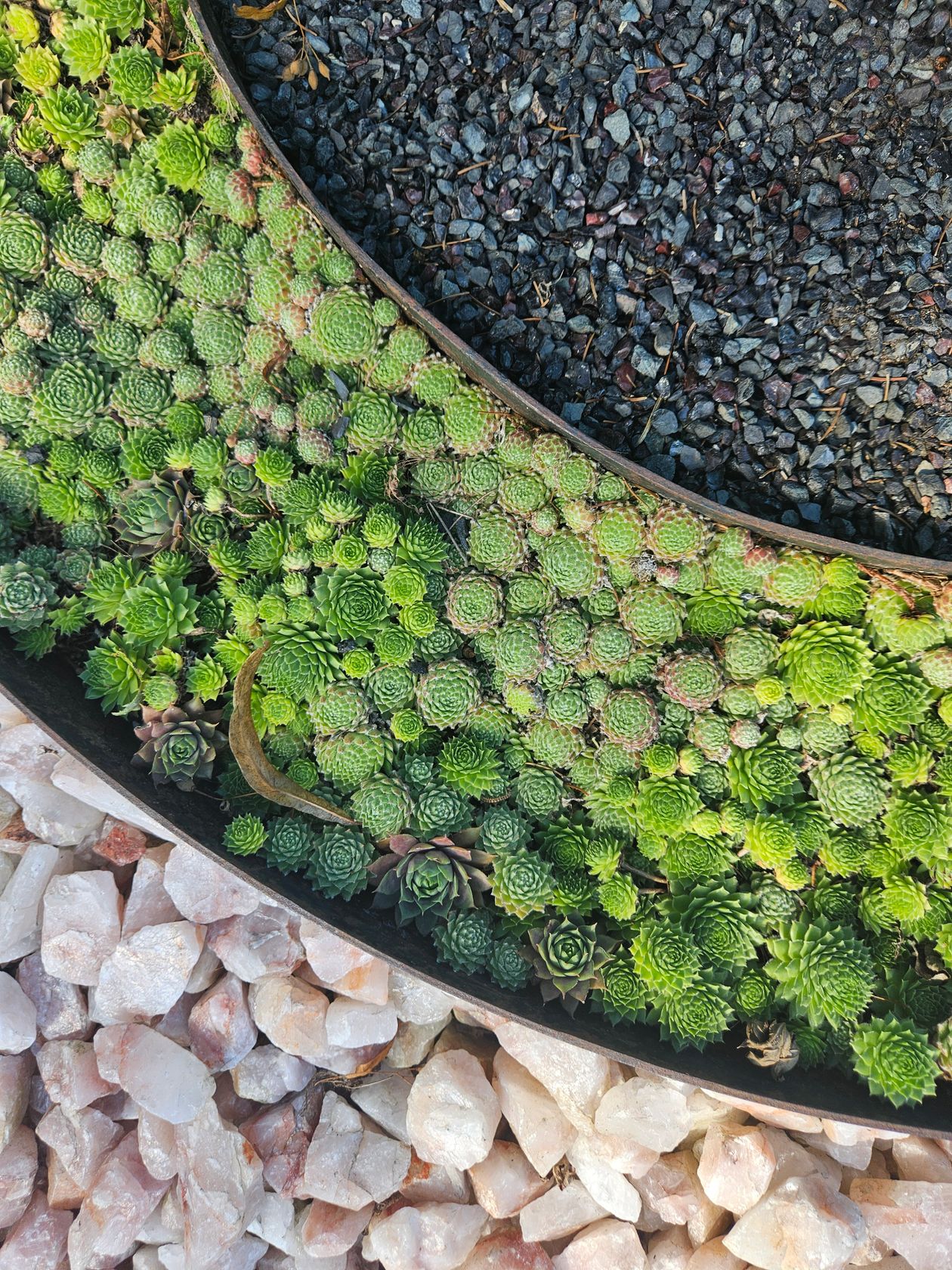
A band of pebbles or gravel along a bed is often sold as rock edging, but nothing in it is a row: it is a mulch band, and it fails by migration, pebbles walking into the lawn and lawn walking into the pebbles. The manufactured edging industry exists largely to contain it: a steel, aluminum, or heavy plastic strip set between the pebble band and the grass is not an optional garnish but the actual edge, with the pebbles as infill. Build it that way and it is a legitimate, handsome, low maintenance border, especially in the desert designs of our Arizona front yard guide. Build it without the strip and you will be picking pebbles out of the mower's path forever.
Sourcing the stone without buying it twice
Rock is priced by the ton and hauled by the yard, and the arithmetic surprises first timers: a single row of 6 to 8 inch cobbles along a 20 foot bed edge takes roughly a quarter to a half ton of stone, depending on how generously the rocks are sized. Buy from a stone yard, not bagged from a garden center, at a third of the price per pound, and buy 10 percent more than the measured run, because the last two feet of an edging run are where the leftover rocks never fit and a second trip costs more than the overage. Fieldstone gathered from your own land, where that is legal and the stone is genuinely yours, is the traditional source and the reason old farm regions are lined with stone edging: the rocks came out of the fields one spring at a time. However it arrives, reject the load if it is mostly rounds for a stacking project or mostly flats for a cobble row; the class table at the top of this guide is a purchasing spec, not just a building one.
Stacked boulders topped with red sedum in a flower bed
Signs you are getting it wrong
Rocks tipping into the lawn were buried too shallow; the fix is resetting at half depth, not pushing them back upright each spring. A wavy face means the string line was skipped. Grass threading through the row means the face gaps were left open or the trench was dug through turf without removing it; lift the section, clear the roots, and reset tight. And pebbles everywhere means a pebble band was built without its containment strip, the one component that was never optional.
How deep should rocks be buried for garden edging?
About half their height. A 10 inch cobble sits roughly 5 inches in the ground, in a trench 4 to 6 inches deep with a flat bottom. Buried at half depth, a rock resists frost heave, mower bumps, and the pressure of the bed's soil and mulch behind it. Rocks set on the surface or buried a token inch are the ones found lying in the lawn by spring.
What size rocks work best for edging a flower bed?
Cobbles in the 4 to 8 inch range are the standard: large enough to bury half deep and still show a face, small enough to place by hand and nest tightly. Use boulders of 12 inches and up as anchors at corners, ends, and path crossings, and flat fieldstone where you want a second stacked course. Pebbles under 2 inches are not a row at all; they form a mulch band that needs a manufactured strip to contain it.
Do I need landscape fabric under rock edging?
No, and under the row itself it causes trouble: fabric under the trench makes a slippery layer that helps rocks migrate, and it surfaces at the face as it degrades. The row's weed control comes from tight face gaps and the soil banked behind it. Fabric has a defensible use under a pebble or gravel band, where it separates stone from soil, and even there a containment strip at the lawn edge matters more.
Can rock edging hold back a raised bed?
A single row holds a bed at or near lawn level. For a bed built up above the lawn, stack a second course of flat stone, offset like brickwork so every stone bridges a joint, which gives an 8 to 10 inch miniature retaining edge. Rounded stone should not be stacked; for height with round stone, use one row of larger boulders buried deeper instead. Anything holding back more than about a foot of soil is a wall project, not an edging project.
How do I keep grass from growing through rock edging?
Deny it the gaps. Set the row with face gaps under an inch, packed from behind with soil, and remove the turf and its roots from the trench line before setting a single rock. Grass invades through open joints and from roots left alive under the row. A section that is already threaded with grass has to be lifted, cleared, and reset; no surface treatment fixes a row that was built over living sod.
Photo credits: Lauren Smith (Pexels); Saša Radojčić (Pexels). Photos are served from this site; follow the credit to the library page for the original.