A dieffenbachia rarely dies of thirst. It dies of kindness, watered on a schedule by an owner who never checked what the mix was doing below the surface. This plant wants a full drink followed by a real drying interval, and the interval is measured in inches of dry soil, not in days on a calendar. Clemson Extension states the bench plainly: water thoroughly, and let the soil dry to the touch to a depth of 1 inch before watering again. Everything on this page hangs off that one test: how to run it, how pot size and season stretch or shrink the interval it produces, where the conflicting advice in other guides comes from, and what to do when the plant has already been kept too wet. One warning belongs up front, because it decides where the plant may live at all: dieffenbachia is toxic to pets and a genuine hazard to small children, covered in its own section below.
Home / Gardening Basics for Beginners
How Often to Water Dieffenbachia: The One Inch Rule, the Root Rot Line, and the Pet Safety Warning
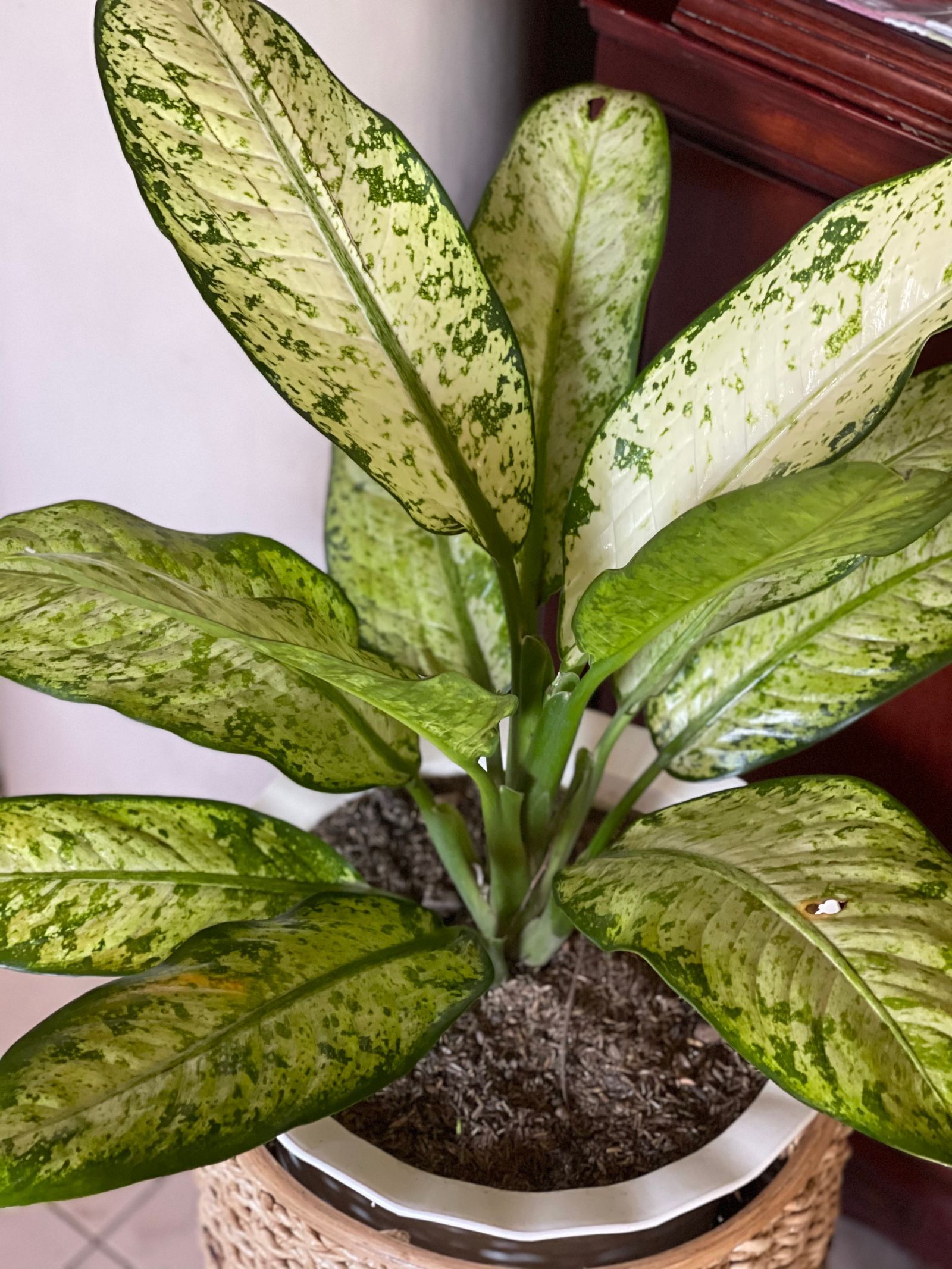
Photo: Vicky De Guzman / Pexels
Watering Calculator: The Dieffenbachia Pot Audit
A dieffenbachia is watered thoroughly, then left until the soil is dry to the touch 1 inch down, the Clemson Extension bench. Enter your pot diameter as both length and width below and a depth of about 1 inch to size that thorough watering for the pot you actually own.
19.9 gallons
For 32 square feet at 1 inch deep. That is about 76 liters, or 10 trips with a standard 2 gallon watering can.
A rain gauge or a straight sided can set in the bed tells you when a sprinkler or soaker hose has actually delivered this depth. Time alone is a guess, because hose pressure varies from house to house.
The conversion is arithmetic, not opinion: one inch over one square foot is 144 cubic inches of water, and a US gallon holds 231 cubic inches, so each square foot at one inch takes 0.62 gallons.
The One Inch Rule: Water Thoroughly, Then Wait for the Test
The rule has two halves and both matter. The watering half is thorough: when you water, water completely, until water runs from the drainage holes and the whole root ball is wetted, then empty the saucer so the pot never stands in its own runoff. The waiting half is the test: push a finger into the mix, and water again only when the soil feels dry to the touch down to about 1 inch. In a typical bright room that test usually comes up dry every 1 to 2 weeks in the growing season, and less often in winter, but those intervals are outcomes, not instructions. A small pot on a sunny sill can pass the test in 5 days; a large floor plant in a cool corner can take 3 weeks. The pot audit above sizes the thorough half of the rule for the pot you own, because a drink that only wets the top half of the root ball trains shallow roots and fools the next finger test.
The Conflict: One Inch or Three?
Search this question and you will find guides telling you to let the top 2 to 3 inches dry before watering. That advice is not invented, but it is not the extension bench, and the two figures should not be averaged into a mushy 2 inch compromise. Clemson's 1 inch test is written for the standard case: a dieffenbachia in a normal indoor pot, in a free draining mix, in a heated or cooled room. The deeper drying figures suit a narrower case, very large pots in cool rooms, where the bottom of the root ball stays wet long after the surface dries and the finger test reads the whole profile. The practical reading is this. Run the 1 inch test on pots up to about 10 inches across. On a big floor pot, check at 1 inch and again deeper with a wooden skewer before you water; if the skewer comes out damp and dark at depth, wait, whatever the surface says. What you should not do is apply the 3 inch rule to a small pot on a bright sill, where it becomes a drought regime for a plant that likes an even moisture supply while it is growing.
Pot, Light, and Season: What Moves the Interval
The test is fixed; the interval it produces is not. Pot size is the biggest lever, because soil volume is a water tank: double the pot diameter and you roughly quadruple the stored water, so a plant that needed a drink weekly in a 6 inch pot may go 2 weeks in a 10 inch pot on the same sill. Material matters too. Terracotta breathes and dries the mix from the sides, shortening the interval; glazed ceramic and plastic hold moisture longer. Light drives the plant's own drinking: a dieffenbachia pushing new leaves in bright indirect light empties its tank far faster than the same plant holding pattern in a dim corner, which is also why moving a plant to a brighter spot without changing your watering rhythm is a classic way to underwater it. Season stacks on top of all of this. In winter, with growth slowed and indoor light at its weakest, the interval stretches, and the correct response is to water less often while still watering thoroughly when the test says so. Air conditioning and heating both dry indoor air, but they do not change the rule; they change how fast the test comes up dry, which the test itself will tell you.
Reading the Plant Between Waterings
The finger test decides the day, but the plant itself reports how the regime is going, and its reports are worth learning. A dieffenbachia on the right rhythm holds its leaves up and out, pushes new leaves from the center through the growing season, and keeps its lower leaves for a long time. Chronic underwatering shows as leaf edges that crisp and brown, new leaves that come in small, and a plant that wilts slightly before every drink and recovers the same day; that pattern means the test is being run too rarely or the dry depth has crept past the bench. Chronic overwatering shows as lower leaves yellowing one after another while the mix is still damp, and growth that stalls even in good light. The two patterns can look similar in a single snapshot, which is why the mix check outranks the leaf check: leaves tell you something is off, the soil at depth tells you which direction. Weighing the pot is the quiet third method. A freshly watered pot is noticeably heavy; a pot at the 1 inch dry point is much lighter. Lift the pot after every watering for a month and your hands learn the interval better than any calendar.
Root Rot: The Overwatering End of the Line
Clemson names the failure directly: dieffenbachia suffers root rot where drainage is poor or watering is too frequent, and the two causes usually travel together. The signs, in order, are a plant that wilts in wet mix, lower leaves yellowing and going soft, stems that feel mushy at the base, and a sour smell from the pot. A plant caught at the wilting and yellowing stage can usually be saved. Tip it out of the pot, shake the mix off the roots, and cut away every root that is brown, grey, or slimy, keeping only the firm white ones. Repot into fresh, free draining mix in a pot with drainage holes, water once to settle the mix, and then hold off until the 1 inch test says otherwise. A plant whose stems have gone soft at the base has usually lost the argument below the soil line; take cuttings from any firm upper stem if you want to keep the plant's genetics, and let the base go. Prevention is the whole game: a pot with holes, a mix that drains, a saucer that gets emptied, and a finger that checks before every drink.
Pet and Child Safety: Read This Before You Place the Plant
The ASPCA lists dieffenbachia as toxic to dogs and cats. The plant carries insoluble calcium oxalates and a proteolytic enzyme, and the poisoning signs are oral: intense burning and irritation of the mouth, tongue, and lips, excessive drooling, vomiting, and difficulty swallowing. Clemson goes further than a warning label and advises against growing dieffenbachia at all in homes where children or pets are present, and NC State rates the plant's poison severity as high. That is the primary source position, and this page will not soften it. If the plant is already in a house with pets or small children, it belongs somewhere genuinely unreachable, a high shelf a cat cannot jump to is a shorter list than most owners think, and fallen leaves get picked up the day they fall, not at the weekend. A pet that has chewed the plant and is drooling, pawing at its mouth, or struggling to swallow needs a veterinarian, not a wait and see evening.
Related guides
Readers working on this usually need these next:
- How Often to Water Pumpkin Plants: The Inch Rule, Split by Growth Stage
- How Often to Water a Peace Lily: The Droop Is a Warning, Not a Schedule
Frequently Asked Questions
How often should I water a dieffenbachia?
Water thoroughly, then wait until the soil is dry to the touch 1 inch down before watering again, per Clemson Extension guidance. In a typical room that works out to about every 1 to 2 weeks in the growing season and less often in winter, but the depth test is the rule and the interval is just what the test usually finds. Big pots, cool rooms, and low light all stretch the interval; small terracotta pots in bright light shorten it.
Should I let the top 2 or 3 inches dry instead?
That figure circulates in care guides, and it suits one case: very large pots in cool rooms, where the root ball stays wet at depth long after the surface dries. Clemson's bench for the standard indoor pot is 1 inch. Rather than averaging the two, run the 1 inch finger test and, on a big floor pot, confirm with a wooden skewer at depth before you water. On a small pot, a 3 inch dry rule is a drought regime, not a watering plan.
Why is my dieffenbachia wilting when the soil is wet?
That combination is the root rot signature. Clemson ties the disease to poor drainage and overwatering: the roots drown and rot, so the plant wilts in mix that is still wet because it has no working roots left to drink with. Unpot it, cut away every brown or slimy root, repot into fresh free draining mix, and water by the 1 inch test from then on. Mushy stems at the base mean the rot has won; take cuttings from firm upper growth instead.
Is dieffenbachia safe around cats and dogs?
No. The ASPCA lists dieffenbachia as toxic to dogs and cats; its insoluble calcium oxalates and proteolytic enzyme cause intense burning of the mouth, tongue, and lips, drooling, vomiting, and difficulty swallowing. Clemson advises against the plant where children or pets are present, and NC State rates its poison severity high. If you keep one, place it genuinely out of reach, clear fallen leaves promptly, and call a veterinarian if a pet chews it and shows mouth pain or swallowing trouble.
Can I mist my dieffenbachia instead of watering?
No. Misting wets the leaves and the very surface of the mix, and the root ball below stays dry, which produces the worst combination this plant can get: dry roots under a damp surface that fools your finger test. Dieffenbachia comes from humid forests and appreciates humid air, but humidity is a room condition, supplied by grouping plants or a humidifier, not a watering method. Water the pot, thoroughly, when the 1 inch test says so.
Photo credits: Vicky De Guzman (Pexels); Nandda Souza (Pexels). Photos are served from this site; follow the credit to the library page for the original.