Nasturtiums punish two mistakes, and spacing is only one of them. The first is planting the trailing types as if they were the bush types: a packet of climbing nasturtium seed sown at bush spacing produces, by July, a single braided mat of vines in which no individual plant can be found, flowering poorly where it is most crowded. The second mistake is kindness, rich soil and fertilizer, which grows magnificent foliage and almost no flowers. The spacing bench itself comes from the University of Florida's IFAS fact sheet for Tropaeolum, written around the Jewel series, the standard dwarf bush type: plant spacing 12 to 18 inches, for a plant 1 to 1.5 feet tall spreading 1 to 2 feet. The planner runs 12 inches in 12 inch rows, the tight end of the Florida bench, because bush nasturtiums are most often grown as an edging or a companion planting where a closed canopy is the point. The trailing types get their own geometry below, measured in feet of fence per plant rather than inches of row.
Plant Spacing for Nasturtiums: Bush Plants and Trailers Obey Different Geometry
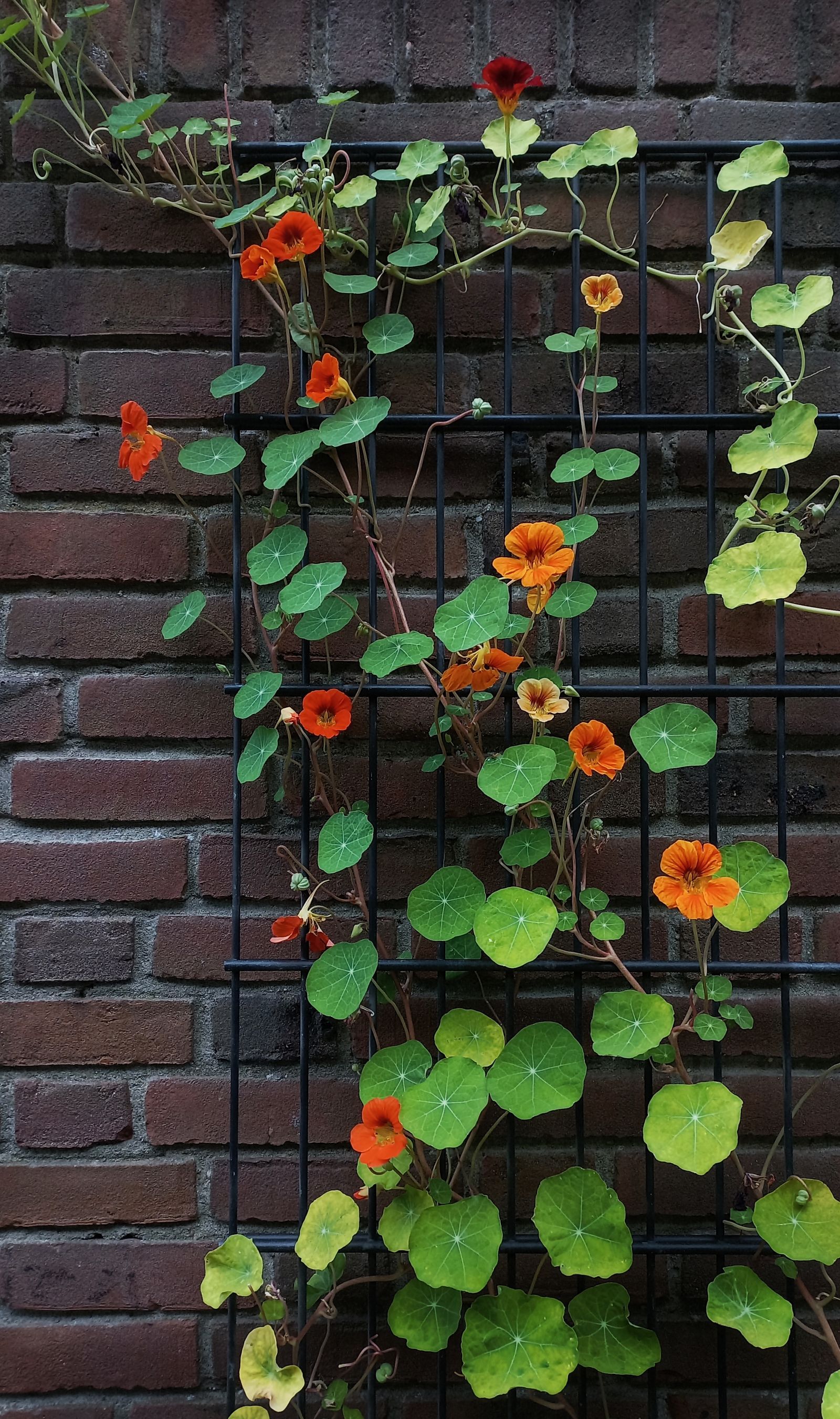
Photo: Oleksandra Zhyvytsia / Pexels
Plant Spacing Planner: The Nasturtium Patch
Nasturtium is in the crop list below at the UF/IFAS spacing of 12 to 18 inches, the planner at 12. Enter your bed size, then read the bush versus trailing split in this article before you sow.
8 tomato plants fit this bed
4 plants per row across 2 rows, on a 24 inch grid. Extension spacing for this crop: 24 in between plants, 48 in between rows.
The grid uses the in-row spacing in both directions, the standard square foot layout for raised beds. In open ground, keep the wider row spacing in the note above so you can walk and weed between rows.
Spacing figures: University of Georgia Cooperative Extension, Circular 963, Vegetable Planting Chart, source.
Bush Types: The Florida Bench at 12 Inches
A bush nasturtium at 12 inches grows outward until it meets its neighbor and then stops competing, forming the continuous mound of round, shield shaped leaves the plant is grown for, with flowers held above the foliage where bees and salad makers can reach them. The Florida range extends to 18 inches, and the wide end suits two situations: dry gardens, where each plant must forage a bigger circle of soil for water, and mixed plantings where the nasturtium is a filler among taller companions rather than a solid edge. In rich, moist soil the same plant spreads to the full 2 feet of the fact sheet's spread figure and crowds at 12 inches, which is a clue to the plant's central paradox, covered below: the better you feed it, the wider it grows and the less it flowers. In containers, one bush plant per 10 to 12 inches of pot diameter fills a window box or a hanging basket rim exactly, and the leaves overhanging the edge are the desired effect, not a spacing error. Seed is sown where the plants will grow, an inch deep, because nasturtiums transplant sulkily; thin seedlings to the final grid when they have two true leaves, and thin without sentiment, since a doubled plant at 6 inches flowers worse than a single at 12.
| Habit | Spacing | Finished size | Best use |
|---|---|---|---|
| Bush (Jewel type) | 12 inches, up to 18 in dry soil | 1 to 1.5 feet tall, 1 to 2 feet spread | Edging, companions, pots |
| Semi trailing | 18 to 24 inches | 2 to 3 feet of spread | Banks, basket centers |
| Trailing and climbing | 1 plant per 2 to 3 feet of support | 6 to 10 feet of vine | Fences, trellises, walls |
| Hanging basket | 3 plants per 12 inch basket | Trails 2 to 3 feet | Patio display |
Trailing Types: Spacing in Feet, Not Inches
The climbing nasturtiums, the tall Tropaeolum majus types sold for fences and banks, should be spaced as what they are, vines. One plant every 2 to 3 feet along a fence gives each vine its own section of support to colonize, and by midsummer the sections merge into a continuous flowering screen without the braided congestion of closer planting. On a bank or slope, where the trailers are often used as a living mulch, the same 2 to 3 foot grid across the slope covers ground in one season. The support matters as much as the spacing: nasturtium climbs by wrapping its leaf stalks around anything slender, so it climbs netting, wire, and thin trellis eagerly and slides off smooth poles and flat boards entirely, and a vine that cannot climb spreads at ground level at triple the planned width. Gardeners growing the trailing types in hanging baskets should count one plant as 2 to 3 feet of eventual trail and plant 3 to a 12 inch basket at most, a basket that looks sparse in May and overflows by July.
The Lean Soil Rule: Spacing's Partner
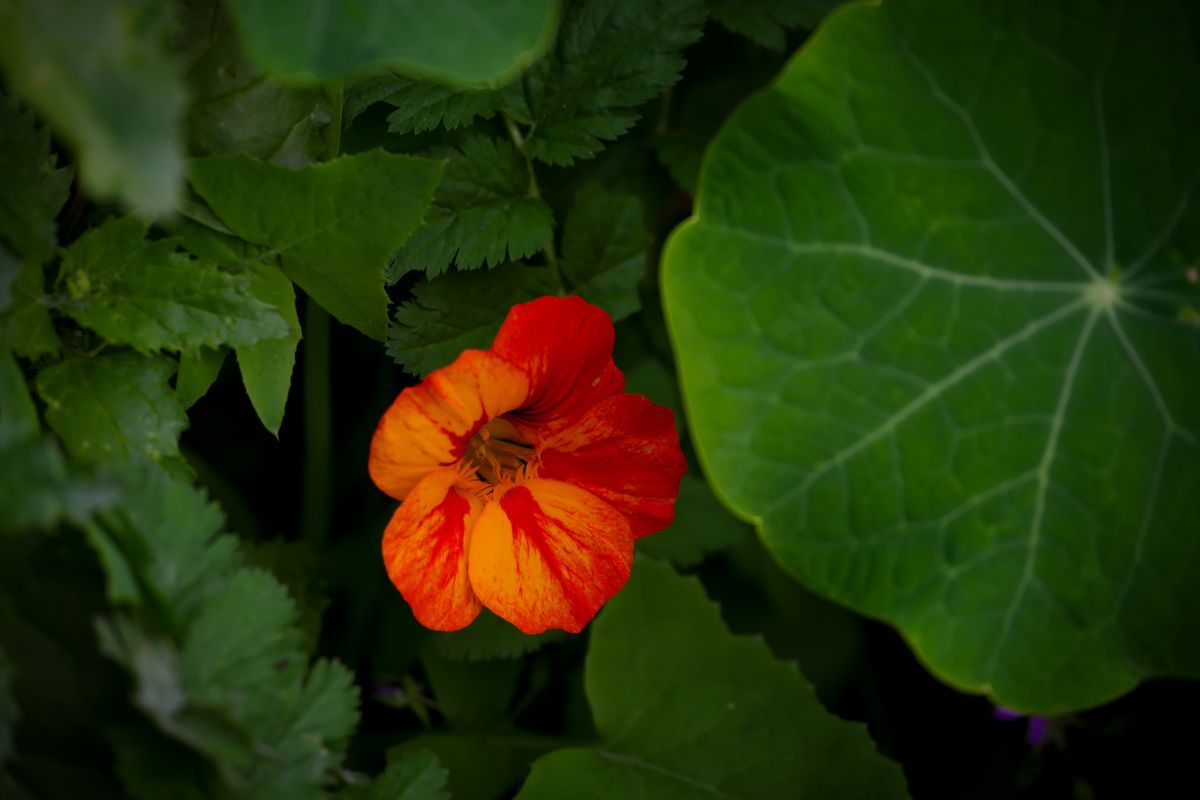
No spacing bench survives rich soil. Nasturtiums flower in response to lean conditions, and in fertile, fertilized ground the plant invests in leaves, spreading past every figure in the table while producing a scattering of blooms hidden under the canopy. The practical consequences run through the whole planting plan. Do not fertilize nasturtiums, at planting or after. Do not plant them in freshly composted beds if flowers are the goal; they are the ideal tenant for the poor, thin, neglected soil at the garden's edge where other annuals sulk. Water in dry spells, because lean is not the same as droughted, but feed never. This is also why nasturtiums are recommended as a companion and trap plant around vegetables: they thrive in the unamended paths and edges, draw aphids away from crops as a sacrificial planting, and ask nothing from the fertility budget the vegetables need. A gardener whose nasturtiums are all leaf should not adjust the spacing; they should stop feeding, and next year plant into worse ground.
Companions, Aphids, and the Edible Harvest
Nasturtium's round leaves and flowers are edible, peppery, and produced in proportion to the plant's light and leanness, so the spacing that maximizes flowers maximizes the harvest too. Pick flowers and young leaves from the outside of the mound, where the plant replaces them fastest, and leave the center to keep growing. The aphid relationship deserves an honest sentence: nasturtiums attract black aphids reliably, which is precisely their trap crop value beside beans and brassicas, and a gardener who plants them as companions should expect to sacrifice the nasturtiums' looks in a bad aphid year, pulling and discarding a badly infested plant rather than spraying the trap. Capers made from the pickled seed pods, the traditional poor man's caper, come from letting some flowers set seed in late summer, one more reason to leave a plant or two unpicked. The marigold spacing page runs the other great edible companion flower of the vegetable garden, with a spacing rule driven by nematodes rather than aphids, and the two plantings share an unamended edge well.
Edging, Paths, and Where Bush Plants Earn Their Keep
The bush nasturtium's spacing makes it one of the most useful edging plants in the vegetable garden, and the edging use has its own geometry. Along a path or bed edge, plant a single line at the 12 inch bench, set back half the plant's spread, about 8 to 10 inches from the edge itself, so the mature mound laps over the border without swallowing the path. The mound's habit does the rest: it covers bare soil, suppresses the weeds that start at every bed edge, and spills a little, which reads as abundance rather than error. Around fruit trees and along fences the trailing types do the same job at their own scale, one plant per 2 to 3 feet forming a flowering groundcover that competes with grass at the fence line and gives pollinators a station at the garden's border. Nasturtiums also serve in the strawberry bed and among squash, where their low canopy shades soil without competing for the crop's light, though among squash the pairing needs watching by August, when both plants are at full spread and the nasturtium's job quietly changes from companion to competitor for water in a dry week. Pulled at that point, it has already earned its place, and the compost takes the rest.
Related guides
Readers working on this usually need these next:
- Plant Spacing for Kale: Baby Leaf Rows and Full Plant Rows Are Different Crops
- Plant Spacing for Star Jasmine: Feet for the Wall, Feet for the Floor
Frequently Asked Questions
How far apart do you plant nasturtiums?
Bush types go 12 inches apart on the University of Florida bench, up to 18 inches in dry soil, in rows 12 inches apart. Trailing and climbing types are vines and are spaced 1 plant per 2 to 3 feet of fence, trellis, or bank. Confusing the two habits is the standard nasturtium spacing failure.
Why are my nasturtiums all leaves and no flowers?
Almost always rich soil or fertilizer. Nasturtiums flower under lean conditions and grow foliage under rich ones. Stop feeding entirely, water only in dry spells, and next season plant them in the poorest soil you have. No spacing change fixes a feeding problem.
Can nasturtiums grow in pots and baskets?
Yes, and they are among the best basket plants. Use one bush plant per 10 to 12 inches of pot diameter, or 3 trailing plants in a 12 inch basket, expecting 2 to 3 feet of trail by midsummer. Keep the mix lean and unfertilized, and water when the top inch dries.
Do nasturtiums come back every year?
They are tender annuals, killed by the first frost, but they self sow freely where seed falls on open soil, and a planting often reappears for years from its own seed. The volunteers arrive at random spacing; thin them to the 12 inch bush grid or the 2 to 3 foot vine grid as they emerge.
Are nasturtiums good companion plants?
Yes, with clear expectations. They thrive in the lean, unamended edges vegetables do not want, their flowers feed pollinators, and they act as a trap crop that draws black aphids away from beans and brassicas. Expect an infested nasturtium to be sacrificed in a bad aphid year; that is the trap working.
Photo credits: Oleksandra Zhyvytsia (Pexels); Magda Ehlers (Pexels). Photos are served from this site; follow the credit to the library page for the original.