Star jasmine, Trachelospermum jasminoides, also sold as Confederate jasmine, is the fragrant white flowered vine of southern fences and trellises, and its spacing question arrives in two forms that need two answers. Planted against a support it will climb, the bench is 3 to 5 feet between vines, with UF/IFAS Charlotte County Extension specifying about 4 feet apart for thick cover on a fence. Planted as a groundcover, where it sprawls instead of climbing, the bench is about 5 feet and a slower close. NC State's Toolbox describes a vine that can run 20 feet on a support, which is the fact that makes the wide numbers sensible: each plant is not filling the space it stands in, it is filling a wall section several feet in every direction. The generic question, how far apart to plant jasmine, folds into this page: the plant the garden trade means by jasmine for fences and groundcover in warm climates is this one, and its benches are the answer. Its groundcover cousin has its own math in the Asiatic jasmine spacing guide.
Plant Spacing for Star Jasmine: Feet for the Wall, Feet for the Floor
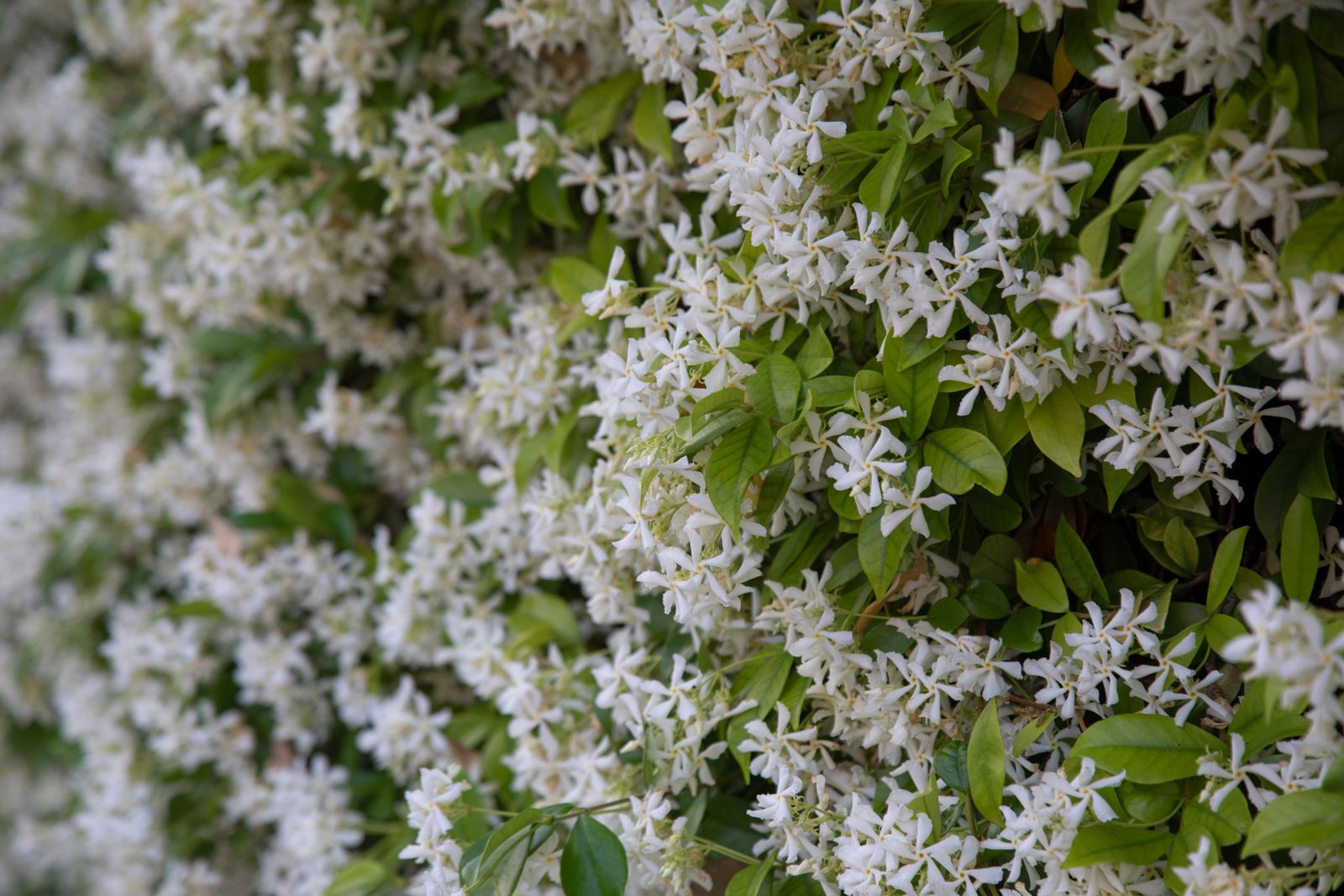
Photo: Engin Akyurt / Pexels
Plant Spacing Planner: The Star Jasmine Run
Star jasmine is in the crop list below at 48 inches for plants on a support, the middle of the UF/IFAS 3 to 5 foot fence band. Enter your fence length as the bed length, then read the groundcover bench in this article.
8 tomato plants fit this bed
4 plants per row across 2 rows, on a 24 inch grid. Extension spacing for this crop: 24 in between plants, 48 in between rows.
The grid uses the in-row spacing in both directions, the standard square foot layout for raised beds. In open ground, keep the wider row spacing in the note above so you can walk and weed between rows.
Spacing figures: University of Georgia Cooperative Extension, Circular 963, Vegetable Planting Chart, source.
On a Support: The 3 to 5 Foot Bench
A star jasmine on a fence or trellis spreads laterally as it climbs, each vine covering a panel of support roughly as wide as it is tall in its first years. At 4 feet apart, UF/IFAS Charlotte County's figure, neighboring vines meet within a couple of seasons and knit into the thick, flower covered wall the plant is famous for. At 3 feet the wall closes faster and the planting costs more; at 5 feet the wall takes an extra season and shows its individual vines longer, which on a decorative trellis can be the intent. Beyond 5 feet on a support, gaps persist for years and gardeners end up training single vines horizontally in both directions to paper over them, which works but spends the plant's energy on travel instead of thickening. Set the plant 6 to 12 inches out from the support, not against it, so the trunk of the vine has room to thicken and air can move behind the first layer of growth, and angle it toward the support at planting.
| Job | Spacing | Source or basis | Cover timing |
|---|---|---|---|
| Fence or wall, thick cover | About 4 feet | UF/IFAS Charlotte County | Meets in about 2 seasons |
| Trellis, faster close | 3 feet | General extension bench, tight end | About 1 to 2 seasons |
| Trellis, specimen vines | 5 feet | General extension bench, wide end | 3 seasons, vines stay distinct |
| Groundcover | About 5 feet | Extension groundcover guidance | Slow close, 2 to 3 seasons |
| Planner figure, flagged | 6 feet 6 inches | Almanac planner, wide outlier | Wider than extension benches advise |
The Outlier, Flagged
One widely used garden planner puts star jasmine at 6 feet 6 inches, and it is worth naming as an outlier rather than quietly including it in a range. That figure sits a foot and a half beyond the wide end of the extension benches for support planting, and at that distance a fence planting has visible gaps for years. Planner spacings are often computed from a mature spread figure applied mechanically, and a vine's spread number, 20 feet of run, does not describe how fast or how thickly it covers a vertical surface in its first seasons, which is what spacing on a support is actually buying. Where the planner's number could serve is a groundcover planting with unlimited patience, and even there 5 feet closes sooner for little extra cost. The extension benches, 3 to 5 feet on support and about 5 on the ground, are the numbers to build on; the 6 foot 6 figure is recorded here so that a reader who meets it elsewhere knows it was considered and set aside, with the reason.
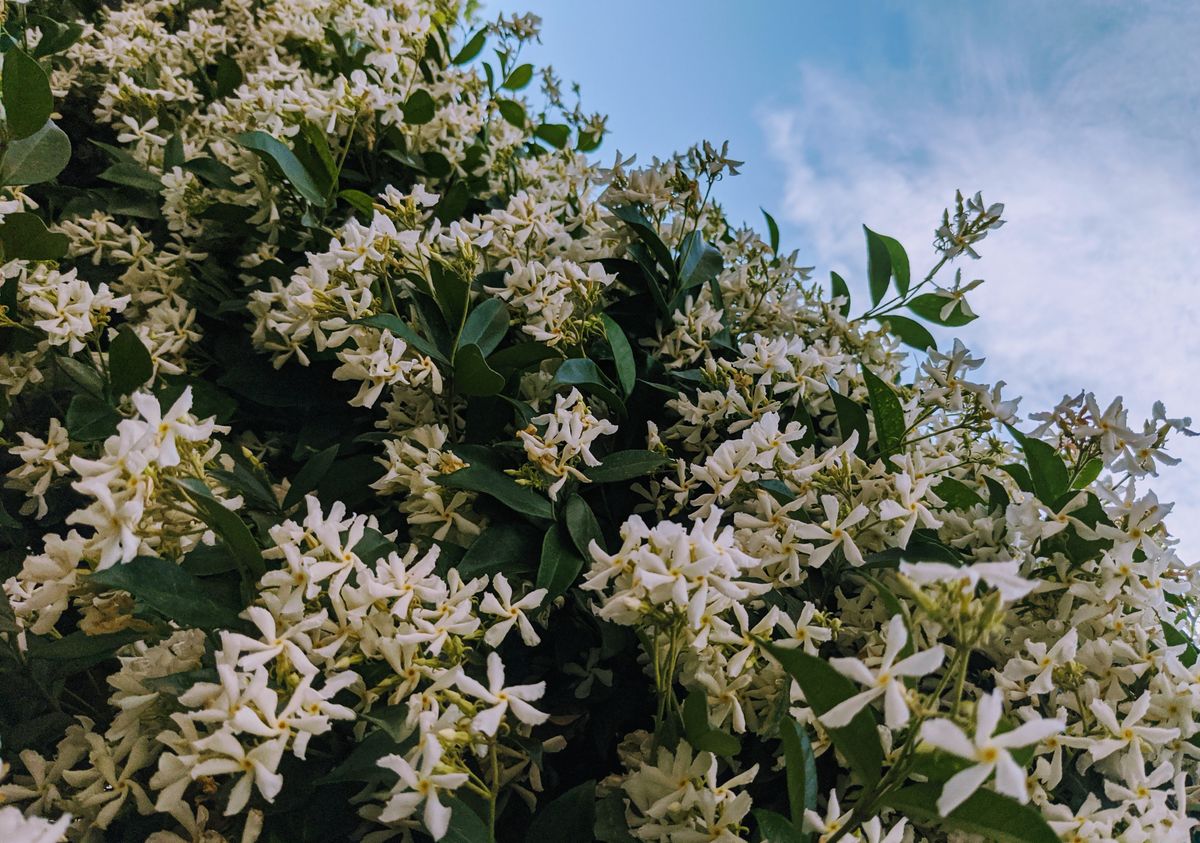
As a Groundcover: The Second Job
Without a support, star jasmine sprawls into a mounding groundcover 1 to 2 feet deep, looser and taller than Asiatic jasmine's flat mat. Spaced at about 5 feet, plants meet in two to three seasons, rooting lightly where stems touch soil, and the planting reads as rolling green rather than a carpet. It is the right choice where the planting should also flower in drifts and where a foot or two of depth is welcome, on banks and broad beds in zones 8 to 10. It is the wrong choice where a tight, flat, walkable edge is needed; that is Asiatic's job at 18 inches. Groundcover star jasmine also climbs anything it touches, so keep the 5 foot grid clear of shrubs and small trees you do not want wearing a vine, or commit to the same two to three shearings a year that hold any jasmine planting in bounds.
Training: The Spacing Assumes It
Spacing on a support only pays if the vines are trained to use their allotted width. A star jasmine left alone climbs straight up its first season and covers a narrow column, leaving its 4 feet of wall bare on both sides. From the first season, fan the young stems out diagonally, tying them loosely to the support at angles, so growth spreads sideways as it rises; the plant fills its panel evenly and the wall closes on schedule. Pinch or snip the tips of stems that reach the top early to push energy into the laggards. Once the wall is covered, maintenance is a single shearing after the spring flower flush, which keeps the surface dense and removes the season's outward reaching runners; a second light trim in late summer is optional in long season climates. Do not shear in late winter or early spring, which removes the wood carrying the spring bloom, the same after bloom rule the site applies to its flowering shrubs generally.
Cold, Containers, and the Margins
Star jasmine is a zone 8 to 10 plant outdoors, marginally hardy in zone 7 in a sheltered spot, and spacing cannot fix a climate mismatch: a vine killed to the ground each winter never builds the framework the 4 foot bench assumes, and in cold margin gardens it is better grown in a large pot, one vine per pot, trained on a tripod or obelisk, and wintered in a bright cool space. In pots the spacing question becomes pot size, 5 gallons minimum for a plant expected to cover anything, and the training is the same fan and shear. At the warm end, in zone 10, growth is fast enough that the wide end of every bench behaves like the tight end; plant at 5 feet on a fence and expect the two season close anyway. Salt spray tolerance makes it a coastal fence staple, spaced the same, with a rinse of the foliage after storms in the driest districts.
Structure by Structure: Arbors, Mailboxes, Chain Link
The support's shape refines the bench. On a flat fence or wall, the 4 foot rhythm rules, one vine per panel bay if the bays are near that width, since a vine centered in its bay covers it most evenly. On an arbor or pergola, plant one vine per post, never two sharing a post, and expect the coverage question to be about the roof: a vine reaches the top of an 8 foot post in its second or third season and then needs its stems led horizontally along the beams, tied in as they grow, or the shade pools at the posts and the top stays bare. On chain link, the fence the plant is most asked to hide, plant at 3 feet rather than 4, because the goal is a complete visual screen and the mesh gives the vine perfect support to thicken against; the planting becomes a green wall that needs its top sheared level once a year. A mailbox post or lamp post takes a single vine, trained in a spiral and sheared into a column, and its spacing question is really a size question: one plant is always enough, and the discipline is the shearing, not the planting. On a tree trunk, which the vine will happily climb, plant 2 feet out from the bark and lead the vine in, and decide honestly whether you want a flowering tree trunk for the next thirty years, because removing an established vine from bark is surgery. Every structure makes the same point the fence did: the spacing is measured in the plant's eventual coverage, and the training is what collects it.
Related guides
These guides sit closest to this one on the garden path:
- Plant Spacing for Zucchini: One Bush, Four Square Feet, and No Room for a Second Thought
- Plant Spacing for Vinca Minor: Fast Cover, Honest Warnings
Frequently Asked Questions
How far apart should I plant star jasmine?
On a support, 3 to 5 feet apart, with about 4 feet the UF/IFAS Charlotte County figure for thick fence cover. As a groundcover, about 5 feet. A popular planner's 6 feet 6 inches is wider than extension guidance supports and leaves gaps for years; it is flagged here as an outlier.
Is star jasmine the same as jasmine for spacing purposes?
For garden center purposes, yes: the vine sold for fences, trellises, and groundcover in warm climates is Trachelospermum jasminoides, and the benches on this page are its answer. True jasmines, Jasminum species, are different plants with their own habits; do not apply vine spacing meant for a 20 foot trachelospermum to a shrub jasmine.
How fast will star jasmine cover a fence?
At 4 feet apart with the young stems fanned and tied diagonally, vines meet in about two growing seasons and knit into a thick wall by the third. Untrained vines climb in narrow columns and cover slowly at any spacing, so the training, not just the distance, sets the date.
Can star jasmine be used as a groundcover?
Yes, at about 5 feet apart, closing in two to three seasons into a mounding cover 1 to 2 feet deep that flowers in drifts. For a flat, tight mat, Asiatic jasmine at 18 inches is the better tool; star jasmine is the looser, taller, more flowery option.
When should I prune star jasmine?
Shear once after the spring flower flush to dense up the surface and remove stray runners, with an optional light second trim in late summer in long season areas. Avoid late winter pruning, which removes the wood that carries spring bloom.
Photo credits: Engin Akyurt (Pexels); Guzel Sadykova (Pexels). Photos are served from this site; follow the credit to the library page for the original.