Flower Garden Ideas: Design in Three Tiers, Plant in Drifts
By the Windchime Walker editorial team
Photo: Franzie Raeber / Pexels
Most flower gardens fail at the garden center, one pretty plant at a time, and the result is the familiar polka dot bed: twenty species, one of each, blooming in turns too sparse to read as a garden. The fix is a design system with a few hard numbers. A bed at least 4 feet deep. Three height tiers, tall at the back, ground level at the front. One color scheme, held. Plants bought and planted in drifts of 3, 5, or 7 of the same variety, never singles. And a succession plan that puts at least one plant in flower in every month of your season. Follow those five rules and almost any plant list becomes a garden; break them and the best plants in the nursery become confetti.
This page is the flower specific design layer. The general layout questions, where beds go and how they are shaped against a house, live in our guide to garden bed ideas, and the border framing version lives in our garden border ideas. What follows is what makes a bed a flower garden once the shape exists: tiers, color, drift math, and succession.
Interactive tool
Flower Garden Design Checklist
Check off each step as you finish it. Your progress stays on this page.
0 of 8 complete
0% done
The three tiers, with heights
Tier
Height
Role
Reliable plants
Back
4 to 6 feet
The wall of the garden; screens fences, carries late height
Delphinium, hollyhock, foxglove, tall sunflowers, Joe Pye weed
Middle
2 to 3 feet
The body of the garden; most of the flower mass
Salvia, echinacea, daylily, phlox, black eyed Susan
The tier rule that matters is proportional: each tier should be roughly half to two thirds the height of the tier behind it, so the eye climbs a staircase instead of hitting a cliff. A 6 foot hollyhock behind a 1 foot edger with nothing between is the classic broken staircase. The middle tier is where most gardens are thinnest and where most of the season's flower power lives, so buy for the middle first and let the back and front be supporting cast.
Against a fence or wall, the tiers stack front to back. In an island bed viewed from all sides, the tiers become a pyramid: tall in the center, stepping down to every edge. Island beds need to be wider than they look on paper, 6 feet across at minimum, or the pyramid becomes a mohawk.
One color scheme, held with discipline
Professional flower gardens run one scheme per bed: hot (red, orange, yellow), cool (blue, purple, pink, white), or the white and green moon garden scheme. The discipline is not about taste; it is about how color reads at distance. A bed of mixed everything reads as noise from the street. A bed in one family reads as a single confident gesture, and the contrast comes from texture and foliage instead of hue chaos.
Two practical corollaries. Buy flower color in quantity: a drift of seven blue salvia is a design element, while seven different blue flowers is a collection. And use foliage as the second color: silver artemisia, purple heuchera, and plain green in different textures give a one scheme bed all the depth it needs without breaking the scheme.
The drift math: 3, 5, 7, and never 1
Plants are placed in odd numbered groups, 3 for small plants and tight beds, 5 as the default, 7 for the main flower masses in a big bed. The odd numbers are not superstition; even groups read as pairs and rows, while odd groups read as natural clumps. The spacing inside the drift follows each plant's own spacing bench, the guides in our spacing series, so a drift is five plants at their proper spacing, not five plants crammed into one hole.
Singles have exactly one legitimate use: the specimen. One large dahlia, one clump of ornamental grass, one rose as a deliberate exclamation point works because everything around it is in drifts. The moment two or three singles of different species appear, the bed slides back toward polka dots.
Succession: the month by month contract
A flower garden should never be empty. The planning tool is a simple grid: rows for your main drifts, columns for the months of your season, and a mark for each plant's bloom window. The contract is at least one mark in every column, and two or three in the peak months. Spring bulbs and early perennials open the year, the big perennial wave carries early summer, annuals and repeat bloomers bridge the midsummer lull that catches beginners out, and asters, sedum, and the last roses close the season.
Annuals are the succession insurance policy: a flat of long blooming annuals tucked into the gaps in June covers the exact weeks when the spring perennials rest. The regional version of that insurance, in a climate where the calendar runs twice a year, is our guide to annual flowers for Florida.
Four style families to build from
Cottage style runs the tiers loose and overstuffed, self sowing annuals like nigella and larkspur woven through perennials, drifts allowed to blur at the edges. Formal style runs the same tiers in straight lines and clipped shapes, with color restricted hardest of all, often one color per bed. The moon garden is the white scheme taken seriously: white flowers, silver foliage, and plants chosen to glow at dusk, sited where the household actually sits in the evening. The meadow style drops the tiers for a woven matrix of grasses and tough perennials at high density, beautiful and the most skill demanding of the four, because it only looks effortless when the plant choices are exactly right for the soil.
Pick one family per bed and let it govern the plant list. A cottage drift inside a formal bed reads as a mistake; the same drift in a cottage bed is the whole charm.
Budgeting the bed: where the money actually goes
A flower garden's budget follows its structure. The perennials that form the tiers are the capital cost, and the way to cut it is patience: buy the middle tier in quarts rather than gallons, plant the drifts at full spacing, and let one season of growth do what the extra money would have bought instantly. Annuals are the operating cost, a flat or two per gap per season, and they are the last place to economize, because they carry the succession contract. Mulch is the quiet line item that protects all the others: 2 to 3 inches over the whole bed each spring suppresses the weeds that would otherwise be your summer weekends. Gardeners who price a design before planting it discover the same ratio everywhere: roughly half the money in the perennial structure, a quarter in soil preparation and mulch, and a quarter in the annuals and bulbs that keep the calendar full. Skimping on soil preparation to buy more plants is the classic false economy; plants forgive small pots, they do not forgive bad ground.
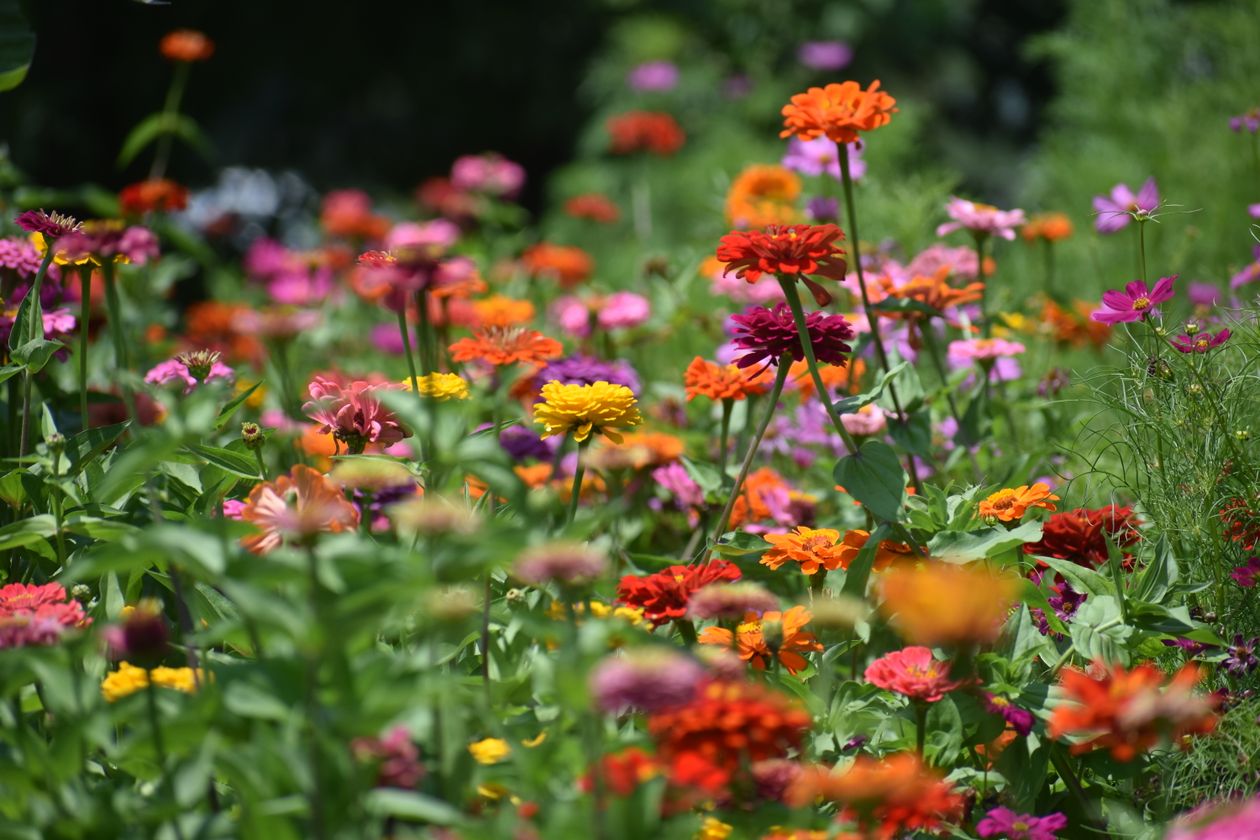
Summer flower garden with mixed blooms and greenery
Signs you are getting it wrong
A bed that blooms all at once in June and then goes green is a succession failure, fixed on paper in winter, not at the nursery in spring. A bed of ones is a drift failure. A front tier taller than the middle is a tier failure that pruning cannot fix; move the plants in fall. And a bed you cannot reach into is a depth failure: no point in a bed should sit more than about 2 feet from an edge or a stepping stone, or the middle becomes a weed sanctuary nobody dares to enter.
At least 4 feet for a border against a fence or wall, which is the minimum depth that fits three height tiers with their proper spacings. Five to six feet is better where you have the room. An island bed needs about 6 feet across to carry a center peak stepping down on all sides. Shallower beds force a single row of plants, which reads as a lineup, not a garden.
How many plants make a drift?
Three, five, or seven of the same variety, planted at that plant's normal spacing. Five is the working default for mid size perennials. Odd numbers read as natural clumps; even numbers read as pairs and rows. One plant of a kind is a specimen, which works only when it is deliberate and surrounded by drifts, not when the whole bed is singles.
What is the easiest color scheme for a beginner flower garden?
The cool scheme: blue, purple, pink, and white. Those colors harmonize almost automatically, the plant choice is enormous, and white separates any two shades that argue. Hot schemes are more exciting and less forgiving, because reds and oranges clash at slightly different temperatures. Whichever family you choose, hold it for the whole bed and get your contrast from foliage and texture.
How do I keep a flower garden blooming all season?
Plan it on a grid in winter: list your drifts, mark each one's bloom months, and require at least one bloom in every month, with annuals hired to cover the gaps. Spring bulbs and early perennials open, the perennial wave carries early summer, long blooming annuals bridge the midsummer rest, and asters and sedum close. A garden that goes quiet in August was not unlucky; it was unplanned.
Should a flower garden be perennials or annuals?
Both, in different jobs. Perennials are the structure: they return each year, carry the tiers, and anchor the succession grid. Annuals are the insurance and the long color: they bloom for months, fill gaps while perennials establish, and cover the lull weeks. A new garden leans on annuals heavily in year one and shifts toward perennials as they mature, which is the normal and correct progression.
Photo credits: Franzie Raeber (Pexels); Lana Kravchenko (Pexels). Photos are served from this site; follow the credit to the library page for the original.