How Often to Water Outdoor Potted Plants: Pot Size and Weather Set the Schedule
By the Windchime Walker editorial team
Photo: Prathyusha Mettupalle / Pexels
Ask how often to water outdoor potted plants and the honest answer is a range so wide it sounds like a dodge: somewhere between twice a day and twice a month, decided by pot size, pot material, plant size, and the weather of the last 48 hours. Extension container guidance converges on exactly that spread. Iowa State Extension notes that small pots in hot, windy weather may need water once or twice a day, while large pots in cool weather may go once or twice a week. Penn State Extension puts container vegetables at at least daily watering in hot months, and Clemson Extension advises checking containers twice a day in hot, dry, windy weather. The schedule is not a day of the week. It is a reading of the pot in front of you.
This guide turns that spread into a system: a table by pot size and weather, the material ladder that ranks how fast containers dry, and the two field tests, lift and finger, that replace guessing. It covers the pots on patios, porches, and balconies, the plants the houseplant guides do not: annuals, herbs, vegetables, and shrubs living outside in containers. For the ones that stay out all winter, pair this with our guide to potted plants that survive winter outside.
Outdoor pots run on pot size and weather, not the calendar: small pots in hot wind can need water once or twice a day, while large pots in cool weather hold for a week. Enter your pot size and climate, then confirm with the lift test and the top inch finger check in this guide.
19.9 gallons
For 32 square feet at 1 inch deep. That is about 76 liters, or 10 trips with a standard 2 gallon watering can.
A rain gauge or a straight sided can set in the bed tells you when a sprinkler or soaker hose has actually delivered this depth. Time alone is a guess, because hose pressure varies from house to house.
The conversion is arithmetic, not opinion: one inch over one square foot is 144 cubic inches of water, and a US gallon holds 231 cubic inches, so each square foot at one inch takes 0.62 gallons.
The schedule by pot size and weather
Pot size
Hot and windy, 85 degrees plus
Warm, 70 to 85 degrees
Cool or cloudy, under 70
Small, under 2 gallons
Once or twice a day
Every 1 to 2 days
Every 3 to 4 days
Medium, 2 to 5 gallons
Every 1 to 2 days
Every 2 to 3 days
Every 4 to 6 days
Large, 5 to 10 gallons
Every 2 to 3 days
Every 3 to 5 days
About once a week
Extra large, 10 gallons plus
Every 3 to 4 days
Every 4 to 7 days
Every 7 to 10 days
Read the table as check intervals, not appointments. A medium pot in a warm week gets checked on day 2, and watered if the top inch is dry, which it usually is. A large pot in a cool week gets checked on day 5 or 6 and often passes the test. Rain resets every row: a half inch of rain on an open patio pot is a full watering, and the count starts again from that day. Pots under eaves and porch roofs get no rain at all, which is the most common reason a sheltered plant dies of thirst in a wet week.
The material ladder: what the pot is made of sets the base rate
Two pots of the same size on the same patio can run days apart because of what they are made of. Terracotta is the fastest drying common material: the clay wall itself wicks water out and evaporates it, which is wonderful for rosemary and lavender and brutal for thirsty annuals in July. Unglazed clay in full sun can need water a full day sooner than the same plant in plastic. Plastic and glazed ceramic hold water longest of the rigid pots, because the wall passes nothing; the mix dries only from the top. Fabric grow bags dry nearly as fast as terracotta, from every side at once. Wood sits in the middle, and self watering pots break the ladder entirely by holding a reservoir, stretching every interval in the table by two to three days once the roots reach the moisture zone.
Match the pot to the plant's thirst before you blame your schedule. A moisture loving plant in a small clay pot on a windy balcony is a twice a day commitment in a heat wave. The same plant in a large glazed pot is a twice a week plant. Most outdoor container failures are that mismatch, purchased in spring and diagnosed in August.
The lift test and the finger test
Nursery growers water thousands of pots a day by weight, and the lift test is their method scaled down. Lift every pot right after a full watering and memorize the heft. Lift it again before you water. A pot that feels dramatically lighter is dry through most of its volume, whatever the surface looks like. For pots too big to lift, rock them: a dry large pot tips with a hollow lightness that a wet one does not have.
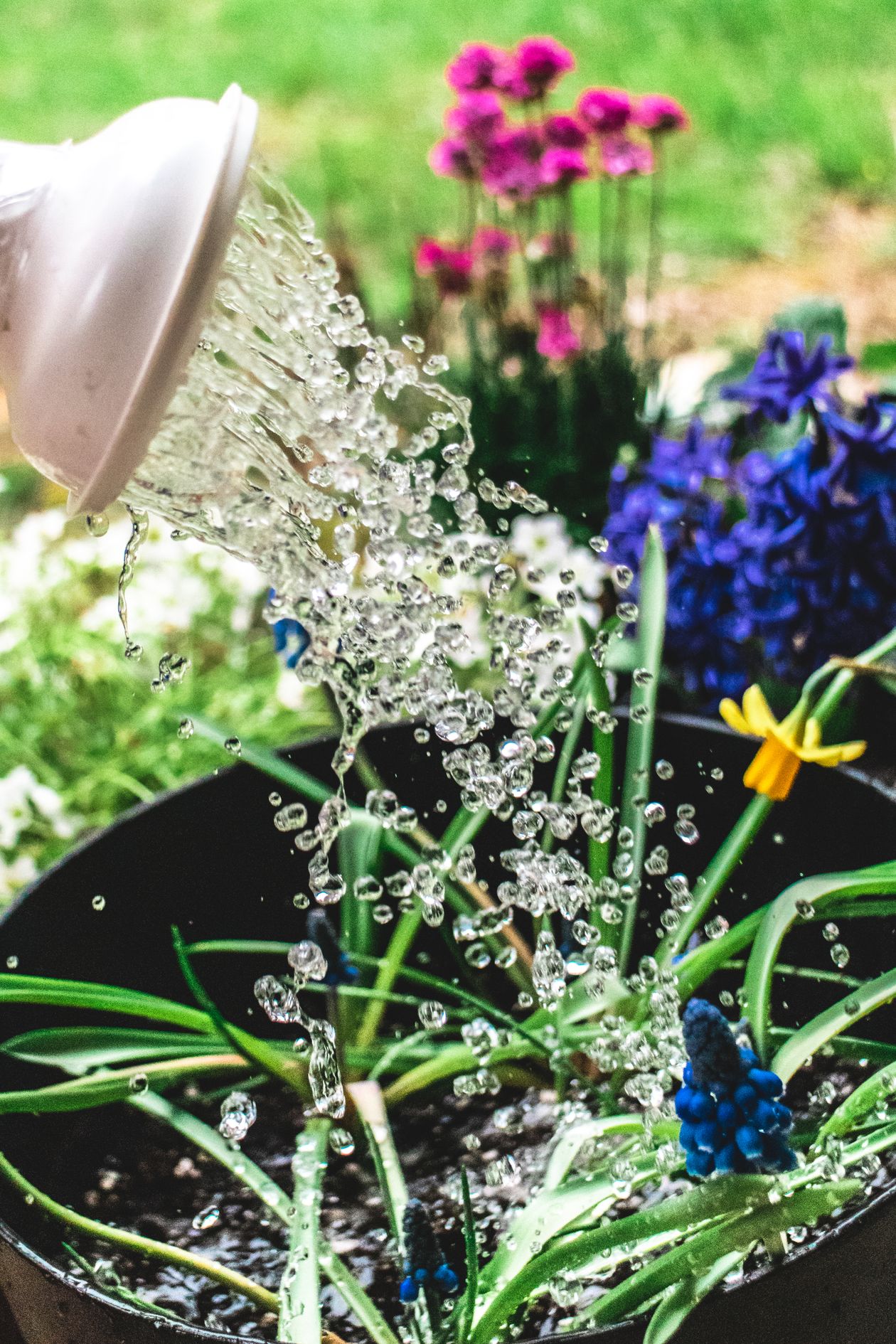
The finger test is the backup: push a finger 1 inch into the mix at the edge and then near the center. For most outdoor annuals, herbs, and vegetables, dry at 1 inch means water now. For Mediterranean herbs and succulents, wait until it is dry 2 inches down. The two tests together take ten seconds per pot, and after two weeks of using them your hands will start answering before your eyes do, which is the real goal. A watering wand with a breaker head, applied slowly until water runs from the drainage holes, does the rest; a hard jet blasts mix out of the pot and channels down the sides without wetting the core.
Plant size, root fill, and the August cliff
A pot dries at the speed of the plant drinking from it, and the plant is growing. The petunia that needed water every 3 days in May fills its pot with roots and canopy by late July and needs it daily, not because the weather changed but because the ratio of leaf to soil flipped. This August cliff catches everyone. When a pot that held for days suddenly wilts by noon, check whether it is rootbound before you blame the heat: roots circling the drainage hole and a root ball that lifts out as one solid plug mean the plant is drinking from a teacup. Pot up a size, or accept the daily watering the plant is now honestly asking for.
Wilting itself needs a careful read outdoors. Many plants flag their leaves in mid afternoon heat with adequate soil moisture and recover by evening; that is heat behavior, not thirst. Water those plants on the finger test, not the flag. A plant still wilted at 8 in the morning, on the other hand, is dry or root damaged, and it gets water immediately.
Vacations, mulch, and grouping
A 2 inch mulch layer on top of the mix is the cheapest schedule extender you own: it can add a day to every interval in the table by shading the surface and cutting evaporation. Grouping pots together helps the same way, raising the humidity in the cluster and shading each other's walls, which is why a grouped patio survives a weekend away that kills a row of isolated pots. For a full week away in summer, move pots into bright shade, water deeply, and accept that the thirstiest small pots may still fail; or run a drip line on a timer into each pot, which is the only vacation system that has never lost a plant to a hot spell.
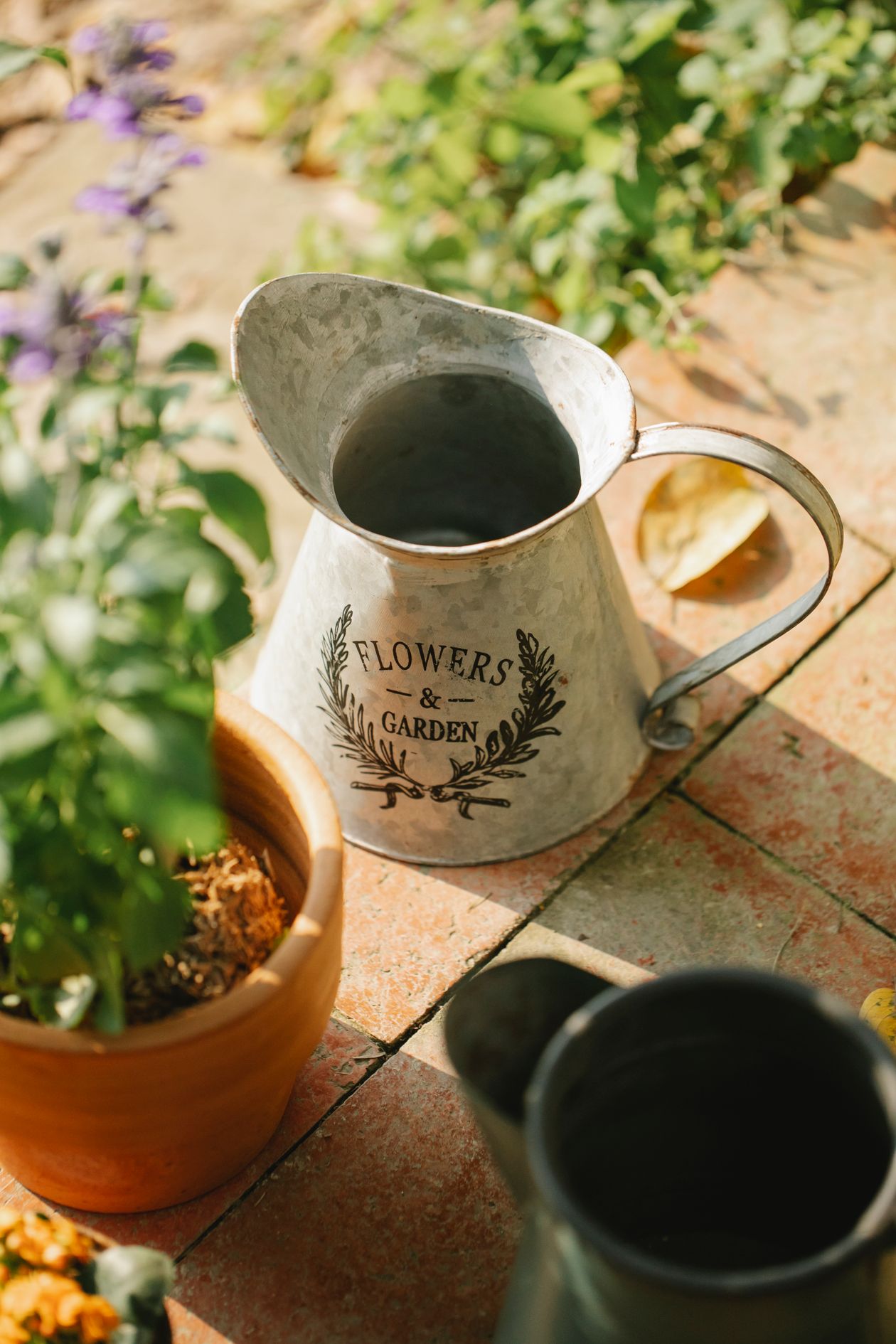
Metal watering jug beside potted flowers on a porch
Signs you are getting it wrong
A white crust on the mix and brown leaf edges mean salts are building up: water slowly and deeply once a month until the runoff runs long and clear. Pots that dry within hours of watering are rootbound or the mix has gone hydrophobic; soak the whole pot in a tub for half an hour to rewet it. Fungus gnats in clouds mean the surface never dries, so let the top inch dry fully between drinks. And a plant that wilts daily in a big pot with moist mix has root damage, not a scheduling problem.
How often should outdoor potted plants be watered in summer?
By size: small pots under 2 gallons can need water once or twice a day in hot, windy weather; medium pots every 1 to 2 days; large pots every 2 to 3 days; and extra large pots every 3 to 4 days. Those are check intervals. Confirm with the finger test, dry at 1 inch for most plants, before you water, and restart the count after any real rain.
Is it better to water outdoor pots in the morning or evening?
Morning is the better default. The plant starts the day charged, the foliage dries fast, and fungal diseases get less of the overnight wetness they love. Evening watering is an acceptable second choice in a heat wave and beats skipping a day. Midday watering is not the leaf scorching crime of garden myth, but more of it evaporates before the roots see it, so it is the least efficient slot.
Why does my terracotta pot dry out so much faster than my plastic one?
Because the clay wall itself is a wick. Water moves through unglazed terracotta and evaporates from the outer surface, so the pot loses moisture from every side, not just the top. In full summer sun that can pull the schedule a full day ahead of an identical plastic pot. Use clay for plants that hate wet feet, and plastic or glazed pots for thirsty plants you cannot visit daily.
How can I tell if a big pot needs water without lifting it?
Rock it gently: a dry large pot feels noticeably lighter and tips more easily than a wet one. Back that up with the finger test at two spots, edge and center, down to the second knuckle. A wooden chopstick pushed to mid depth works too; soil clinging and a dark stain mean moisture remains. Surface dryness alone lies on big pots, because the core can be wet for days under a dry crust.
Should I water outdoor pots every day while on vacation?
The plants should get water on their normal rhythm, which in summer heat means someone or something has to do the checking. The reliable options are a drip line on a battery timer with an emitter in each pot, or a neighbor armed with the lift test. Grouping the pots in bright shade and mulching the surfaces buys two to three days of grace, but a week of July heat with no system at all will cost you the small, thirsty pots.
Photo credits: Prathyusha Mettupalle (Pexels); Gary Barnes (Pexels). Photos are served from this site; follow the credit to the library page for the original.