Indoor Plants That Clean the Air: What the NASA Study Actually Found
By the Windchime Walker editorial team
Photo: Erik Mclean / Pexels
Indoor plants do clean air. The honest question is how much, and the honest answer requires two studies, not one. In 1989, NASA researcher B.C. Wolverton tested common houseplants in sealed chambers of about 0.88 cubic meters and found that plants removed 50 to 90 percent of injected chemicals like benzene, formaldehyde, and trichloroethylene within 24 hours. That study is real, peer-reviewed, and quoted everywhere.
What is quoted less often is the follow-up. In 2019, researchers at Drexel University reviewed the chamber literature and converted the results into clean air delivery rates. Their finding: a plant's median clean air delivery rate is about 0.023 cubic meters per hour, and you would need somewhere between 10 and 1,000 plants per square meter of floor space to equal the air cleaning your building's ordinary ventilation already provides. Both studies are true. They describe different rooms. This guide gives you the plant list, the chemistry, the pet safety data, and a realistic plan: enjoy plants for what they genuinely do, and use ventilation and source control for the heavy lifting.
Interactive tool
Clean Air Plants Reality Checklist
Check off each step as you finish it. Your progress stays on this page.
Pet safety is part of the air quality decision, not a footnote. A peace lily scrubbing benzene in a chamber does a household with a curious cat no favors. The non-toxic bench (spider plant, Boston fern, parlor palm) is deep enough to furnish a pet household entirely, and the checklist above sorts the picks by safety as well as chemistry.
What the chamber results actually mean in a home
The NASA chambers were sealed, tiny, and dosed with chemical levels far above a normal room, with no fresh air exchange at all. In that box, a plant and its root-zone microbes were the only cleaning mechanism, and over 24 hours they did measurable work. Your living room is none of those things: it leaks air constantly, your HVAC exchanges more, and opening a window for 10 minutes moves more air than a shelf of plants processes in days.
The Drexel review's 10 to 1,000 plants per square meter range is the number to remember when a listing claims a single snake plant will purify a bedroom. It will not, in any measurable whole-room sense. Neither will ten. A jungle of a hundred plants in a small room starts to register, and at that point you are running a greenhouse that happens to have a bed in it.
What plants genuinely do for indoor air and health
None of this makes houseplants pointless; it makes the marketing pointless. Plants demonstrably raise humidity in dry rooms through transpiration, which eases dry skin and airways in winter. They capture some dust on leaf surfaces. Their root-zone microbes do metabolize volatile compounds at a small, real rate. And the best-documented benefit is not chemical at all: people in plant-filled rooms report lower stress and better concentration, and several controlled studies support a modest version of that claim.
There is also a night-shift curiosity: snake plants and other CAM plants take in carbon dioxide at night and release oxygen, unlike most plants. The amounts are small relative to a sleeping human's output, but the direction is right, and it is a fair tiebreaker for a bedroom plant choice between two species you like equally. Care for them is famously forgiving, as how often to water snake plant explains.
What actually cleans your air, ranked
If indoor air quality is the real goal, the effective interventions are unglamorous. First, source control: low-VOC paints and furnishings, no indoor smoking, a vented range hood used every time you cook. Second, ventilation: open windows when outdoor air is clean, run bathroom and kitchen exhaust fans, keep HVAC filters fresh. Third, filtration: a HEPA purifier sized for the room removes particles, and activated carbon handles many gases and odors. Fourth, plants, for humidity, mood, and a small microbial assist. A household that does the first three and adds plants has genuinely clean air. A household that buys a pothos and skips the rest has a pothos.
Choosing and placing plants if you want the real benefits
Buy for the conditions you have, because a thriving plant transpires and a dying one molds. Low light rooms suit pothos, snake plant, and Chinese evergreen; bright rooms suit palms and ferns with humidity help. Cluster plants where you spend time, keep leaves dusted so stomata work, and avoid overwatering, since chronically wet soil grows mold that actively worsens the air you were trying to improve. The moisture discipline in how often to water prayer plant is a good model: consistently moist, never soggy, and never standing in water.
The root zone is the real filter
The most interesting finding in the NASA work is usually skipped: much of the chemical removal happened not in the leaves but in the root zone, where soil microbes metabolize volatile compounds that diffuse down to them. Wolverton's later designs exploited this with activated carbon filters and fans drawing room air through the planter itself. A passive plant on a shelf uses only a whisper of that mechanism, because almost no room air ever reaches its root zone.
This is why the honest enthusiast's upgrade is airflow, not more plants. A small fan moving room air gently across a plant cluster increases leaf and soil contact with the air. Commercial "active" planters with fans and carbon exist and do measurably more than passive pots, though still modestly compared with a real purifier. Understanding the mechanism protects you from the marketing: any claim that ignores how air reaches the roots is selling the chamber result without the chamber.
A realistic plant plan, room by room
Bedroom: one or two easy, low-light plants you will actually keep alive, a snake plant or pothos, plus the real air tools: a fresh HVAC filter and a window opened when weather allows. Living room: a cluster of three to five plants near seating for humidity and mood, including a parlor palm or Boston fern if your light and humidity support it. Home office: a desk plant for the documented focus and stress benefits, which is the strongest evidence-backed reason to own any of them. Bathroom: a fern or pothos enjoying the shower humidity, doing more for the room's feel than its chemistry.
In every room the pattern is the same: plants as the enjoyable final layer on top of ventilation and source control, chosen for your light, your pets, and your watering temperament. That is a genuinely good outcome. It just is not a purification system, and now you know the two studies well enough to say exactly why.
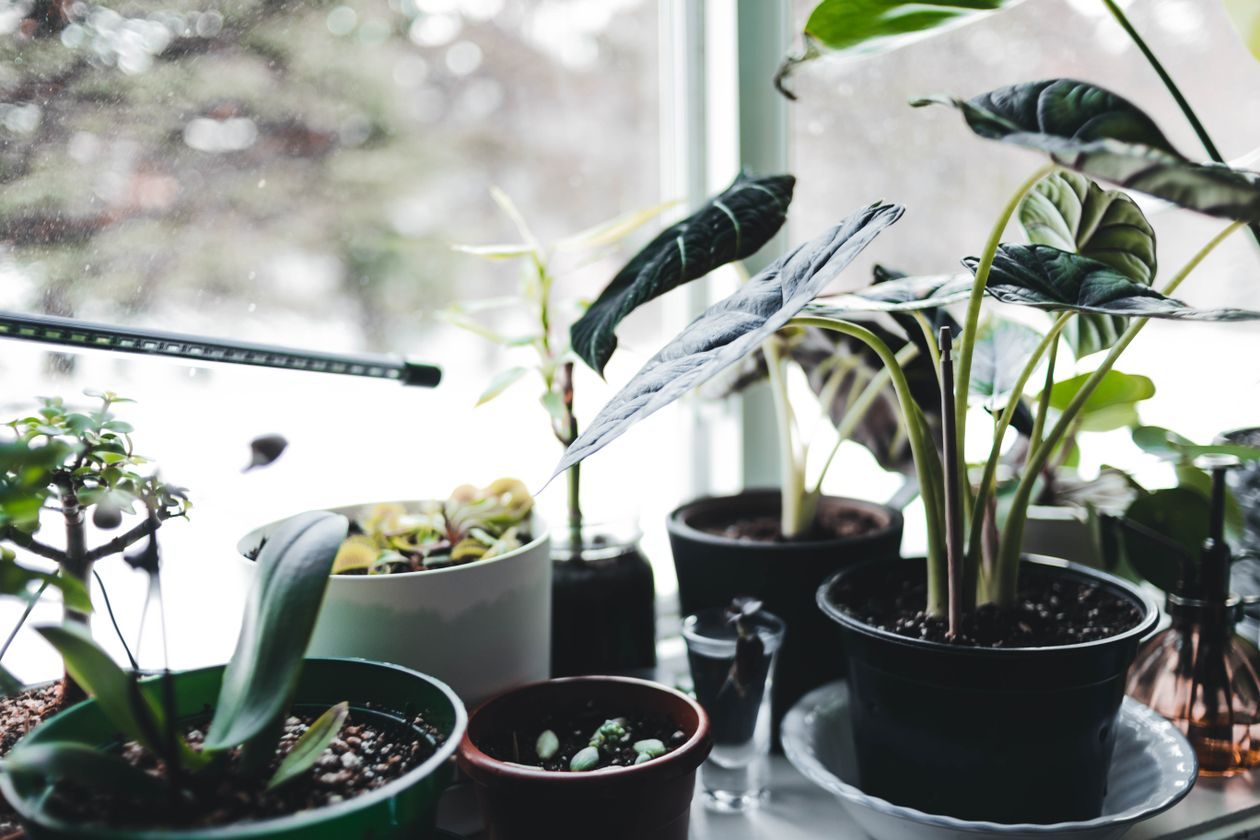
A collection of potted houseplants on a bright windowsill
Far more than marketing suggests. The 2019 Drexel University review of the chamber-study literature calculated a median clean air delivery rate of about 0.023 cubic meters per hour per plant, meaning you would need roughly 10 to 1,000 plants per square meter to match the effect of ordinary building ventilation. A normal collection improves humidity and mood, not whole-room chemistry.
Did NASA really say plants clean the air?
Yes, with context. The 1989 NASA study led by B.C. Wolverton found plants removed 50 to 90 percent of certain chemicals within 24 hours inside sealed 0.88 cubic meter chambers designed for space habitat research. The results were real but describe sealed chambers with no ventilation, not furnished rooms with air exchange.
Which air-cleaning plants are safe for cats and dogs?
From the NASA-tested list, spider plant, Boston fern, and parlor palm are listed as non-toxic by the ASPCA. Peace lily, snake plant, golden pothos, English ivy, and Chinese evergreen are all toxic to pets if chewed. Check any plant against the ASPCA database before bringing it into a pet household.
Do snake plants clean the air at night?
Snake plants use CAM photosynthesis, taking in carbon dioxide and releasing oxygen at night, which is the reverse of most plants. The effect is real but small compared with a room's air volume and a sleeper's breathing. Choose a snake plant for its toughness and looks; treat the night oxygen as a pleasant bonus, not a health device.
What is the best way to actually improve indoor air quality?
Control sources first (low-VOC materials, vent cooking, no indoor smoke), ventilate second (open windows, run exhaust fans, maintain HVAC filters), and filter third (a correctly sized HEPA unit, with activated carbon for gases). Plants come fourth, contributing humidity, dust capture on leaves, and well-supported psychological benefits.
Photo credits: Erik Mclean (Pexels); Natalia Sevruk (Pexels). Photos are served from this site; follow the credit to the library page for the original.