Front Yard Landscaping Ideas With Rocks and No Grass: A Complete No-Lawn Design
By the Windchime Walker editorial team
Photo: Judy Horn / Pexels
Deleting the lawn is easy. Replacing it with something that looks designed rather than abandoned is the actual project. The no-grass front yards that work share a structure: roughly 60 to 70 percent of the area in hardscape, gravel, and paths; the remaining 30 to 40 percent in planted pockets with real structure plants; boulders used as architecture, buried about a third of their depth and grouped in odd numbers; and a water plan, usually a dry creek bed, that turns drainage into the design's strongest line.
The payoff is real. Beyond the mowing you never do again, turf replacement commonly cuts landscape water use by 50 to 70 percent in the accounts of homeowners and water utilities that track conversions, with the biggest savings in hot, dry climates where lawn irrigation dominated the water bill. The checklist below sequences a full conversion. If you are keeping some lawn or starting smaller, front yard landscaping ideas with rocks covers rock-forward designs that still include grass.
Interactive tool
No-Grass Rock Front Yard Checklist
Check off each step as you finish it. Your progress stays on this page.
0 of 8 complete
0% done
The layout: zones before materials
Sketch three zone types before buying a single stone. Circulation: the path from sidewalk to door and any access routes, in the most durable surface (flagstone, pavers, or compacted crushed gravel). Planting pockets: the beds, which should be generous, connected shapes rather than scattered islands in a sea of gravel, because plants are what make the yard read as a garden. Feature space: one or two moments of emphasis, a boulder group, a specimen plant, a dry creek crossing the path on a small bridge or stepping stones.
The 60 to 70 percent hardscape figure surprises people until they measure a successful example. A yard that is 90 percent gravel with a few plants looks like a parking lot; a yard that is 40 percent gravel with lawn-sized planting beds looks unfinished. The ratio is the design. Planting pockets get soil, compost, and drip irrigation; everything else gets gravel over landscape fabric or, better in planting-adjacent areas, gravel over compacted base with no fabric to bunch and surface later.
Rock choices, honestly compared
Material
Best use
Watch out for
Crushed gravel (angular, 3/8 to 3/4 inch)
Paths and general ground cover
Angular edges lock together and stay put; this is the workhorse
Pea gravel (rounded)
Almost nothing underfoot
Migrates, scatters, and is miserable to walk on; avoid for paths
River rock
Dry creek beds, accents
Rounded stones read as water-worn; perfect in creeks, odd as field cover
Decomposed granite
Paths and patios in dry climates
Needs stabilizer and edging; can track into houses
Boulders
Features, retaining, structure
Bury one third; a boulder sitting on grade looks dropped, not placed
Flagstone
Stepping stones, entry paths
Set on compacted base with tight joints for a clean line
The crushed versus rounded distinction is the one that decides whether you love or hate the yard in year two. Angular crushed rock compacts into a firm, walkable surface. Rounded pea gravel behaves like ball bearings forever. Choose accordingly, and edge every gravel area with steel, stone, or timber edging, because uncontained gravel migrates into everything.
The dry creek: drainage as design
A dry creek bed is a shallow swale lined with river rock of graduated sizes, large at the edges, small in the center, following the path water already takes across your yard. In dry weather it is a composition line that gives the design movement. In a storm it is functioning infrastructure that carries roof and yard runoff without erosion. Route it under the path with a culvert or over it with flat stepping stones, and plant its banks with the toughest drought plants you have, since the creek zone alternates between flood and drought.
Never invent a creek path that fights your drainage. Water has already voted on the route; your job is to make its route beautiful. A creek that ignores the real flow becomes a decorative trench beside an erosion problem.
Plants for a no-grass yard
Structure first: small trees or large shrubs for height (planted with the offset and depth care in front yard landscaping ideas after tree removal if a removal preceded this project), then mid-size drought shrubs, then ground-level perennials and grasses in drifts. Favor regionally adapted and native plants with silver, gray, or deep green foliage that looks intentional against stone: lavender, ornamental grasses, yucca and agave in warm zones, sedums, and tough perennials like yarrow that bloom for months on almost no water.
Plant in odd-numbered drifts of 3, 5, or 7, echoing the boulder grouping rule, because the human eye reads odd groups as natural and even groups as arranged. Mulch planting pockets with the same gravel as the paths for a unified field, or with bark inside the pockets if your plants prefer organic mulch; the visual seam between the two is a design decision, not an accident.
Maintenance reality and rules
Year one maintenance is weeding the gravel (a pre-emergent schedule or prompt hand-pulling) and watering new plants deeply while they establish. By year two, established drought plants on drip need little, gravel needs an annual top-up in traffic lanes, and the whole yard asks for a few weekends a year instead of a few hours a week. Check local rules before you start: some HOAs and municipalities regulate front yard materials, require a percentage of living plants, or ban gravel parking strips. A 10 minute rule check beats a violation letter after 6 tons of rock.
A sample layout for a standard suburban lot
Picture a 40 by 25 foot front yard, house on the north side, street to the south. A 4 foot flagstone path runs from the sidewalk to the front door, slightly curved. The dry creek enters at the northwest corner where the downspout discharges, meanders across the yard's natural low line, passes under the path on two flat stepping stones, and exits at the southeast corner to the street swale. Three boulders anchor the creek's widest bend, buried a third deep, in a group of three with the largest at about 30 inches across.
Planting pockets fill the yard's four corners and a deep bed along the house foundation: a small multi-stem tree in the southwest pocket for afternoon shade on the house, shrub drifts of 5 along the foundation, perennial drifts of 7 in the sunny southeast, and a low groundcover field in the northeast. Everything else, about two thirds of the area, is crushed gravel over compacted base with steel edging at every boundary. Total plant count is modest, total structure is strong, and from the street the yard reads as a designed landscape that happens to contain no grass at all.
Converting in phases on a real budget
Phase one is removal and bones: kill or strip the lawn, grade the drainage, lay the path and creek, and set the boulders. This is the heavy, dirty phase and the one where rental equipment earns its cost. Phase two is the planting pockets: soil, compost, drip lines, and the structure plants, which are the most expensive plants and the ones worth buying at larger sizes. Phase three is gravel everywhere else, perennial drifts, and the finishing top-up.
Phasing over two seasons is financially sane and horticulturally fine, with one warning: bare, unplanted pockets between phases grow weeds with enthusiasm. Mulch every finished pocket the day it is built, and if the gravel phase must wait, a temporary cover crop or heavy mulch on the future gravel zones keeps the site civilized. What does not phase well is drainage: the creek and grading must be complete before anything decorative goes in, because retrofitting drainage under a finished yard costs double.
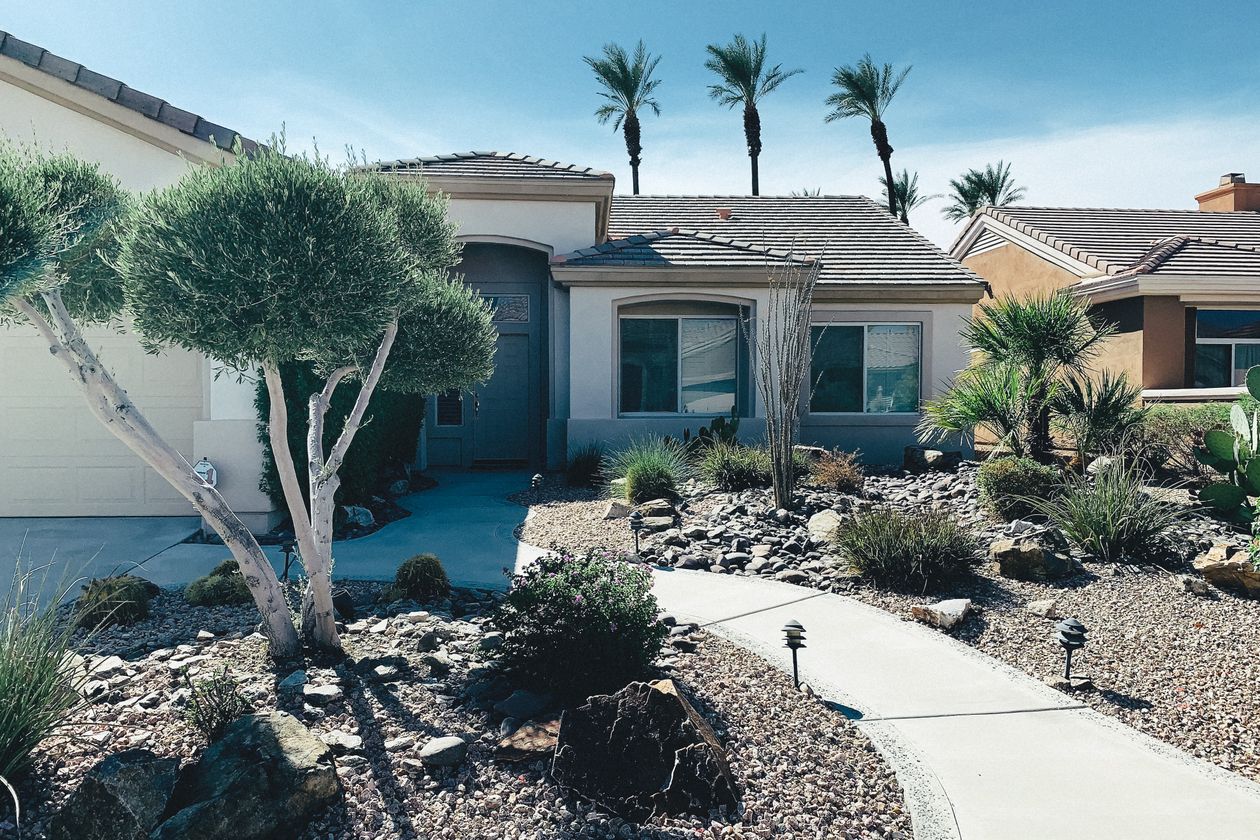
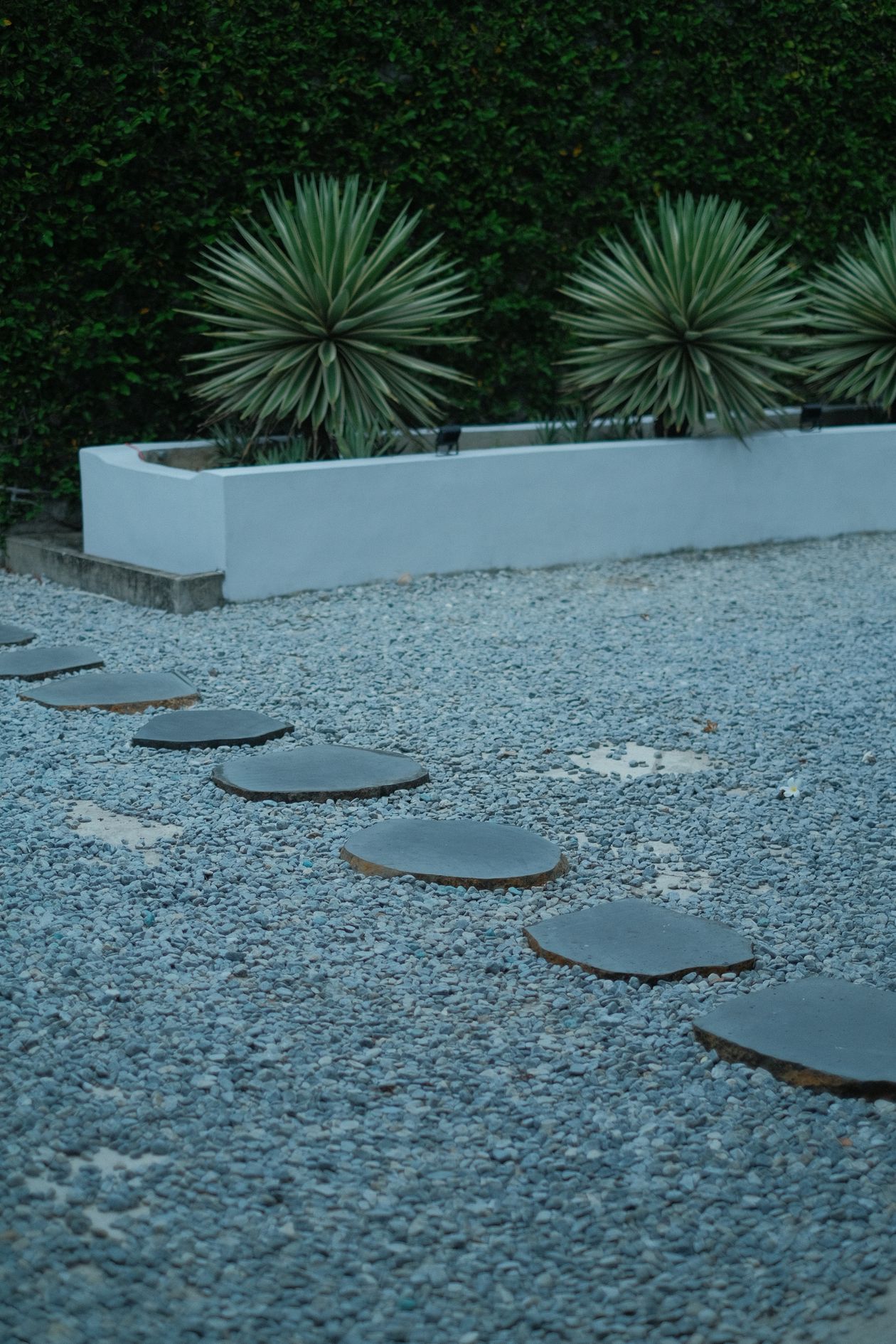
A front yard with gravel, stone paths, and drought-tolerant plants instead of lawn
How much of a no-grass front yard should be rock or hardscape?
About 60 to 70 percent hardscape, gravel, and paths, with 30 to 40 percent in generous planted pockets. Much more rock reads as a parking lot; much less leaves the design looking unfinished. Plants provide the life and structure; stone provides the order. Both need enough area to do their job.
What is the best rock for a front yard with no grass?
Angular crushed gravel, 3/8 to 3/4 inch, for paths and general cover, because it locks together and stays walkable. Use river rock in dry creek beds where its rounded, water-worn look belongs, flagstone for stepping paths, and boulders buried a third deep as features. Avoid rounded pea gravel anywhere you walk.
How much water does removing a lawn save?
Homeowners and water utilities commonly report 50 to 70 percent reductions in landscape water use after turf replacement, with the largest savings in hot, dry regions where lawn irrigation dominated outdoor use. Exact savings depend on what replaces the turf; a no-grass yard full of thirsty plants saves far less than one planted with adapted, drought-tolerant species on drip.
How do I keep weeds out of a gravel front yard?
Start with a clean base: remove existing vegetation completely, compact the base layer, and consider landscape fabric under pure hardscape zones (never under planting pockets where it impedes soil life). Then stay ahead of seedlings with a pre-emergent in spring or prompt hand-pulling; weeds in gravel are a small weekly job or a large monthly one.
Are no-grass front yards allowed everywhere?
Not always. Some HOAs and municipalities require a minimum percentage of living plant material, restrict gravel, or regulate front yard appearance. Because the 60 to 70 percent hardscape design keeps 30 to 40 percent planted, it satisfies many living-cover rules, but verify your local requirements before ordering materials.
Photo credits: Judy Horn (Pexels); Pew Nguyen (Pexels). Photos are served from this site; follow the credit to the library page for the original.