Echinacea, the purple coneflower, is planted in drifts more often than in rows, which makes its spacing question sound looser than it is. A drift is still a spacing decision, just one measured in clumps per area instead of inches per row, and the failure modes are the familiar pair: crowded plants that mildew and flop, or a sparse scatter that never reads as a drift at all. The extension frame is generous. NC State's Echinacea purpurea profile describes a plant 3 to 4 feet tall and allows available planting space from 12 inches to 3 feet, which is the whole argument in one line: the species tolerates a wide band, and the gardener's job is picking the point in it that matches the purpose. For a flower bed where airflow and individual clumps matter, the working consensus is 18 to 24 inches. For a meadow drift, the wide end of the NC State band is honest spacing. For the dwarf cultivars, none of the above applies. This page runs each case on its own bench.
Plant Spacing for Echinacea: Coneflower Spacing for Drifts, Beds, and Bees
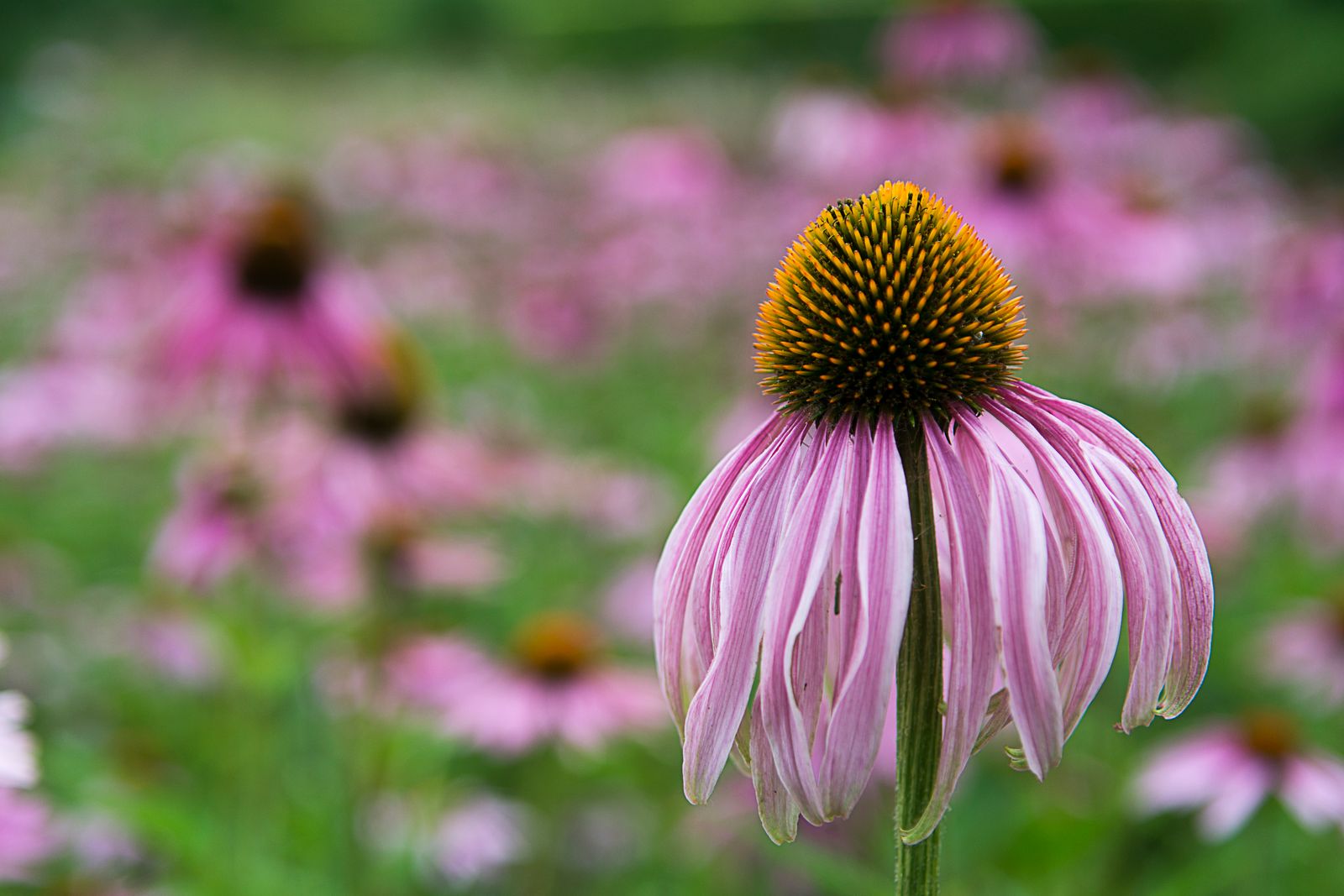
Photo: Jan van der Wolf / Pexels
Plant Spacing Planner: The Coneflower Drift
Echinacea is in the crop list below at 18 to 24 inches for airflow, the planner at 18 in rows 24 apart, inside the NC State band of 12 inches to 3 feet. Enter your bed size, then read the dwarf cultivar exception in this article.
8 tomato plants fit this bed
4 plants per row across 2 rows, on a 24 inch grid. Extension spacing for this crop: 24 in between plants, 48 in between rows.
The grid uses the in-row spacing in both directions, the standard square foot layout for raised beds. In open ground, keep the wider row spacing in the note above so you can walk and weed between rows.
Spacing figures: University of Georgia Cooperative Extension, Circular 963, Vegetable Planting Chart, source.
The Benches: Bed, Drift, and Dwarf
The planner on this page runs the bed bench, 18 inches within the row and 24 inches between rows, the middle of the 18 to 24 inch consensus. At that spacing a coneflower clump, which widens steadily for three years, fills its station without sealing against its neighbors, air keeps moving after rain, and the planting holds its structure in the wet weeks when crowded echinacea flops outward from the center. The drift bench is wider and counted differently: space clumps 24 to 36 inches apart in an irregular pattern, 5 to 7 plants to a drift group, with odd numbers and varied spacing so the group reads as a natural stand rather than a grid that lost its ruler. A single drift of 7 plants at drift spacing covers roughly 25 to 35 square feet once mature. The dwarf bench covers the compact cultivars, the PowWow class and its kin, which mature at 16 to 24 inches tall and 12 to 16 inches wide; space them 12 to 16 inches apart, where they make a genuine edging plant. Confusing the dwarf bench with the species bench is the common retail error in both directions: species plants on dwarf spacing crowd by year three, and dwarfs on species spacing leave a bed looking underplanted for its whole life. The site's coneflower care page covers the season after planting; spacing is the decision that decides whether that season is easy.
| Case | Spacing | Pattern | Plants for a 4 by 8 foot bed |
|---|---|---|---|
| Species, flower bed | 18 inches in row, 24 between rows | Grid or staggered rows | About 10 to 12 |
| Species, meadow drift | 24 to 36 inches | Irregular groups of 5 to 7 | n/a, count by group |
| Dwarf cultivars | 12 to 16 inches | Rows or edging | About 24 to 32 |
| Single specimen | 24 inches of clear space | One clump, room to widen | n/a |
Why Airflow Sets the Bed Bench
Echinacea's diseases are mostly air diseases. Powdery mildew films the foliage in humid still weather, aster yellows arrives by leafhopper and spreads plant to plant through a crowded stand, and the clumps themselves decline from the center when old growth seals over. None of these is controlled by a spray schedule as reliably as by the 18 to 24 inch bench and one hygiene habit: cut out and destroy any plant showing the green, stunted, witches-broom growth of aster yellows as soon as it appears, because that plant is a reservoir, and its neighbors' spacing is their only protection. The same air argument answers the gardener who wants to plant at 12 inches, the bottom of the NC State band, for instant fullness. Twelve inches is a legitimate bench for a planting you intend to divide or thin in year two, and the band exists because the species tolerates it. As a permanent spacing it buys one full-looking first season with three crowded ones, and coneflowers resent disturbance enough that the thin-out is rarely as clean as the plan. Plant the bench for the plant's third year, not its first photograph; echinacea is a perennial, and its spacing is a three-year decision wearing a one-afternoon disguise.
The Wildlife Terms: Heads On, Stems at Knee Height
NC State's profile carries two management instructions that belong in a spacing article because they change what the planting looks like for half the year. Leave the seed heads standing: the cones are a winter seed source that goldfinches work methodically, and a drift of echinacea left standing feeds birds and reads as structure in the winter border instead of a cut-down vacancy. Then, when stems are finally cut, cut them to 12 to 24 inches rather than to the ground, because native stem-nesting bees occupy the hollow stems at exactly that height band, and the standing stubs are next spring's nursery. Both instructions argue for the drift and bed benches above: a planting spaced as a perennial stand, left standing through winter, is habitat in a way a tight annual-style carpet never becomes. The gardener's side of the bargain is one untidy season. Spent echinacea in winter is not the border's prettiest hour, and the honest answer is that the birds and bees are the payment, and the spring cutback to 12 to 24 inch stubs, done once, resets the bed for the year. Gardeners who cannot abide the winter look can cut half the drift and leave half, a compromise the bees accept without comment.
Dividing Old Clumps and Refreshing the Stand
Echinacea clumps age from the center outward: by year four or five a mature clump is a ring of vigorous growth around a woody, thinning middle, flowering less even as it occupies more ground. Division is the refresh, and it is also a spacing event, because a divided clump returns to the bed as several young plants that need the full bench again. Divide in early spring as growth starts, or in early fall in mild climates: lift the clump, cut or pry it into sections with roots and a crown piece each, discard the dead center without sentimentality, and replant the sections at the standard 18 to 24 inch bed spacing, watered in and kept moist through their first weeks. The arithmetic surprises gardeners: one tired clump typically yields 3 to 5 divisions, which is a new drift, so plan where they go before you lift, or the surplus migrates into gaps at dwarf spacing and recreates crowding. Self-sown seedlings deserve the same discipline. Echinacea seeds itself freely where heads are left standing, which the wildlife section of this page recommends, and the seedlings arrive at random spacing, often inches apart. Thin them in spring to the bench, moving the thinnings to start new drifts; an unthinned self-sown patch is the crowded bed of the airflow section, arrived at by kindness rather than by planting.
Companions and the Drift Design
A drift of echinacea rarely grows alone, and companion spacing follows the same air logic. The classic partners are ornamental grasses, whose vertical, airy habit interplants with coneflowers at the same 18 to 24 inch rhythm without sealing the canopy, and the two together make the standard meadow-garden matrix: grasses as the filler at slightly tighter spacing, echinacea as the repeated flower at the bench. Rudbeckia, salvia, and Russian sage share the bench and the cultural wants, sun, drainage, and lean soil, and a mixed drift of the four at uniform spacing reads as one planting with a long combined season. What not to interplant is anything that wants rich, wet soil, because the companions' watering needs will be visited on the echinacea, whose center-out decline is as often a water verdict as an age one. Design the drift in groups rather than singles: three or five coneflowers of one cultivar, then grass, then the group repeated, gives the eye the repetition it reads as intention. A drift of single plants scattered evenly reads as a collection, the same one-of-each error the flower bed pages warn against, and no spacing correction can fix a design problem after the plants are in.
Related guides
These related guides round out the picture:
- Asparagus Plant Spacing: the 15 Year Bed, Laid Out at the Minnesota Standard
- Plant Spacing for Vinca Minor: Fast Cover, Honest Warnings
- Lisianthus Plant Spacing: The Cut Flower Grid
- Plant Spacing for Yarrow: Match the Gap to the Variety
- Plant Spacing for Butterfly Weed: Set It Once, Never Move It
Frequently Asked Questions
How far apart should I plant coneflowers?
For the species in a flower bed, 18 to 24 inches; the planner runs 18 inches in the row and 24 between rows. NC State's profile allows a wide band, 12 inches to 3 feet of planting space, and the choice inside it is purpose: drifts go 24 to 36 inches in irregular groups, dwarf cultivars go 12 to 16 inches.
How many echinacea plants do I need for a drift?
Five to seven plants per drift group at 24 to 36 inch spacing, in odd numbers with varied distances so the group reads naturally. One mature drift of 7 covers roughly 25 to 35 square feet. Several drifts of the same cultivar, repeated, read as one meadow planting.
Can I plant coneflowers 12 inches apart for a fuller look?
The NC State band allows 12 inches, but as a permanent spacing it crowds by year three, when clumps widen, air stalls, and mildew and decline follow. Use 12 inches only if you genuinely plan to divide or thin in year two. The 18 to 24 inch bed bench is the plant-for-its-third-year choice.
Should I cut down coneflowers in fall?
NC State's guidance is to leave the seed heads for birds through winter, then cut dead stems to 12 to 24 inches rather than to the ground, because stem-nesting bees use the hollow stubs. A drift left standing is winter habitat and structure; the spring stub cut resets it.
Do dwarf coneflowers use the same spacing?
No. Compact cultivars in the PowWow class mature at 12 to 16 inches wide and take 12 to 16 inch spacing, where they work as edging. Planting them on the species bench leaves a bed permanently underplanted, and planting species on the dwarf bench guarantees crowding.
Photo credits: Jan van der Wolf (Pexels); alex ohan (Pexels). Photos are served from this site; follow the credit to the library page for the original.