Dahlias punish generic spacing because the name covers plants from a 12-inch bedding dwarf to a dinnerplate giant that tops 5 feet and spreads like a shrub. Plant the giant on a bedding bench and it eats its neighbors by August; plant the dwarf on the giant's bench and the bed looks empty all season. The fix is to space by size class, and the cleanest statement of the classes comes from UF/IFAS, whose dahlia profile puts standard types at 18 to 24 inches apart, large varieties at 2.5 feet, pompoms at 2 feet, and dwarfs at 12 to 18 inches. The planner on this page runs the standard bench, 18 inches within the row and 24 inches between rows, and the table below adjusts it by class. Everything else about dahlia spacing, the staking, the thinning, and the depth argument, hangs off getting the class right first, which is why the tuber you buy matters: the variety name and its mature height are printed on the package, and height is the class.
Plant Spacing for Dahlias: Spacing by Size Class, With Stakes at Planting
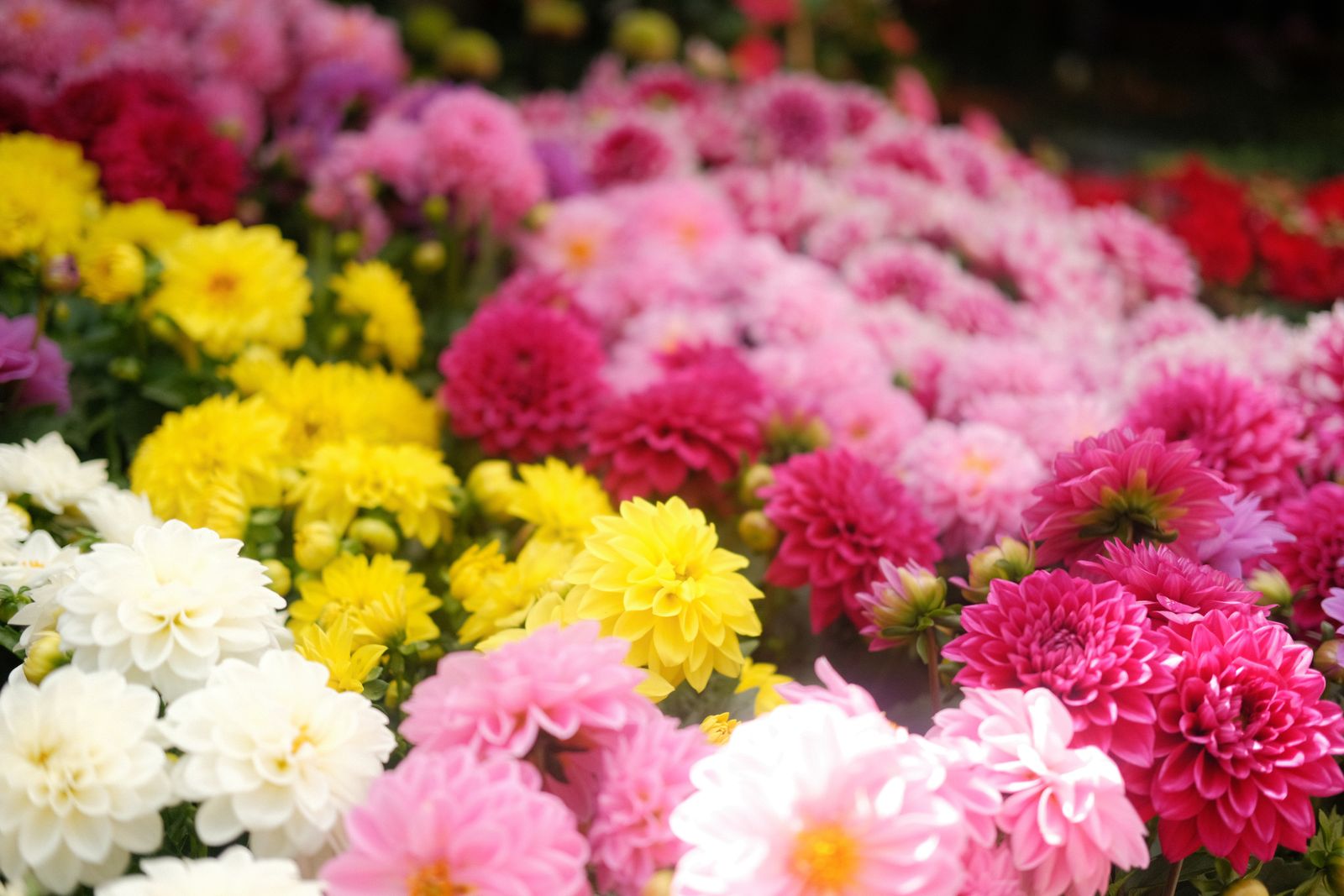
Photo: Eyüpcan Timur / Pexels
Plant Spacing Planner: The Dahlia Row
Dahlias are in the crop list below at the UF/IFAS spacing of 18 to 24 inches, the planner at 18 in rows 24 apart. Enter your bed size, then use the size class table in this article to adjust for dinnerplates and dwarfs.
8 tomato plants fit this bed
4 plants per row across 2 rows, on a 24 inch grid. Extension spacing for this crop: 24 in between plants, 48 in between rows.
The grid uses the in-row spacing in both directions, the standard square foot layout for raised beds. In open ground, keep the wider row spacing in the note above so you can walk and weed between rows.
Spacing figures: University of Georgia Cooperative Extension, Circular 963, Vegetable Planting Chart, source.
The Size-Class Table
Read your variety's mature height off the package and space from this table. Where a variety straddles classes, space it as the larger class; dahlias forgive extra room and never forgive crowding, because crowded dahlias are mildew dahlias by late summer.
| Size class | Typical mature height | Spacing in the row | Between rows | Stake |
|---|---|---|---|---|
| Dinnerplate and large decorative | 4 to 6 feet | 24 to 30 inches | 30 to 36 inches | Yes, heavy stake at planting |
| Standard decorative and cactus | 3 to 4 feet | 18 to 24 inches | 24 inches | Yes, at planting |
| Pompom and ball | 2 to 3 feet | 18 to 24 inches (UF/IFAS: 2 feet) | 24 inches | Usually, in wind |
| Dwarf and bedding | 12 to 20 inches | 12 to 18 inches | 18 inches | No |
Air is the hidden term in every row. Dahlias are powdery mildew candidates in still, humid weather, and spacing is the primary cultural control: a bed at the wide end of each band, with room for air to move between plants, stays cleaner than a fungicide schedule on a crowded bed. The cutting garden runs the same numbers for a different reason, because a plant you harvest from weekly needs working room around it, and the gardener's body is part of the spacing plan. If you garden in a humid climate, take the top of every band without apology. The site's dahlia care page covers the season that follows planting; this page's job ends when the tubers are in at the right distances, staked, and thinned.
Depth: The Flagged Conflict, and the Staking Rule
Two planting instructions come with the spacing, and one of them is a genuine source conflict that this page flags rather than settles. UF/IFAS puts dahlia planting depth at 6 to 10 inches. Most retail guides and tuber packagers print 4 to 6 inches. Neither figure is averaged here. The practical reading: depth interacts with soil and climate, with deeper planting suiting light soils and cold springs, where the tuber sits below the last frost swings, and the shallower figure suiting heavy soils where a deep tuber in cold wet ground rots before it sprouts. Pick the end of the combined range that matches your soil, and know that the extension figure exists before you call the package wrong. The staking rule has no conflict at all: tall types are staked at planting, not after they grow. Drive the stake beside the tuber as you plant, because driving it later spears tubers you cannot see, and tie the stem in loosely as it grows. A 4 to 6 foot dahlia staked in August, after it has flopped, never stands straight again; the same plant tied from June is a column. UF/IFAS adds the thinning rule that completes the planting system: when shoots emerge, thin each clump to the 3 most vigorous shoots. Three strong stems flower better, stand better, and mildew less than eight weak ones competing in the same footprint, and the spacing you so carefully measured is wasted if each station grows a crowd.
Rows, Beds, and Pots
The planner's 18 by 24 inch standard bench assumes rows, and rows suit dahlias: they are a crop as much as an ornament, lifted in fall in cold climates and harvested all summer for the vase. In a 4-foot bed, two rows at the standard bench with the bed's edges as working room is the comfortable maximum; three rows crowd the middle row's air and your reach. In pots, spacing becomes one tuber per container, and the container is sized by class: dwarfs in 10 to 12 inch pots, standards in 5-gallon and up, dinnerplates in 10-gallon or the ground, because a big dahlia in a small pot is a watering emergency with leaves. Pot dahlias also stake at planting and thin to 3 shoots, same as the bed. One more placement rule from the extension profile: dahlias want full sun and a site out of strong wind, and spacing cannot fix a wind tunnel, where even well-staked tall types shred. If the site is windy, drop a class in height rather than tightening the spacing for mutual support; mutual support among dahlias mostly means mutual mildew.
Spacing Failures: What Too Tight and Too Wide Look Like
The too-tight bed announces itself in a specific order. First the plants meet early, in June rather than July, and the bed looks lush and successful. Then the lower leaves, shaded and still, develop the gray-white film of powdery mildew, which climbs as the summer humidity builds, because the canopy holds wet air against the foliage after every rain and watering. Flower size falls off next, since crowded plants spend on stem what they should spend on bloom, and finally the whole bed flops in the first serious storm, each plant having grown tall and thin reaching for light it had to compete for. Every stage of that sequence is a spacing verdict, and none of it is fixed by feeding or spraying after the fact. The too-wide bed fails more politely: individual plants are magnificent, the rows look gappy, and the yield per square foot, the only number a cutting gardener is paid in, runs half what the ground could carry. Weeds colonize the bare lanes, which returns the labor the wide spacing was supposed to save. The corrective for both is the same habit: record the variety, the class you spaced it as, and a one-line verdict at lifting time in fall. Dahlia spacing knowledge is perishable because varieties change yearly, and the gardener's own bed, measured against the extension classes, is the dataset that turns this page's bands into your garden's exact numbers within two seasons.
Across the Years: Lifting, Dividing, and Spacing Drift
In cold climates dahlias are lifted each fall, and the spacing decision quietly renews itself every spring, which creates a failure mode unique to the crop: spacing drift. A tuber planted as a single eye becomes a clump; a clump divided carelessly becomes three stations where the plan called for one, and within two seasons the bed holds twice the plants its spacing was designed for, each one smaller and more crowded than the class table assumed. The discipline is to divide to the plan, not to the clump: each station gets one healthy tuber with one eye, or a small division of two or three tubers for an instant clump effect at the wide classes, and surplus divisions are gifts, trades, or compost, not extra stations squeezed into the row. Warm-climate gardeners who leave tubers in the ground face the same arithmetic in place: lift and divide every 2 to 3 years, resetting each station to its division, because an undisturbed clump becomes its own crowd. The fall lifting is also the audit moment from the section above: measure what each variety actually did, its true height and spread in your soil, against the class you spaced it as, and adjust next spring's row accordingly. Dahlias reward this bookkeeping more than any other flower in the cutting garden, because no other common plant spans such a range of sizes under one name.
Related guides
Readers working on this usually need these next:
- Plant Spacing for Delphinium: Spacing by Height Class, Stakes Included
- Cabbage Plant Spacing: The Head Size Rule Behind the Conflicting Numbers
- Hydrangea Plant Spacing: By Species and Mature Width
- Lisianthus Plant Spacing: The Cut Flower Grid
- Ranunculus Plant Spacing: 6 to 8 Inches, Claws Down
Frequently Asked Questions
How far apart should I plant dahlias?
By size class, on the UF/IFAS bench: standard types 18 to 24 inches apart, large varieties 2.5 feet, pompoms about 2 feet, and dwarfs 12 to 18 inches. The planner runs 18 inches in the row and 24 between rows for standard dahlias. When a variety straddles classes, space it as the larger one.
How deep do I plant dahlia tubers?
Sources conflict and this page flags it rather than averaging: UF/IFAS says 6 to 10 inches deep; most retail guides print 4 to 6 inches. Deeper suits light soil and cold springs; shallower suits heavy soil where a deep tuber can rot before sprouting. Match the depth to your soil.
Do dahlias need staking?
Tall types do, and the stake goes in at planting time, beside the tuber, before growth starts. Driving a stake later spears unseen tubers, and a flopped 5-foot plant never restraightens. Dwarf bedding types are the exception and stand on their own.
How many shoots should each dahlia clump grow?
Three, per UF/IFAS: thin emerging shoots to the 3 most vigorous per clump. Three strong stems outflower and outstand a crowd of weak ones, keep air moving through the plant, and honor the spacing you planted instead of recreating crowding at every station.
Can I grow dahlias in pots?
Yes, one tuber per pot, sized by class: dwarfs in 10 to 12 inch pots, standards in 5 gallons or more, dinnerplates in 10 gallons or in the ground. Stake tall types at planting and thin to 3 shoots, exactly as in a bed.
Photo credits: Eyüpcan Timur (Pexels); Carl H. McBublo (Pexels). Photos are served from this site; follow the credit to the library page for the original.