Emerald Green Arborvitae Spacing: 3 to 4 Feet for a Hedge That Fills In
By the Windchime Walker editorial team
Photo: Valeria Drozdova / Pexels
'Emerald Green' arborvitae (Thuja occidentalis 'Smaragd') is the default privacy hedge plant in cold climates because of its shape: 12 to 15 feet tall at maturity but only 3 to 4 feet wide. Spacing follows directly from that width. For a hedge that knits into a solid screen, plant 3 to 4 feet apart measured trunk to trunk. For specimen plants you want to admire individually, give them 5 to 6 feet. For a deep, staggered double row, set rows 4 feet apart with plants offset.
There is a real disagreement in the sources about hedge spacing, and this guide flags it rather than hiding it: many trade and nursery sources say 2 to 3 feet, while extension-style guidance tends to say 3 to 4 feet. Both camps grow hedges that work; they optimize for different things. Use the planner below to run your hedge length at either spacing and compare plant counts and cost before you dig.
Interactive tool
Plant Spacing Planner: The Emerald Green Arborvitae Hedge
Emerald Green is in the crop list below at a 36 inch grid from the NC State plant data: a 3 to 4 foot trunk-to-trunk hedge spacing with rows at 4 feet for double screens. Enter your hedge length to count plants at tight, standard, and specimen spacing.
8 tomato plants fit this bed
4 plants per row across 2 rows, on a 24 inch grid. Extension spacing for this crop: 24 in between plants, 48 in between rows.
The grid uses the in-row spacing in both directions, the standard square foot layout for raised beds. In open ground, keep the wider row spacing in the note above so you can walk and weed between rows.
Spacing figures: University of Georgia Cooperative Extension, Circular 963, Vegetable Planting Chart, source.
Spacing at a glance
Planting style
Spacing (trunk to trunk)
Row spacing
Result
Tight hedge, fast screen
2 to 3 feet
Single row
Solid in 2 to 3 years, crowded by year 8
Standard hedge
3 to 4 feet
Single row
Solid in 3 to 4 years, healthy long term
Specimen planting
5 to 6 feet
n/a
Each plant keeps its natural cone shape
Double staggered row
3 to 4 feet within row
4 feet between rows
Deep screen for wide properties and windbreaks
Near a fence or wall
3 to 4 feet, offset from barrier
At least 2 feet from the fence
Airflow behind the hedge, room to shear
The fence offset deserves emphasis. A hedge planted tight against a fence gets no airflow or light on its back side, browns out there, and gives you no room to work. Two feet minimum from the fence line keeps the back side alive and lets you step behind the hedge with shears.
The 2 to 3 foot vs 3 to 4 foot disagreement, explained
Trade sources that sell the plants often recommend 2 to 3 feet because customers want a screen fast, and a tight hedge does close a year or two sooner. The cost shows up later: by year 8 to 10 the plants are competing hard, interior foliage thins, snow load damage increases because the canopy is one fused mass, and replacing a dead plant in the middle becomes surgery.
Extension guidance at 3 to 4 feet accepts a slower close in exchange for plants that still have individual root and canopy space at maturity, since 3 to 4 feet is the plant's actual mature width. A hedge at 3.5 feet will look slightly gappy in year one and indistinguishable from the tight hedge by year four, while staying healthier in year twelve. If your priority is screening a new patio this summer, choose the tight spacing with open eyes. If the hedge is a 20 year decision, choose 3 to 4 feet.
Measure trunk to trunk, and lay out before you dig
All spacing for this plant is measured from the center of one trunk to the center of the next, not from the edge of the foliage. Nursery plants arrive with canopies wider than their long-term spacing logic suggests, so trust the tape, not your eyes. Run a string line, mark every planting position with a flag or a paint dot, and step back and look before the first hole.
Dig each hole twice as wide as the root ball but no deeper; the top of the root ball should sit level with or a half inch above the surrounding grade. Arborvitae planted too deep decline slowly and mysteriously, and in a hedge that decline shows up as one yellowing plant in a green wall three years later.
What goes wrong at each extreme
Planted too tight (under 2 feet), Emerald Greens fuse into a single stressed organism: interior dieback, spider mite outbreaks in hot dry spells, and catastrophic snow splitting because no plant can flex independently. Planted too wide (over 5 feet in a hedge), the gaps never truly close because the plant's genetic width caps at about 4 feet; you get a row of separate cones with see-through slots between them, forever.
The middle failure is uneven spacing: a hedge with alternating 2 foot and 5 foot gaps looks accidental no matter how healthy the plants are. Measure every position. Hedges are geometry projects that happen to be alive.
Watering and establishment for a new hedge
New arborvitae need deep watering weekly through their first growing season, soaking the root ball and the surrounding soil so roots chase moisture outward. Our companion guide on how often to water emerald green arborvitae covers the full establishment schedule. Mulch the hedge row with 2 to 3 inches of bark mulch, kept a few inches away from the trunks, to hold that moisture and suppress weeds while the canopy closes.
Once established, Emerald Green is respectably drought tolerant, but a hedge in its second summer still deserves a deep drink during long rainless stretches. Winter watering before the ground freezes matters in cold climates, because evergreen foliage keeps losing water all winter while frozen roots cannot replace it.
Alternatives and companions in the spacing planner
If your site is too shady, too wet, or too deer-ridden for arborvitae, the spacing math changes with the plant. Compare the footprint logic with other planner entries such as broccoli plant spacing for the vegetable garden, or think about the hedge as the bones of a larger design using the ideas in front yard landscaping ideas with rocks for the beds in front of it.
Deer deserve a direct mention: in heavy deer country, Emerald Green is a winter salad bar, and no spacing fixes that. Either commit to fencing or repellent programs, or choose a less palatable screen plant from the start.
Planting the hedge: a step-by-step sequence
Start with the string line and flags at your chosen spacing, then dig all the holes before planting any of them; a row of open holes exposes layout mistakes while they are still cheap to fix. Set each plant in its hole, backfill halfway, water to settle, then finish backfilling and water again. This two-stage watering removes the air pockets that dry out sections of root ball.
Check depth obsessively. The root flare should sit at or slightly above grade. In clay soil, plant a full inch high, because backfill settles and clay holds the water that rots a buried crown. Form a shallow watering basin along the row, lay the mulch, and give the whole hedge a final deep soak. Stake only if the site is windy and the plants are tall and top-heavy; most Emerald Greens stand fine on their own.
Timing matters. Spring planting gives roots a full season to establish before winter, and fall planting 6 weeks before the ground freezes works well in most cold climates. Summer planting succeeds too, but only with committed weekly watering. What fails reliably is planting into a dry fall and forgetting the hedge until spring; evergreens enter winter thirsty and desiccate.
Shearing and how spacing plays out over the years
Shear a young hedge lightly once a year, in late spring after the growth flush, keeping the profile slightly narrower at the top than the bottom so lower branches keep their light. Never cut back into bare interior wood; arborvitae does not regrow from old wood, and a hole cut into the green shell is permanent.
Year by year, here is what correct spacing looks like. Year 1: separate cones with visible gaps, which is normal and not a mistake. Year 2 to 3: canopies touch at the tips. Year 3 to 4: at 3 to 4 foot spacing the wall closes and shearing starts shaping one continuous surface. Year 8 and beyond: the hedge is mature architecture. The tight 2 to 3 foot hedge reaches the wall stage about a year sooner, then begins paying for it in thinning interiors, while the standard hedge is still improving.
If one plant dies mid-hedge, replace it with the largest specimen you can find and expect a 2 year catch-up. A hedge at standard spacing forgives this; a fused tight hedge makes the replacement's establishment genuinely difficult because the neighbors steal its light and water.
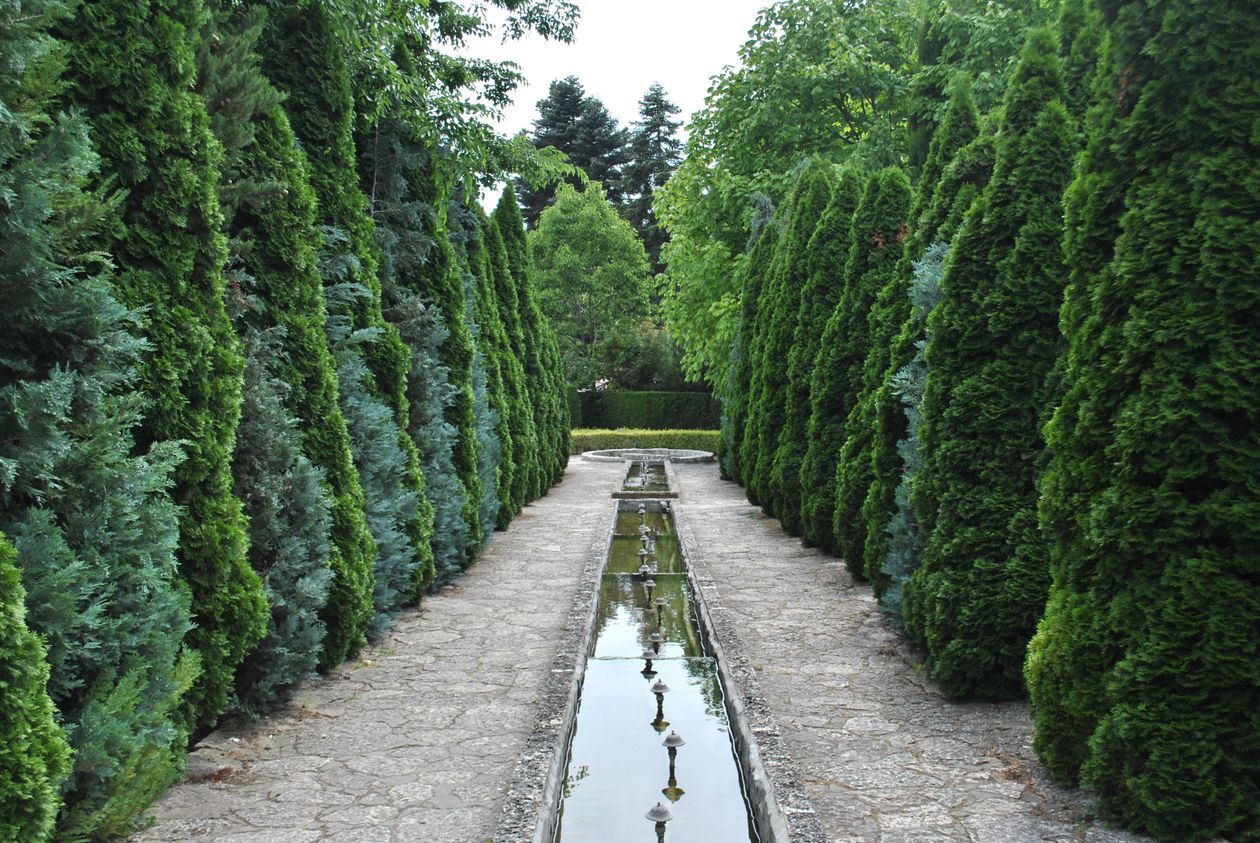
Emerald Green arborvitae hedge forming a dense green screen
How far apart should I plant Emerald Green arborvitae for a hedge?
Plant 3 to 4 feet apart, measured trunk to trunk, for a hedge that fills in within 3 to 4 years and stays healthy at maturity. Trade sources often say 2 to 3 feet for a faster screen, but that spacing crowds the plants by year 8. Since the mature width is only 3 to 4 feet, spacing beyond 4 feet leaves permanent gaps.
How many Emerald Green arborvitae do I need for a 50 foot hedge?
At 3 foot spacing, about 17 plants; at 3.5 feet, about 15; at 4 feet, about 13. Divide the hedge length by the spacing and add one plant for the end. The planner above calculates the count for your exact length and spacing, including double rows.
Can I plant Emerald Green arborvitae 2 feet apart?
You can, and the screen will close quickly, but expect heavy competition by year 8 to 10, more interior dieback, and harder plant replacement. Two-foot spacing is a short-term screen strategy. For a hedge you intend to keep for decades, 3 to 4 feet is the safer investment.
How far from a fence should arborvitae be planted?
At least 2 feet from the fence or wall to the trunk, so the back of the plant gets light and air and you can walk behind it to shear. Planted flush against a barrier, the back side browns out and the hedge becomes one-sided.
How tall and wide does Emerald Green arborvitae get?
Expect 12 to 15 feet tall and 3 to 4 feet wide at maturity in most home landscapes, growing roughly 6 to 9 inches per year once established. That slow, narrow growth is exactly why it suits hedges, and why spacing wider than its mature width never closes.
Photo credits: Valeria Drozdova (Pexels); Alexey Demidov (Pexels). Photos are served from this site; follow the credit to the library page for the original.